Skip to content
You can now search across every topic, entity and event.What's new
Drones: Industry & Defence
13APR

Iran Fires 4,446 Drones in Five-Week Campaign

2 min read
13:26UTC

CSIS quantified the cost-exchange crisis: 71% of Iranian strikes are drones costing a fraction of the missiles used to stop them.

TechnologyDeveloping
Key takeaway

Iran's drone campaign proved the cost-exchange crisis is operational, not theoretical.

CSIS published its first detailed analysis of Iran's drone campaign in the Gulf on 3 April 2026. Since Operation Epic Fury began on 28 February, Iran has launched 4,446 drones and 1,725 missiles. 71% of recorded strikes were drone-based. 1

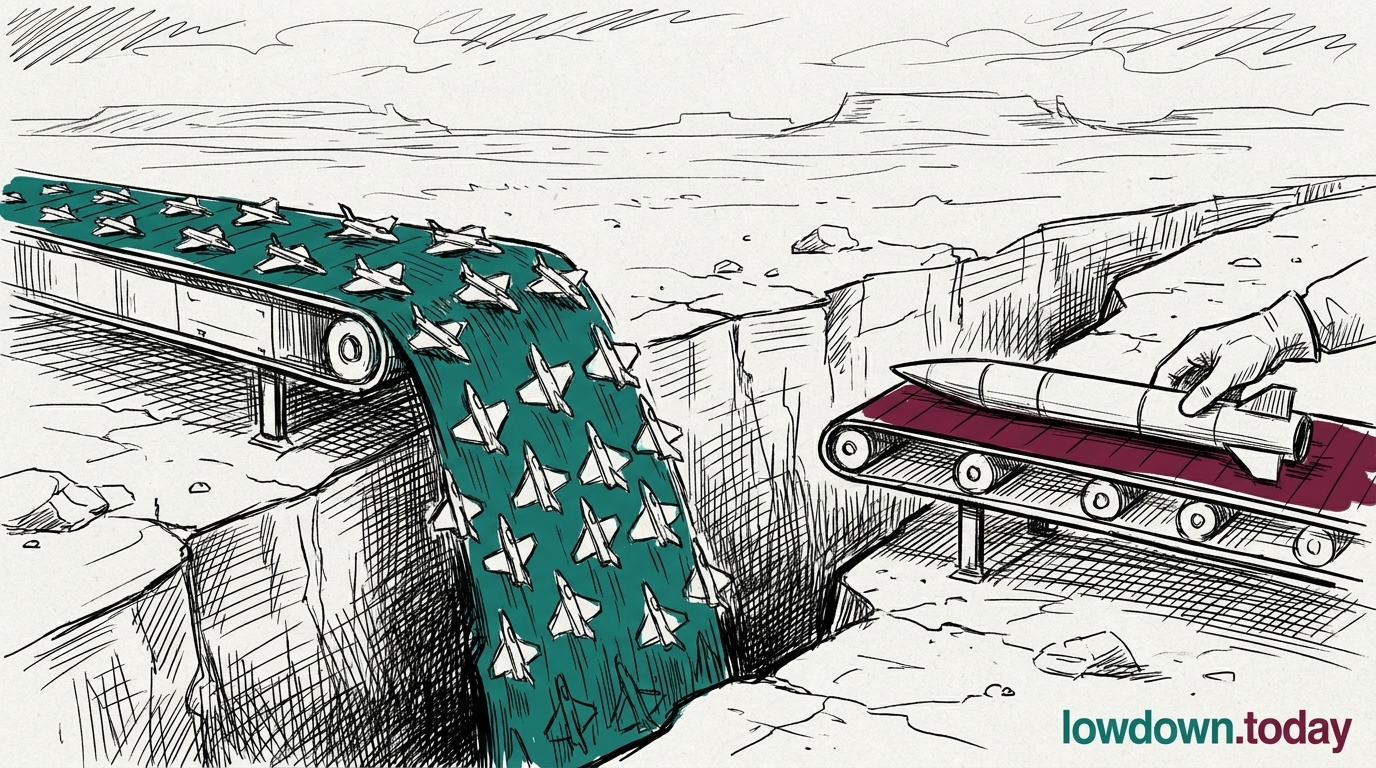
The UAE absorbed 55% of all incoming strikes. The initial wave on 1 March comprised 1,206 strikes; sustained pressure continued at 190 to 392 per day. CSIS framed the campaign as a deliberate cost-imposition strategy: a Shahed-136 costs between $20,000 and $50,000, while defending against it with a Patriot missile costs 80 to 200 times more. 2

The report recommended adopting Ukraine's approach (cheap interceptor drones at $2,000 to $4,000 per unit) rather than missile-based defence . CSIS also noted evidence of possible Russian Geran-2 variants in Iranian stocks, suggesting reciprocal Iran-Russia technology transfer. 3 The data gives the Pentagon's Drone Dominance programme its most concrete demand signal yet: the threat is not hypothetical, and the current arsenal is orders of magnitude too small.

Deep Analysis

In plain English

Iran has been firing hundreds of low-cost drones at US allies in the Gulf every day for five weeks. Each drone costs roughly the same as a family car. To shoot them down, the US has been using missiles that cost more than a luxury house. CSIS, a Washington think tank, counted the numbers: 4,446 Iranian drones launched, the UAE taking 55 per cent of the hits. The report confirmed what many had feared: Iran is winning the economics of this conflict even if it is not winning tactically. The suggested fix is to stop using expensive missiles and start using cheap counter-drones instead, costing $2,000 to $4,000 each, similar to what Ukraine has been doing.

Deep Analysis
Root Causes

Iran developed its Shahed programme specifically in response to US precision-strike dominance, mirroring the logic of anti-ship missiles used to threaten carrier groups: impose unacceptable costs on a superior adversary rather than match them platform-for-platform.

The UAE's 55% share of incoming strikes reflects its role as the primary forward base for US forces in the Gulf, making it the highest-value target set for cost-imposition.

Evidence of Russian Geran-2 variants in Iranian stocks suggests the Iran-Russia technology transfer relationship is reciprocal: Russia received Shahed-136 designs for use in Ukraine; Iran received upgraded variants in return, deepening the campaign's industrial underpinning.

What could happen next?
  • CSIS data provides the Pentagon's Drone Dominance programme with a concrete demand signal, likely accelerating Gauntlet II timelines and funding.

  • Evidence of Russian Geran-2 variants in Iranian stocks will intensify pressure on Gulf states to accept tighter sanctions enforcement on Iran-Russia technology transfer.

First Reported In

Update #4 · Factories Under Fire: America's Drone Gap Meets Reality

Breaking Defense· 4 Apr 2026
Read original
Different Perspectives
Procurement sceptics
Two identically sized IDIQs to different primes within seven weeks, and a five-nation pact where one partner moves weeks ahead of the rest, could just as easily read as an industrial base still improvising vendor mix as a deliberate hedging doctrine. Neither ceiling appears sized against a validated requirement yet.
Chinese component suppliers
FCC and Pentagon-level restrictions on Chinese-origin airframes and motors have progressively excluded DJI-linked suppliers from federal counter-drone catalogues, narrowing the field JIATF-401 and Gauntlet II can buy from to a short list of certified domestic bidders. Beijing reads the exclusions as protectionism dressed as security policy.
Quantum Systems
Quantum Systems
Blackstone, Airbus, Advent and Noteus reportedly priced the Munich drone maker at $8 billion, more than double its prior mark, on the strength of 19,000 Ukraine missions rather than confirmed revenue. It is betting production capacity, not current sales, is what buyout capital is now paying for.
United Kingdom
United Kingdom
Britain released the first LEAP effector money three weeks after its defence secretary quit over the size of the drone budget, splitting £3.16 million across three small firms rather than one contractor. It expects the other four LEAP partners to follow its pace, not set their own.
JIATF-401
JIATF-401
The task force handed AeroVironment a $500 million counter-drone ceiling identical to Perennial Autonomy's from seven weeks earlier, while its own Gauntlet II red team prepares to attack the drones the winners of that sprint will build. It expects to keep several qualified suppliers warm rather than certify one.
DroneShield
DroneShield
DroneShield appointed retired Rear Admiral Lee Goddard as an independent director from 1 July, its second board move since founder Oleg Vornik's April exit. The ASIC probe into November's disclosures and share sales stays open, so the admiral steadies the story without closing the file.
