Skip to content
Briefings are running a touch slower this week while we rebuild the foundations.See roadmap
Drones: Industry & Defence
4APR

Factories Under Fire: America's Drone Gap Meets Reality

4 min read
20:57UTC

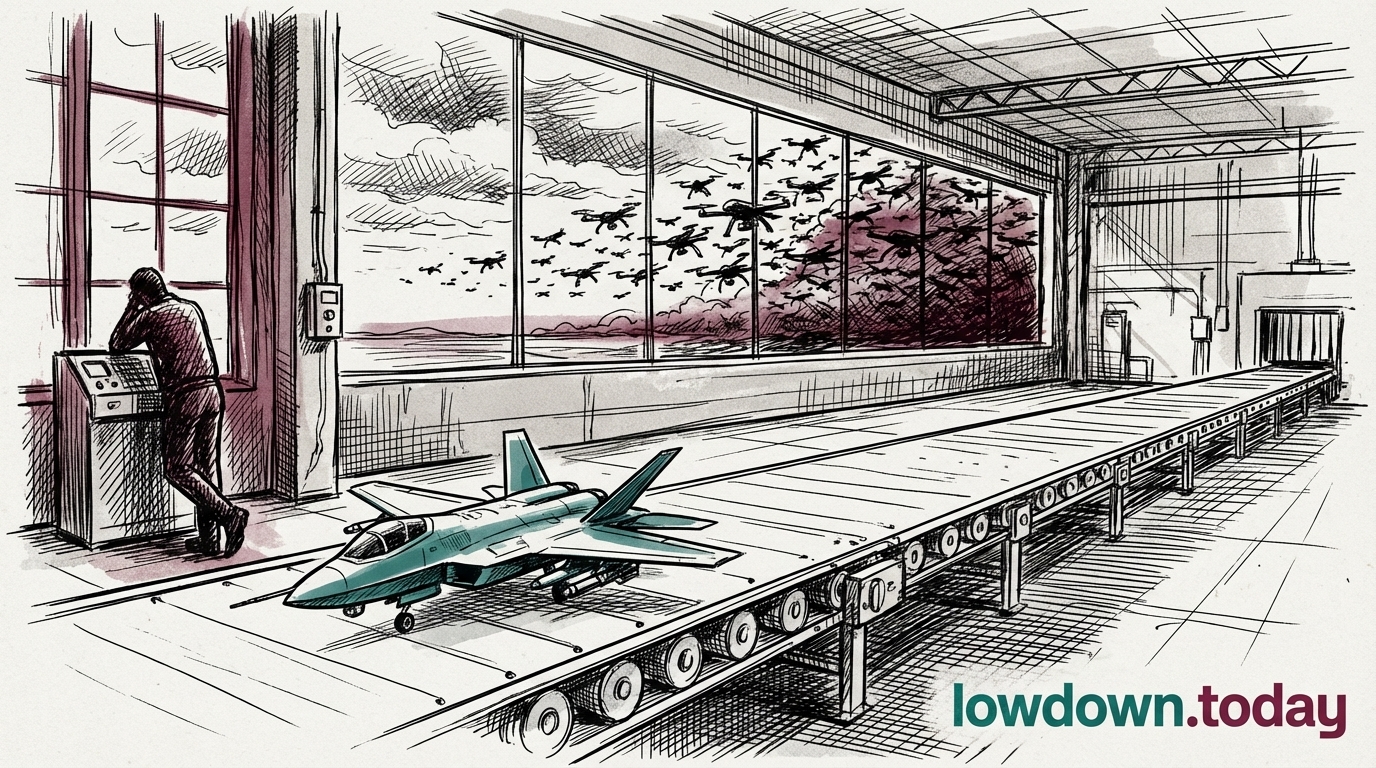
Iran's five-week campaign has fired 4,446 drones at US allies, yet the Pentagon has produced only dozens of its own combat drones. Three directed-energy weapons entered the field in a single month as the industrial base scrambles to close a gap between 300,000-drone ambitions and single-digit production lines.

Key takeaway

Industrial output, not capability, is now the binding constraint on drone strategy.

This briefing mapped
Loading map…
Military
Economic
Competitive
Regulatory

The first US-made loitering munition flew its combat mission five weeks ago. The Pentagon still has enough to arm a single platoon.

Sources profile:This story draws on neutral-leaning sources

SpektreWorks' LUCAS loitering munition became the first US-made combat drone to see action on 28 February 2026 during Operation Epic Fury; Pentagon CTO Emil Michael confirmed the inventory stood at 'dozens' against a 300,000-drone procurement target.

LUCAS proved affordable mass doctrine works in combat but exposed a production gap between dozens of drones and a 300,000 target. 

Anduril's Ohio factory sent its first autonomous combat aircraft down a 22-workstation line before the concrete was scheduled to cure.

Sources profile:This story draws on centre-right-leaning sources from United States
United States

Anduril's Arsenal-1 factory in Pickaway County, Ohio shipped its first YFQ-44A Fury collaborative combat aircraft in late March 2026, four months ahead of the original July 2026 schedule; the 22-workstation line employs roughly 30 workers and will produce 150 aircraft per year at full three-shift capacity.

Arsenal-1's early production run makes Anduril the first company with a dedicated CCA factory, setting the pace for the collaborative combat aircraft programme. 

A Patriot missile costs $4 million. AeroVironment says its third-generation laser can do the same job for the price of a coffee.

Sources profile:This story draws on neutral-leaning sources

AeroVironment unveiled the LOCUST X3 directed-energy weapon at the AUSA Global Force conference in Huntsville, Alabama on 25 March 2026; the third-generation laser delivers 20 to 35-plus kilowatts, defeats Group 1 through Group 3 drones, and costs approximately $5 per engagement.

LOCUST X3 offers a cost ratio of roughly 800,000 to 1 against Patriot for drone intercepts, directly targeting the cost-exchange crisis Iran's campaign exposed. 

Three directed-energy counter-drone systems from three companies entered the field or demonstration in a single month.

Sources profile:This story draws on neutral-leaning sources

Epirus revealed the Leonidas AGV autonomous ground vehicle at AUSA Global Force in March 2026, integrating high-power microwave defeat with General Dynamics as platform integrator and Kodiak Robotics providing autonomous driving; the US Navy separately confirmed ODIN, its shipboard laser weapon, saw combat deployment aboard a destroyer during Operation Epic Fury.

Simultaneous fielding of laser and microwave counter-drone systems signals the structural shift from missile-based intercept to energy-based defeat is now operational. 

CSIS quantified the cost-exchange crisis: 71% of Iranian strikes are drones costing a fraction of the missiles used to stop them.

Sources profile:This story draws on mixed-leaning sources from United States
United States

CSIS published its first detailed analysis of Iran's drone campaign in the Gulf on 3 April 2026, recording 4,446 drones and 1,725 missiles launched since 28 February; 71% of strikes were drone-based, the UAE absorbed 55% of incoming strikes, and the initial wave on 1 March comprised 1,206 strikes.

CSIS data transforms the affordable mass debate from procurement theory into an after-action finding with hard numbers. 

Europe is now DroneShield's largest market. The company is building sovereign manufacturing capacity before the contracts arrive.

Sources profile:This story draws on centre-right-leaning sources from United States
United States

DroneShield opened its European headquarters in Amsterdam on 30 March 2026 and confirmed EU manufacturing is underway with first deliveries expected by mid-2026; European revenue reached $98 million in 2025, representing 45% of total company revenue, with an EU pipeline of $1.2 billion as of February 2026.

DroneShield's EU pivot, backed by $98 million in European revenue and a $1.2 billion pipeline, positions it as the default counter-drone vendor for European sovereign procurement. 

A new partnership with Origin Robotics gives DroneShield something it lacked: the ability to physically destroy a drone, not just detect or jam it.

Sources profile:This story draws on centre-right-leaning sources from United States
United States

DroneShield signed a memorandum of understanding with Origin Robotics on 31 March 2026 to integrate the BLAZE kinetic interceptor into its DroneSentry-C2 command platform, adding physical intercept capability to its existing sensor and jamming systems.

Integrating BLAZE kinetic intercept into DroneSentry-C2 moves DroneShield from detection and electronic defeat into physical destruction, completing a full-spectrum counter-drone offering. 

GPS-denied swarming is the next capability the Pentagon will demand. Red Cat bought it before the requirement was published.

Sources profile:This story draws on neutral-leaning sources

Red Cat Holdings closed its acquisition of Apium Swarm Robotics on 30 March 2026, adding GPS-denied swarming autonomy to its portfolio; the company reported FY2025 revenue of $40.7 million, up 161% year-on-year, and will operate Apium as an independent subsidiary.

Acquiring Apium positions Red Cat for the next phase of US Army drone procurement, which will require coordinated autonomous operations in GPS-denied environments. 

The Royal Netherlands Navy became the first NATO fleet to put Shield AI's vertical take-off drone into service after Arctic sea trials.

Sources profile:This story draws on neutral-leaning sources from Italy
Italy

The Royal Netherlands Navy declared Shield AI's V-BAT unmanned aircraft operational on 30 March 2026 following Arctic sea trials aboard HNLMS Johan de Witt; 12 units were acquired and eight Dutch ships will carry the system, making the RNLN the first NATO navy to declare V-BAT operational.

V-BAT's operational declaration by the first NATO navy validates maritime drone ISR adoption beyond the US military. 

Every US drone delivery company is operating on temporary waivers. The regulation that would unlock scale is now overdue.

Sources profile:This story draws on neutral-leaning sources

The FAA's Part 108 rule governing BVLOS drone operations had not been published as of 4 April 2026, missing the March–April 2026 target after a reopened comment period closed 11 February; operators including Zipline continue to rely on individual waivers, capping growth of US commercial drone delivery.

Each month of Part 108 delay forces commercial operators like Zipline to rely on individual waivers, capping the growth trajectory of a multi-billion-dollar sector. 

The statutory clock expired. Commerce said nothing. The industry built for tariffs that may never arrive.

Sources profile:This story draws on neutral-leaning sources

The Section 232 national security investigation into UAS imports, opened in July 2025, passed its 270-day statutory deadline on approximately 28 March 2026 with no Commerce Department report transmitted to the President and no tariff announced; the administration's 2 April tariff proclamation covered only metals.

The expired deadline without action signals the administration may be quietly deprioritising drone tariffs, leaving domestic manufacturers without expected trade protection. 

A £5 million contract for the only one-way effector on the UK military register anchors a broader £140 million push to build a domestic drone base.

Sources profile:This story draws on neutral-leaning sources from Netherlands
Netherlands

Callen-Lenz, a British SME, was awarded a £4.996 million contract for the Nyan one-way effector drone on 2 March 2026, the only system of its type on the UK Military Aircraft Register; the contract sits within a broader £140 million rapid investment tranche from the UKDI programme, covering 20 British SMEs, 11 micro-SMEs, and two academic institutions.

The UKDI programme's rapid investment in British SMEs mirrors the US Gauntlet approach but explicitly targets domestic ownership. 

Sources:Naval News

Counter-drone data will feed into national missile defence for the first time, backed by a $24.4 billion FY26 allocation.

Sources profile:This story draws on centre-right-leaning sources from United States
United States

The Pentagon's Golden Dome missile defence budget increased by $10 billion, with JIATF-401 set to share counter-drone data with the national missile defence architecture for Group 3 and larger drones; total missile defence allocation reached $24.4 billion in the FY26 Pentagon plan.

Linking JIATF-401 counter-drone data to Golden Dome signals the Pentagon now treats drone threats as part of the national missile defence architecture. 

Closing comments

Escalating. Iran's campaign has shifted from demonstrating capability to imposing sustained cost: CSIS data shows daily sortie rates of 190-392, not a one-off strike package. Geran-2 variant evidence suggests Russia-Iran technology transfer is deepening the campaign's industrial sustainability. US directed-energy and production responses are accelerating but remain months from operational scale; the gap between threat tempo and response capacity is widening in the near term before it narrows.

Different Perspectives
US Pentagon / defence industry
The LUCAS combat debut and Arsenal-1 first delivery confirm the affordable-mass strategy is technically sound; closing the production gap from dozens to 300,000 requires multi-year volume contracts the Pentagon has not yet issued, and directed-energy deployment confirms the intercept-cost crisis is solvable.
DroneShield / Australian counter-drone
European revenue at 45% of total validates the EU-first pivot; Amsterdam manufacturing and the BLAZE kinetic MOU complete a full-spectrum detect-to-destroy offering timed precisely for ReArm Europe procurement cycles.
Ukraine drone manufacturers
Iran's campaign is the export pitch: Ukrainian one-way effectors provide the cheap-interceptor model CSIS recommends, and framework agreements with Saudi Arabia and Qatar signal Gulf states are converting that case into contracts.
European NATO procurement
The Dutch V-BAT operational declaration and DroneShield's Amsterdam hub show European members are not waiting for alliance-wide standards; sovereign procurement is running ahead of NATO consensus because the operational gap is live.
Chinese drone industry
Section 232 tariff silence and the FAA BVLOS delay preserve Chinese component pricing in US commercial markets; Gauntlet II's China-free BOM mandate is the real structural threat, and the window to qualify substitutes closes in August.
Gulf states
Gulf states
Absorbing 55% of Iran's drone strikes transforms the UAE from a passive host of US forward basing into an active demand signal for counter-drone sovereignty; Ukrainian and European vendors are competing for a procurement window the campaign has forced open.
