Skip to content
Briefings are running a touch slower this week while we rebuild the foundations.See roadmap
Drones: Industry & Defence
7JUN

619 attacks over four days at Pokrovsk

2 min read
11:27UTC

Four days of ground assaults, with 163 directed at the Pokrovsk axis alone, prompted the Institute for the Study of War to assess that Russia's spring campaign is under way.

TechnologyDeveloping
Key takeaway

Russia launched its spring offensive at the moment Ukraine's air defence supply was most vulnerable.

Commander-in-Chief Syrskyi confirmed 619 ground attacks over four days from 17 to 20 March, with 163 directed at the Pokrovsk axis alone 1. The Institute for the Study of War assessed Russia's spring and summer offensive as now under way 2.

The tempo eclipses the previous 2026 record of 286 combat engagements on 18 March . Russian forces had already seized Hryshyne northwest of Pokrovsk , tightening pressure on what ISW and CEPA assess as the last defensible terrain before open steppe in the Donbas. The Pokrovsk axis absorbed more than a quarter of all attacks in the four-day period.

Zelenskyy claimed in the previous update that Ukraine had disrupted Russia's planned March strategic offensive through the Zaporizhzhia counteroffensive . But analysis from Meduza suggests the Zaporizhzhia advance has been "positional" and slowing since mid-February 3, with ISW measuring 257 square kilometres recaptured against Zelenskyy's claim of 460. The net 33 square miles Russia lost between 17 February and 17 March may reflect the limit of Ukraine's counter-offensive capacity rather than an ongoing strategic reversal.

Russia's offensive launched in the precise window when America's interceptor supply split between two wars. Moscow appears determined to reverse its territorial losses while Ukraine's shield is thinnest.

Deep Analysis

In plain English

Ukraine's top general confirmed Russia launched 619 separate ground attacks in just four days — an average of over 150 per day. For context, the previous 2026 record was 286 in a single day. The heaviest fighting is near a town called Pokrovsk, which military analysts describe as one of the last natural defensive positions before flat, open ground. If Russia takes it, Ukrainian forces would need to defend across open steppe — much harder than the current terrain. The Institute for the Study of War has formally declared Russia's spring offensive has begun.

Deep Analysis
Root Causes

Russia's spring offensive timing reflects deliberate strategic calculation.

The window between December 2025 and April 2026 coincides with peak US interceptor scarcity: the Iran war is consuming Patriot rounds faster than they can be replaced, and PURL diversion threatens to reduce Ukraine's allocation further.

Pokrovsk was selected as the main axis because ISW and CEPA both assess it as the last defensible terrain before open steppe. Capturing it would straighten Russia's line and allow faster advance toward Kramatorsk and Sloviansk — the twin cities anchoring Ukraine's entire eastern defence.

First Reported In

Update #8 · Pentagon diverts funds; 948 drones fired

Al Jazeera· 27 Mar 2026
Read original
Different Perspectives
Denmark (host nation)
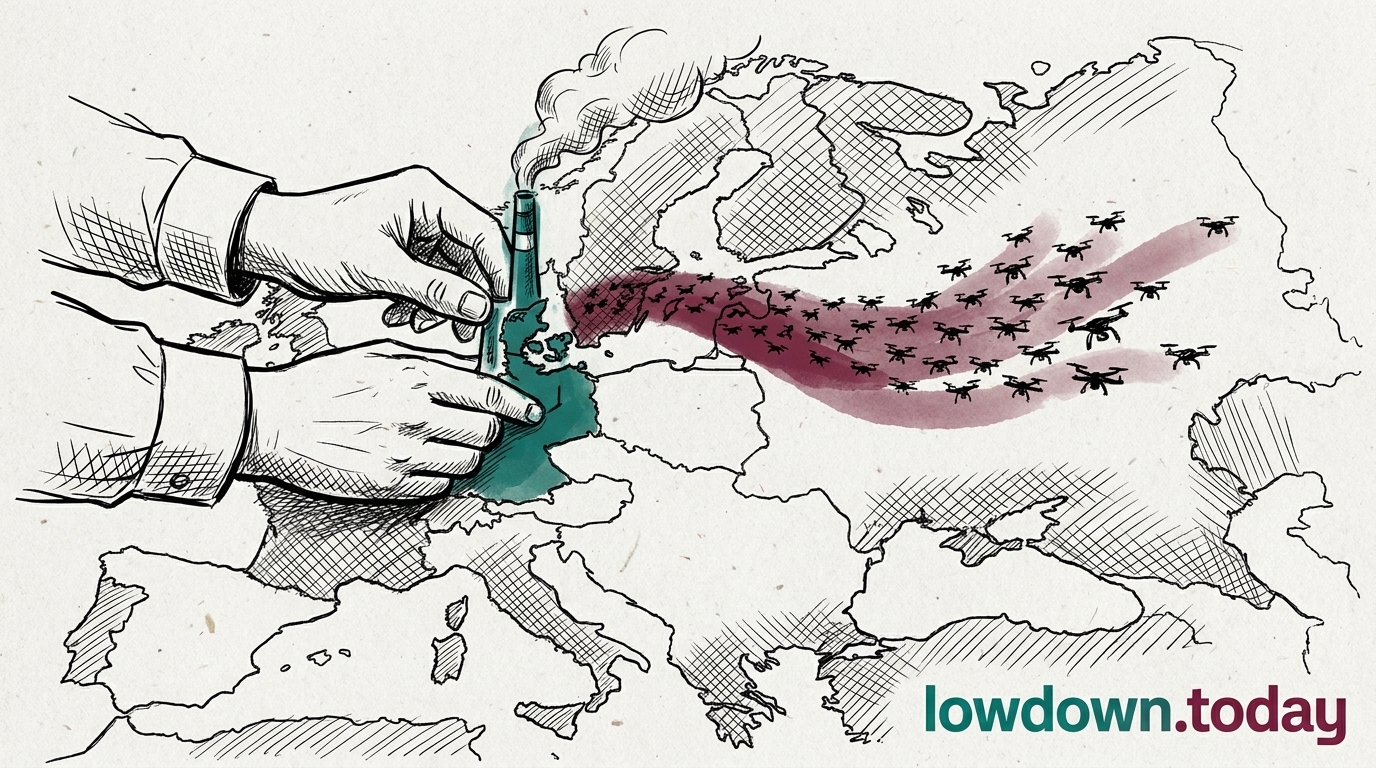
Denmark accepted Fire Point's Skrydstrup plant after committing to bilateral defence co-production at the B9 Nordic summit in May; the facility sits beside a Danish F-35 base, sharing security perimeters. NATO has published no legal guidance on whether hosting Ukrainian weapons production converts Denmark into a co-belligerent, leaving the host-state obligation unresolved.
Russian Ministry of Defence
Russia's 117% YoY drone-output rise in April, accelerating from a 68% full-year 2025 baseline, validates the FPV mass-production doctrine and hands Moscow a cleaner targeting argument for the Skrydstrup plant than any hidden production line offered; a Ukrainian weapons facility on NATO sovereign territory is a legitimate military target under the laws of armed conflict.
Baltic NATO states (Latvia, Estonia, Lithuania)
Latvia deployed mobile drone-intercept teams on 29 May using domestic Origin Robotics and Eraser interceptors, the first kinetic Baltic border response to Russia's 117% output surge. The Baltic states are the primary target market for Ukraine's ten EU export offices, giving them direct commercial access to combat-tested interceptors their own manufacturers have not yet matched.
Pentagon / Joint Interagency Task Force 401
Two Ukrainian entrants in Drone Dominance Phase 2 and Red Cat's SEC-filed STE partnership bring combat-iterated Ukrainian designs into US procurement without triggering Foreign Military Sale approvals; the programme's performance-scoring methodology does not require US-origin hardware. Northrop holding the Common UAS Payload standard means a heritage prime captures interface revenue regardless of which startup airframe wins.
Ukrainian defence industry (Fire Point / Spetstechnoexport)
Fire Point's Skrydstrup construction start and Spetstechnoexport's Red Cat partnership execute Zelensky's 13 May Bucharest proposal: converting wartime production surplus into a state export apparatus, independent of US approval chains. For Ukraine, embedded manufacturing on NATO soil protects propellant supply from Russian strikes while generating hard currency the war effort needs.
Chinese drone manufacturers (DJI, Autel)
Autel's Ralls Corp Fifth Amendment filing and DJI's Ninth Circuit quantification of USD 1.56 billion in 2026 losses are parallel constitutional attacks on a classified-evidence exclusion mechanism; neither company can contest the intelligence allegations directly, so both are betting on due-process doctrine to reopen the FCC authorisation route.
