Skip to content
You can now search across every topic, entity and event.What's new
Drones: Industry & Defence
7JUN

C-UAS spend looks like $29bn, reads $9bn

2 min read
11:27UTC

Global counter-drone procurement was logged at $29bn for Q1 2026, but $20bn of that is an Anduril contract ceiling, not cash; the honest read is roughly $9bn in a single quarter.

TechnologyDeveloping

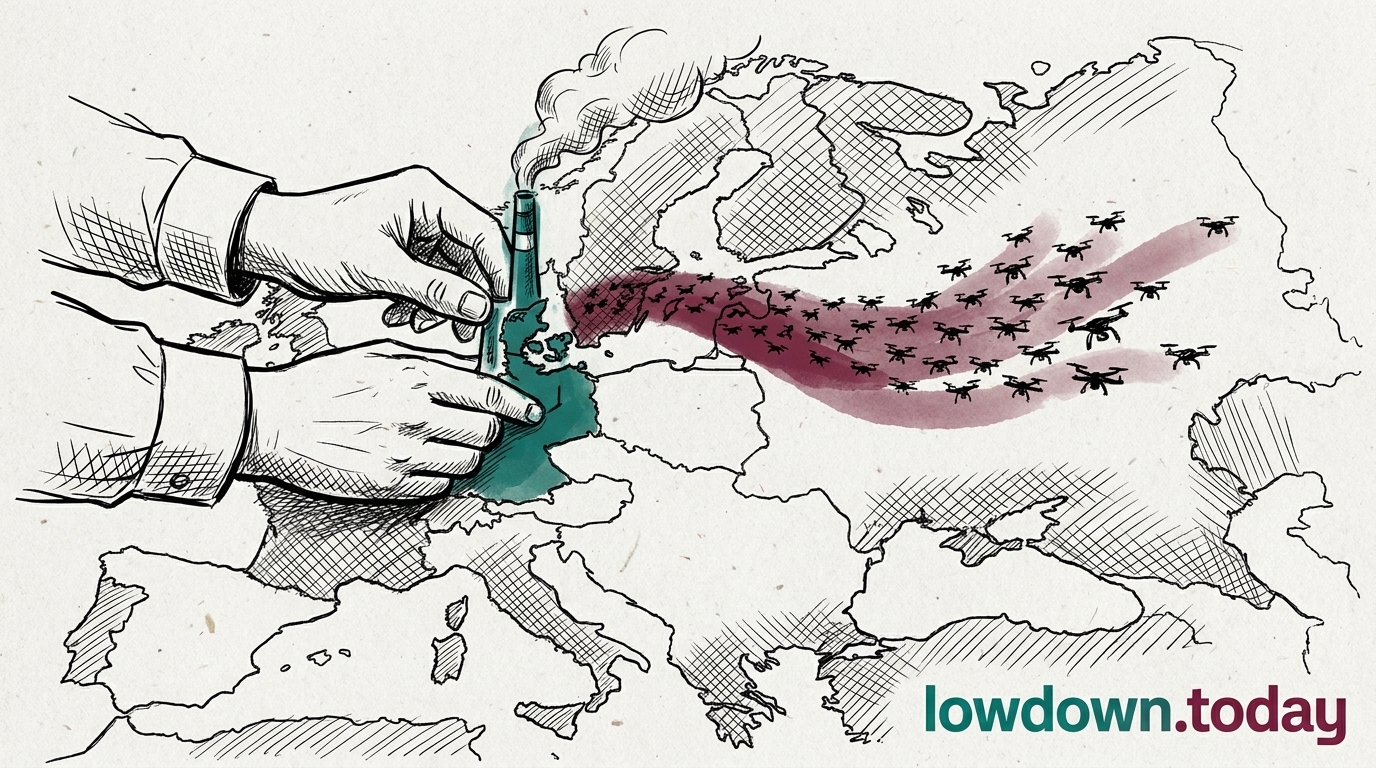
Industry tracker Unmanned Airspace logged $29bn of global Counter-UAS (counter-unmanned-aircraft-systems, C-UAS) government procurement in Q1 2026, against $12.6bn for all of 2025 1. C-UAS covers the systems built to detect and shoot down hostile drones, a market the war in Ukraine and the Baltic incursions have pushed up sharply.

The headline overstates the spend. About $20bn of the $29bn is the Anduril Army enterprise-vehicle ceiling, a ten-year IDIQ (indefinite-delivery, indefinite-quantity) contract cap rather than cash committed 2. Strip it out and roughly $9bn was actually committed in the quarter, near 70% of the entire 2025 total. The honest read is the $9bn, not the $29bn.

Even the conservative figure marks a step-change, and it sits alongside the capital repricing private markets show, where Anduril's own Series H reset the sector's valuation ceiling . New state buyers, including Poland, drove the underlying surge. The structural caveat is concentration: when a single firm's contract ceiling can inflate a global figure by two-thirds, the market's true breadth is harder to read than the totals suggest.

Deep Analysis

In plain English

Governments around the world spent or committed to spend roughly $29 billion on counter-drone systems in just the first three months of 2026, more than double what they spent in the whole of 2025. Counter-drone systems are technologies that detect, track, and destroy hostile drones, like the ones Russia has been firing at Ukraine and that have also strayed into Baltic NATO states. There is an important caveat: about $20 billion of that $29 billion total is a single contract ceiling for Anduril, a US company. A contract ceiling is more like a credit limit than actual spending, the US Army has agreed it can buy up to that amount, but has not necessarily ordered it yet. The real new money committed in Q1 is closer to $9 billion, which is still a significant surge.

First Reported In

Update #11 · Ukraine starts exporting the factory

Defense News· 7 Jun 2026
Read original
Different Perspectives
Australian Department of Defence
The $6.9 million counter-drone award to DZYNE, part of Ondas's $70 million order book, is a funded delivery against a real budget line while most of Farnborough's reveals carry no disclosed contract value.
Baykar
Baykar
Astore Levante extends the Bayraktar TB3 into a European joint venture the same way the Kizilelma export deal opened Indonesian production, treating proven Turkish airframes as the basis for allied manufacturing rather than new design programmes.
Leonardo
Leonardo
Declaring LBA Systems fully operational converts a Turkish export relationship into Italian production lines for Astore Levante, giving Italy a domestic combat-drone manufacturing base without funding a new airframe from scratch.
Minneapolis City Council (Vice President Jamal Osman)
The council killed a free Skydio trial 6-6 over the company's Israeli and ICE sales, not its drone-as-first-responder technology. It sets a precedent that other councils evaluating DFR vendors will now have to weigh alongside cost and capability.
UK Ministry of Defence
BAE's Brontanax reveal at Farnborough runs alongside the MoD's own Project NYX and Project Corvus competitions, neither of which has named Brontanax a winner. A demonstrator and a £300 million programme name are not yet a production order.
Procurement sceptics
Two identically sized IDIQs to different primes within seven weeks, and a five-nation pact where one partner moves weeks ahead of the rest, could just as easily read as an industrial base still improvising vendor mix as a deliberate hedging doctrine. Neither ceiling appears sized against a validated requirement yet.
