Skip to content
You can now search across every topic, entity and event.What's new
Drones: Industry & Defence
15JUN

Pentagon's drone buy lands a third short

2 min read
11:15UTC

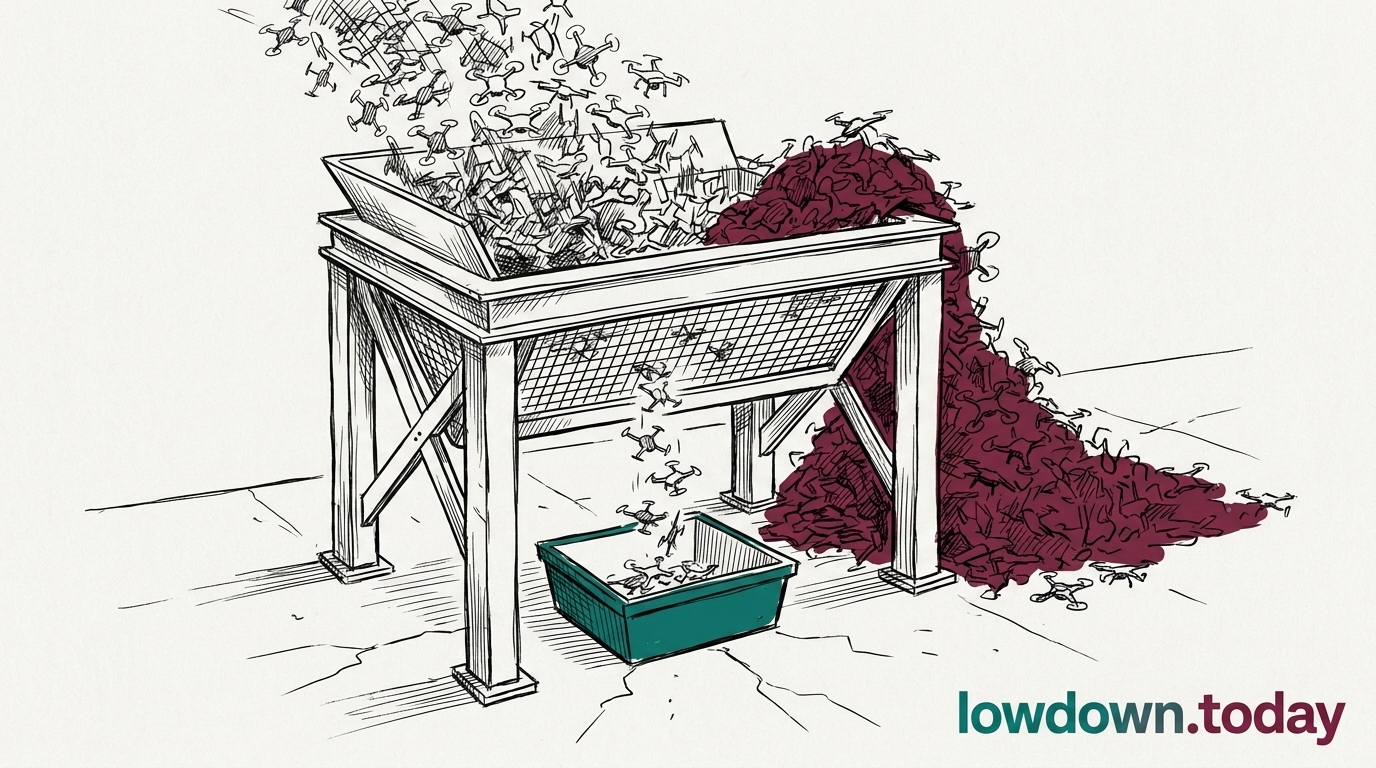
The Pentagon's flagship attack-drone programme closed its first phase 10,000 units short and accepted only 43% of the lead vendor's deliveries. A European AI drone meanwhile passed the US Army's own proving ground in Lithuania, while Anduril conceded a $1.2bn operating loss and no profit until 2030. After months of ambition figures, delivery data is starting to outrank them.

Key takeaway

The drone sector's first proving-ground reckoning has arrived: ambition figures now have delivery data attached.

This briefing mapped
Loading map…
Military
Economic
Competitive

The Pentagon's first attack-drone phase closed about 10,000 units below its 30,000 target, and lead vendor Neros cleared only 43% of the 2,400 Archer drones it shipped.

Sources profile:This story draws on neutral-leaning sources

The Pentagon's first attack-drone buy closed about 10,000 units short of 30,000, and lead supplier Neros had fewer than half of its 2,400 drones accepted at inspection. Phase 2 cuts the price cap to $3,500-$4,500 and requires Chinese parts to be removed by August 2026.

Both conditions squeeze out smaller makers who cannot source Western motors cheaply enough to turn a profit. If rejection rates in Phase 2 track Phase 1, the programme will fall short again. 

Sources:TechTimes

US soldiers from V Corps scored 15 kills across 17 engagements with Helsing's HX-2 at Pabrade, Lithuania, the first confirmed US Army operational test of a European autonomous strike drone.

US Army soldiers from V Corps hit 15 out of 17 targets with Helsing's HX-2 at Pabrade, Lithuania on 9 June. The test jammed satellite navigation (GPS) and disrupted communications signals. Scoring 88% under those conditions is the result that matters: it is what the US Army demanded, not a vendor demonstration.

The result opens Helsing to NATO-wide procurement conversations, but US orders require a separate acquisition process the test result alone cannot trigger. 

Anduril expects 2026 revenue near $4.3bn alongside a $1.2bn operating loss, with profitability pushed out to 2030 against a $61bn valuation set last month.

Sources profile:This story draws on centre-leaning sources from United States
United States
LeftRight

Anduril expects to earn about $4.3bn in 2026 while losing $1.2bn, and has told investors it will not reach profitability until 2030. Its $61bn valuation, set in May 2026, prices the company at 27 times current revenue.

That multiple assumes Anduril's Lattice software becomes the US military's drone-management standard and that Congress passes a $54.6bn autonomous-warfare budget. Helsing's US Army test in Lithuania and the House Armed Services Committee's pending mark-up are the two immediate tests of those assumptions. 

Parsons confirmed on 10 June that its DroneArmor system folds DroneShield's electronic-warfare sensor into a single AI-driven kill chain now running at a US security agency's southern border.

Sources profile:This story draws on neutral-leaning sources

Parsons, a US defence engineering firm, confirmed on 10 June that it put DroneShield's electronic-warfare sensor inside its DroneArmor kill-chain. DroneArmor now runs at a US security agency's southern border.

For DroneShield, a sub-component slot inside a live government system earns steady renewal income rather than one-off sales, but only while Parsons keeps the contract. An open Australian regulatory probe runs alongside the commercial win. 

Red Cat launched a $225m equity offering on 12 June, filed to buy Quaze Technologies in stock, and landed a first Japan Ministry of Defense order for its Black Widow drone.

Sources profile:This story draws on neutral-leaning sources

Red Cat Holdings raised $225m on 12 June and filed to buy Quaze Technologies, a Canadian wireless-power company. It also landed a first order from Japan's defence ministry for its Black Widow reconnaissance drone.

Japan's order reflects its 2022 shift to a counter-strike doctrine that requires building a drone inventory from scratch. Red Cat holds a first-mover advantage: no compliant rival has yet entered Japan's procurement catalogue. 

DroneShield and Ondas-owned Sentrycs were both selected to provide counter-drone coverage at the 2026 FIFA World Cup in Kansas City, against a $250m federal security budget.

Sources profile:This story draws on neutral-leaning sources

DroneShield and Sentrycs were chosen to protect matches at the 2026 FIFA (football's world governing body) World Cup in Kansas City. Sentrycs was recently bought by Ondas Holdings. The federal counter-drone budget is $250m, from FEMA (the US emergency management agency).

The World Cup is the largest live counter-drone test outside a war zone in US history. A clean deployment earns a government-validated reference. A visible failure plays out in front of billions of viewers. 

Closing comments

Direction: sideways with tightening. The drone-industrial boom continues (Phase 2 is funded at $300 million-plus, Anduril is scaling, Red Cat is raising capital) but the tolerance for undelivered ambition is narrowing. The specific mechanisms that would tip this upward: the August 2026 Chinese-component deadline forcing a vendor-field reset and HASC marking up the DAWG line at or near the $54.6 billion request. The mechanism that tips it into a reckoning: Phase 2 acceptance rates tracking Phase 1 at 40-50%, which would leave the Pentagon's 300,000-drone-by-2027 target unreachable on the current timetable and force a structural programme redesign rather than a Phase 3 continuation.

Different Perspectives
Pentagon / Defense Innovation Unit
The DIU's own programme managers characterised the 43% acceptance rate as within the expected curve for a first-generation industrial ramp. Phase 2's tighter price caps and Chinese-component deadline signal the programme is accelerating supplier-quality selection, not retreating from the 300,000-drone target.
Helsing / European defence-AI sector
Helsing's 88% GPS-denied hit rate at Pabrade is its first US Army validation credential, arriving alongside an $18 billion valuation and a Bundestag €1.46 billion framework. Nordic, Baltic, and Central European defence ministries now have a US-scored European alternative to reference in procurement without waiting for a US programme of record.
Anduril investors
Anduril investors
Bernstein Research's Douglas Harned placed the 27-times-revenue multiple in the context of enterprise-software platform primes: the buyer prices a future monopoly on the Lattice software layer, not 2026 earnings. The Helsing Flytrap result and Phase 1 shortfall are the first live tests of those assumptions since the $61 billion valuation closed.
Ukraine / combat-data exporters
Ukrainian firms entered Pentagon Drone Dominance Phase 2 alongside Skycutter (ID:3988), and Red Cat's formal Spetstechnoexport partnership (ID:3987) carries Black Widow to Japan. Combat-proven data is the export Ukraine can monetise while its domestic export ban blocks hardware sales to Gulf states spending millions per salvo on less-proven alternatives.
DroneShield / Australian C-UAS sector
DroneShield is simultaneously embedded in a US prime's fielded kill chain, selected for the world's largest civil C-UAS deployment, and navigating an open ASIC probe with a first-strike AGM vote on record. Strengthening commercial fundamentals and an unsettled boardroom are running in parallel at exactly the moment US buyers weigh supplier stability.