Skip to content
You can now search across every topic, entity and event.What's new
Data Centres: Boom and Backlash
7JUL

New York freezes new permits by decree

2 min read
09:27UTC

Governor Kathy Hochul froze new hyperscale data-centre permits across New York for a year on 14 July, signing an executive order rather than waiting on a bill still stuck on her desk.

IndustryDeveloping
Key takeaway

New York's year-long permit freeze holds by decree, but the next governor could reverse it as quickly.

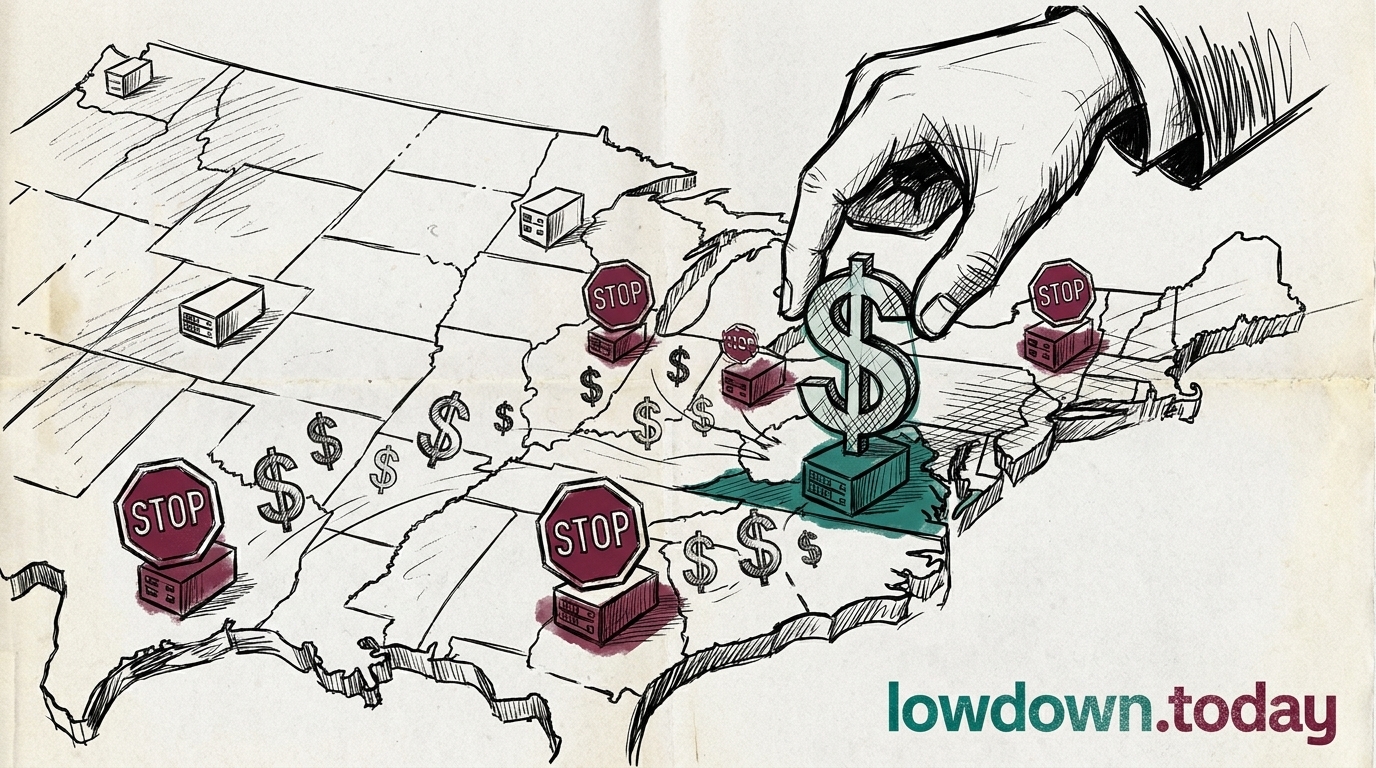
Governor Kathy Hochul signed an executive order on Tuesday 14 July freezing discretionary environmental permits for new hyperscale data centres across New York for one year, routed through the state Department of Environmental Conservation (DEC). 1 hyperscale campuses, the gigawatt-scale server farms run by the largest cloud operators, need DEC sign-off on their air, water and land permits before construction. During the freeze the state will draft a Generic Environmental Impact Statement (GEIS), a single broad review meant to set standard conditions for the whole class.

New York becomes the first US state to enforce a statewide freeze of this kind. Maine's legislature passed the first such moratorium in April, only to see Governor Janet Mills veto it and the House sustain that veto. Every other statewide attempt has stalled in committee. Hochul's order holds precisely because she did not route it through her legislature.

A North Country lawmaker had urged her to veto the freeze weeks earlier, warning it would cost upstate investment . She reached instead for authority she controls outright, DEC discretionary permits, a lever any governor can pull without a legislative session. That speed carries a cost: an executive order survives only as long as the administration that signs it, so the next governor could lift the freeze as fast as this one imposed it. The Responsible Data Center Development Act, passed by both chambers, still sits unsigned on her desk as the more durable instrument.

The demand has not paused with the permits. Developers keep filing for gigawatt-scale campuses across the Northeast, and the order shuts a top-three state economy while the queue behind it lengthens.

Deep Analysis

In plain English

New York's governor, Kathy Hochul, has used an executive order, a power she can exercise alone without asking the state legislature, to stop the Department of Environmental Conservation from approving any new large data-centre construction for one year. This affects only new projects; anything already permitted keeps going. A separate bill doing something similar already passed the legislature in June but is still sitting unsigned on Hochul's desk. Her order does not replace that bill or force her hand on it; the two tracks are running side by side, and only she knows which she prefers long term.

Deep Analysis
Root Causes

New York's freeze is possible without new legislation because the frozen permits are discretionary State Environmental Quality Review Act reviews issued by the Department of Environmental Conservation, not by-right approvals; a discretionary permit can be paused by executive directive to the issuing agency, while a right to build without further state sign-off cannot.

The Responsible Data Center Development Act, still unsigned after passing both chambers on 4 June, would have imposed the same freeze by statute. Hochul's order achieves the same practical effect while leaving that bill's fate, and any veto decision, untouched.

What could happen next?
  • Consequence

    Hyperscaler site-selection teams evaluating New York projects lose a full year of permitting certainty and may redirect near-term capital to states without an active freeze.

  • Precedent

    An executive-order freeze, rather than a signed bill, gives other governors facing similar pressure a faster unilateral route that does not require a legislative majority.

First Reported In

Update #10 · New York freezes data centres by decree

New York Governor's Office· 15 Jul 2026
Read original
Different Perspectives
Global hyperscale operators
Operators are still filing gigawatt-scale campuses and Meta is proceeding with its $10bn Lebanon, Indiana site despite the county-level bans nearby, betting Q2 capex outruns the patchwork of restrictions. Industry framing casts New York's freeze, Oregon's surcharge and Indiana's bans as taxes and levies that push build-out toward faster-permitting jurisdictions such as India and the Gulf.
EirGrid
EirGrid
EirGrid set a 900 MW instantaneous demand-loss ceiling because a single voltage dip can trip many data centres onto backup power at once, risking imbalance above 1,150 MW. It wrote the limit into a standing procedure rather than waiting for an emergency to force one.
US host communities and ratepayers
Prince William residents backed the 8-0 denial of Dulles South over the Occoquan watershed, drinking water for eight million people, while Oregon's approved tariff cuts residential bills 1.3% by charging large loads 29% more. Their position: consent and cost-attribution belong in law, not left to a developer's or a utility's discretion.
Hassan Allam Digital Infrastructure
Hassan Allam Digital Infrastructure, an Egyptian conglomerate rather than a foreign hyperscaler, reportedly secured a domestic hyperscale licence with a $400m first phase, per single-source reporting still to be verified. It reads as home-grown sovereign compute ambition, building national capacity rather than importing a US or Gulf operator's campus.
Damac Digital
Damac Digital
Damac Digital keeps building toward roughly 6,000 megawatts of hyperscale capacity across 13 countries while Virginia taxes power and New York weighs a freeze. Every dollar or month of delay a US state adds is capacity a Gulf developer can site somewhere with faster permitting and no equivalent levy.
Acequia communities, Santa Fe County
Santa Fe County commissioners voted unanimously on 2 July to freeze any data centre over one megawatt, citing the acequia irrigation commons that has shared scarce water since Spanish colonial rule. They expect the low threshold to draw the same Fifth Amendment challenge RCM Hill brought against Hill County, Texas.

