Skip to content
Welcome, thoughtbot's Giant Robots listeners!Start here
Data Centres: Boom and Backlash
26NOV

Ireland codes a 900 MW load-loss limit

2 min read
18:00UTC

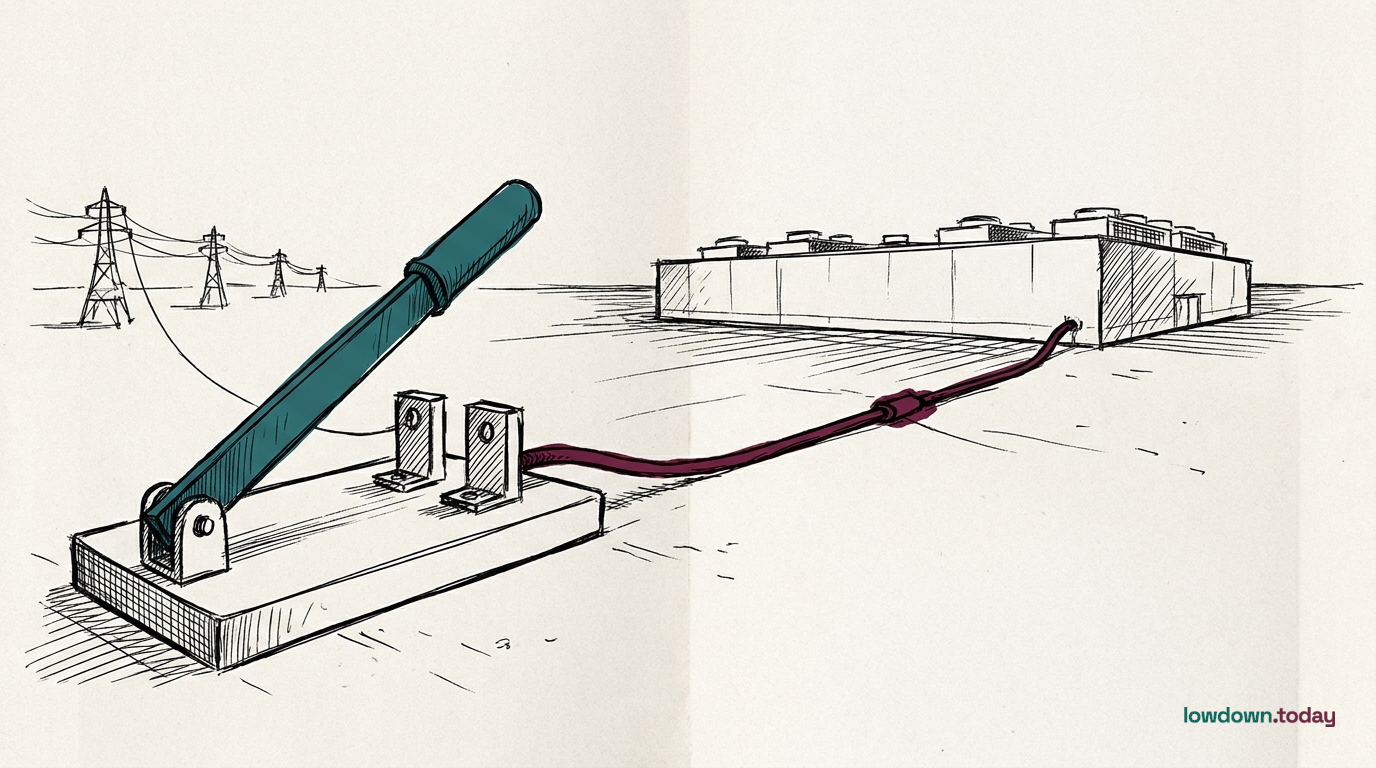
EirGrid and SONI issued a grid-fault curtailment procedure to data centres on 30 June, capping instantaneous demand loss at 900 MW to stop synchronised backup-power trips destabilising the grid.

IndustryDeveloping
Key takeaway

Ireland made data-centre curtailment a permanent grid rule, while the US still declares an emergency each time.

EirGrid and SONI, the grid operators for the Republic of Ireland and Northern Ireland, issued a fault-ride-through (FRT) demand-curtailment procedure to affected data-centre customers on Tuesday 30 June, live from July.⁠1 fault-ride-through is the grid-code requirement that a large load stay connected through a brief voltage dip rather than trip to its own backup generators. Their MPID345 paper set a 900 MW ceiling on how much demand the grid can afford to lose at once, warning that a single fault could otherwise knock more than 1,150 MW of data-centre load offline together.

The physics matches a risk the beat has tracked mostly in America. The US Department of Energy (DOE) used Section 202(c) emergency powers to let PJM, the largest US grid operator, curtail backup-equipped data centres twice in 2026, and Ireland's energy regulator, the CRU, reopened large-load connections in June even as EirGrid warned of shortfalls.

The two systems reached the same class of ceiling from opposite legal directions. Washington must declare a statutory emergency event by event; Dublin has written a standing grid-code rule that runs on its own. Both treat concentrated data-centre load as a single point of failure the grid must be able to shed, and the build-out is what created that risk.


Deep Analysis

In plain English

Ireland's electricity grid operators, EirGrid and SONI, have told data-centre customers there is now a hard limit on how much power demand can suddenly vanish from the grid at once, for example if a big data centre trips offline during a fault. That limit is 900 megawatts; above roughly 1,150 megawatts of sudden loss, the grid itself could become unstable. This matters because Dublin's data centres already use about half of the region's electricity. The rule does not stop new data centres connecting, but it does mean big campuses now have to prove they will not destabilise the grid if something goes wrong.

Deep Analysis
Root Causes

EirGrid's 900 MW ceiling exists because Ireland's data-centre demand, now about 32% of national electricity against 22% in 2024, grew faster than CRU's 2025 reconnection conditions anticipated; the regulator required 80% renewable supply and full on-site backup from new entrants, but did nothing to cap the instantaneous demand loss a fault at a large Dublin campus could cause across the whole system.

The 1,150 MW imbalance warning is the gap between what EirGrid judges the system can absorb without mitigation and what a cluster of large Dublin sites tripping simultaneously would actually cost; the 900 MW ceiling is the operator drawing a line just below that failure threshold rather than waiting for CRU to write a new connection rule.

Escalation

The procedure is a defensive grid-code measure, not evidence of an imminent shortfall; escalation would be a live curtailment event or a further tightening of the ceiling if Dublin campus growth continues.

What could happen next?
  • Risk

    Operators unable to demonstrate fault-ride-through compliance may face new engineering costs or curtailment exposure even after clearing CRU's 2025 connection conditions.

  • Precedent

    A standing grid-code ceiling, rather than a one-off emergency order, gives European grid operators a template that does not require new legislation to enforce.

First Reported In

Update #10 · New York freezes data centres by decree

EirGrid / SONI· 15 Jul 2026
Read original →
Different Perspectives
MUFG
MUFG
Mitsubishi UFJ (MUFG) and Morgan Stanley are preparing to sell a loan of about $4.5bn secured on the GPUs CoreWeave runs for Meta in Dalton, Georgia, with price talk of 7% to 7.5%, Bloomberg reported. Meta's contract is expected to win the loan investment-grade ratings, though CoreWeave is rated below investment grade and the loan has not priced.
CX Tech
CX Tech
CX Tech's £16.5bn, 1,000 MW plan for the former Chapelcross nuclear site has drawn more than 10,000 representations, the most Dumfries and Galloway's planners have received, BBC News reported. The company says the scheme could support up to 750 construction jobs and about 540 permanent posts; comments close on 29 November.
Nate Glubish, Alberta's technology and innovation minister
Glubish tabled Bill 42 on 18 November to ban power plants and data centres on Class 1 and 2 farmland and within 600 m of homes, a day after the regulator approved a 1,494 MW plant that fails both tests. The bill exempts projects already approved or under review, so the Indus plant stands.
NEXTDC's chairman and chief executive
After a second pay strike and a defeated spill on 20 November, NEXTDC's leaders said they are exploring a joint venture for the S4 Sydney campus and do not expect to raise shareholder capital for contracted capacity. They raised FY27 underlying EBITDA guidance to A$260m-A$275m, still excluding about A$140m tied to Melbourne's stalled M3 site.
Friends of the Irish Environment, Friends of the Earth Ireland and ClientEarth
The three groups argued in the High Court on 18 November that the CRU's data-centre connection framework breaches the 2015 Climate Act by ignoring carbon budgets, which the CRU denies. Judge Micheal O'Connell reserved judgment with no date, so the framework stands meanwhile.
South Korean data-centre industry groups
Industry groups told Etnews on 13 November that tougher grid scoring for one sector alone is unfair, three days before the climate and energy ministry raised the capital-region pass mark to 75 from 70. Pending applications are judged on the new bar; the pilot assessed 28 capital-region projects worth 1.9 GW.

Written with AI from Lowdown's published reporting. Not individually reviewed by an editor. Editorial standards.