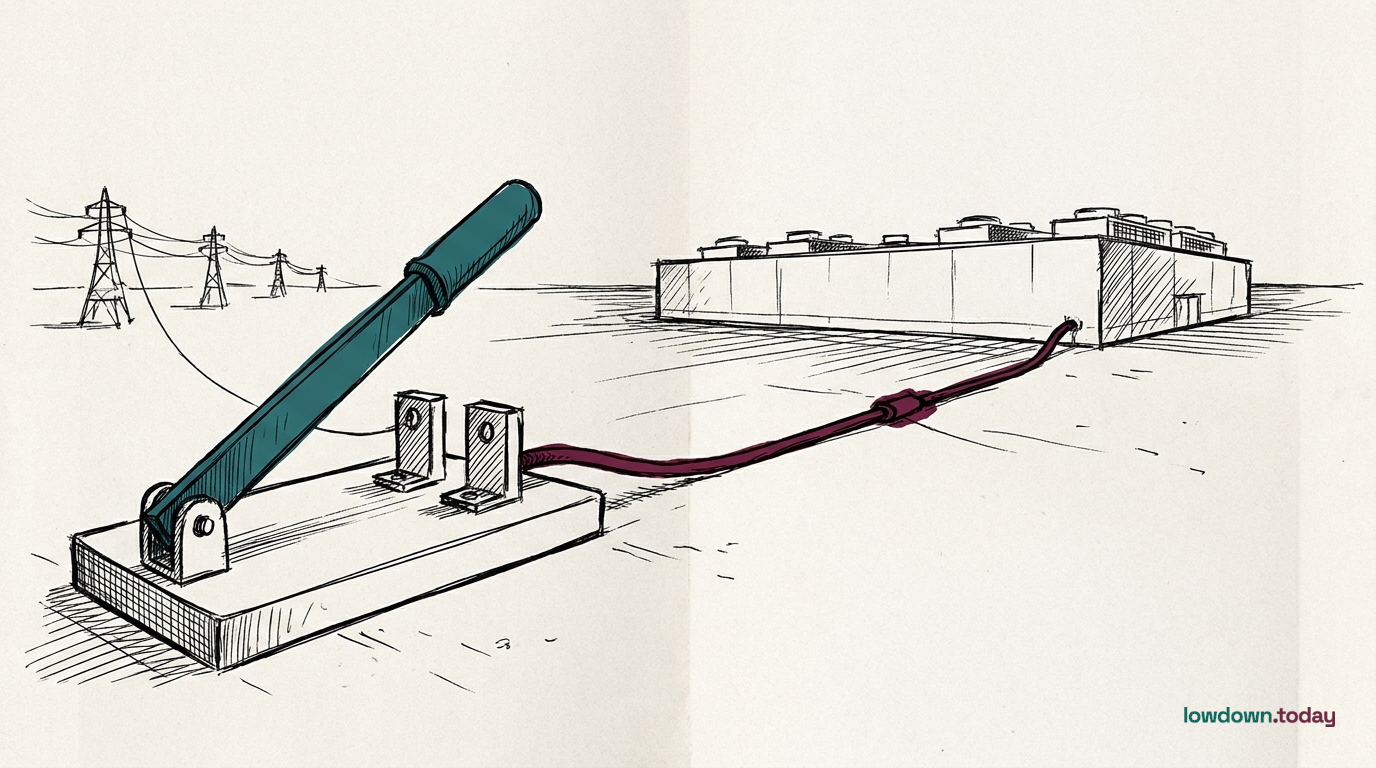
SPP (Southwest Power Pool, the grid for the central Plains states) would cut a data centre's cheaper power to zero whenever the local price passes $25 per megawatt-hour (MWh)1. That price is one of the answers the six grid operators regulated by FERC (the Federal Energy Regulatory Commission) filed between 13 and 20 November to its orders on large loads. Each would offer data centres a cheaper "non-firm" service that can be cut off. Four name the price at which that happens, while PJM Interconnection and CAISO (the California Independent System Operator) set no price threshold.
MISO (the Midcontinent Independent System Operator) would interrupt non-firm load when the local price passes $100/MWh. NYISO (the New York Independent System Operator) would cap non-firm bids at $200/MWh. ISO New England, the region's independent system operator, would order non-firm load to cut back at $250/MWh, a price its grid reached in about 1% of hours from 2021 to 2025. In principle, the lower the trip price, the more hours a data centre gives up, and the less the households sharing its grid pay to build for it.
Firm power costs more. MISO would charge a nonrefundable $250,000 application fee and a $100,000 study deposit, while SPP would assign any upgrade cost above a "safe harbor" of $500,000 per megawatt (MW), capped at $25m per request, to the customer for up to 40 years. NYISO's queue shows why the operators want a cheaper tier: it holds 51 large-load projects totalling about 12,670 MW, against forecasts that at most about 2,880 MW of it is built by 2040. FERC has accepted none of the six plans, and states and utilities can still contest them.
PJM, the grid that serves northern Virginia's data-centre cluster, filed its plan on Monday 16 November and says it already serves about 10 gigawatts (GW) of large computational load. On 22 July nearly 3.9 GW of data-centre load dropped onto onsite generation in a single event, the kind of sudden swing PJM's separate ride-through filing (ER27-522-000) is written to prevent. The push for all six filings came from the Trump administration: Energy Secretary Chris Wright directed FERC on 23 October 2025, under Section 403 of the Department of Energy Organization Act, to start rulemaking on large-load connections, and FERC's "show cause" orders of 18 June followed. Britain rations grid places by sponsorship and caps instead, since ministers can now reserve capacity for sponsored projects and data-centre connections after 2030 will be capped by region.
On the reliability side, the North American Electric Reliability Corporation (NERC) asked FERC to create two new registered-entity types for data-centre owners and operators2. They cover sites of 50 MW or more supplied at 100 kilovolts (kV) or above, which NERC estimates capture 68,288 MW, roughly 86% of the computational load projected by the end of 2027. Registration would make a data-centre owner answerable to NERC, where today it is only a utility's customer. The standards those owners would answer to, adopted by NERC's board in October on the threshold set at the first ballot, must reach FERC by 31 December.




