Skip to content
You can now search across every topic, entity and event.What's new
Data Centres: Boom and Backlash
26APR

Virginia taxes power behind the meter

4 min read
09:44UTC

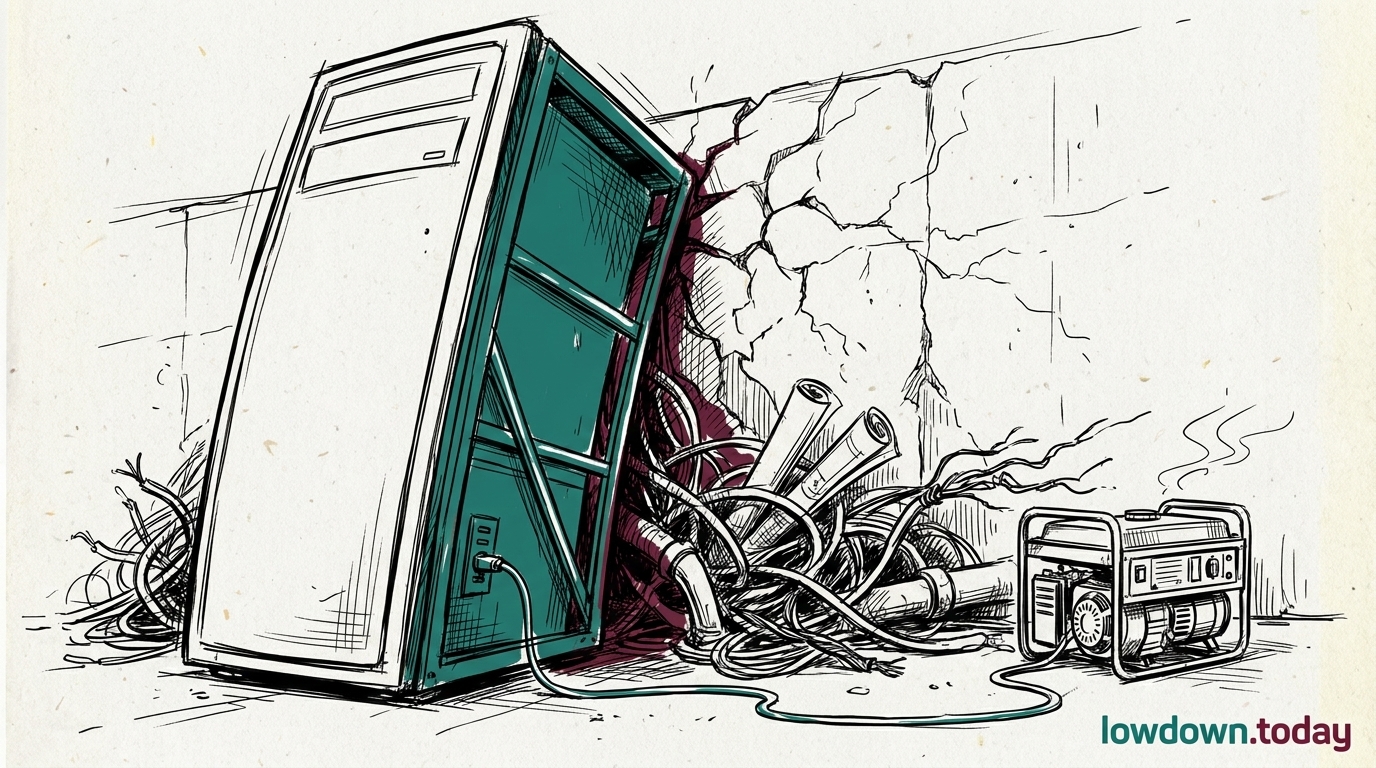
Virginia's two-year budget, passed 22 June, charges data centres $0.011 for every kilowatt-hour they burn, including power they generate on site. No US state had taxed power generated behind the meter until now.

IndustryDeveloping
Key takeaway

Virginia is the first US state to tax data centres on the power they make themselves.

Virginia passed a two-year budget on 22 June that charges data centres $0.011 for every kilowatt-hour (kWh) they consume, including the power they generate themselves on site 1. The Senate carried it 23 to 16 and the House 71 to 22. It is the first US levy to reach past the meter, taxing the same self-generated power the Department of Energy (DOE) ordered curtailed twice in 2026 in PJM territory .

The tax is capped at $600m a year and sunsets on 1 July 2028. To get there, lawmakers dropped the $35 to $45 per kilowatt backup-generator fee floated in mid-June and kept the sales-and-use exemption the Senate had wanted to end. Compass Datacenters, which walked away from two Virginia sites when the tax outlook was unclear , now has a number to plan around, even if it is a higher one.

Charging per kilowatt-hour consumed, rather than per kilowatt of generator nameplate, ties the levy to actual compute use, so it captures AI inference growth directly instead of capacity that may sit idle. For operators the squeeze now comes from three directions at once: the DOE can switch the on-site plant off, Virginia charges for what it produces, and the turbines that run it sit in a multi-year supply queue. The data-centre lobby says the levy will deter investment; the counter-view is that a known cost restarts projects that uncertainty had frozen.

Deep Analysis

In plain English

Virginia is home to the world's largest cluster of data centres, mostly concentrated in Loudoun County in Northern Virginia. Until now, data centres in Virginia paid very little state tax because the state wanted to attract the investment. But that created a growing problem: data centres use so much electricity that they put pressure on the power grid, yet they paid almost nothing toward grid upgrades. On 22 June, Virginia's legislature passed a new state budget that includes a small tax on every unit of electricity that data centres consume: $0.011 for each kilowatt-hour (kWh), whether that electricity comes from the public grid or from a private generator the data centre owns. The tax is capped at $600m per year and expires in July 2028, giving the state two years of revenue while the longer-term framework is debated. Compass Datacenters, which had cancelled two planned Virginia sites because of tax uncertainty (ID:3628), now has a number it can include in its financial projections.

Deep Analysis
Root Causes

Virginia's budget standoff produced a consumption tax rather than the capacity-based generator fee the Senate originally proposed for two structural reasons.

First, a per-kWh consumption tax is legally defensible as a general excise levy on electricity use; a per-kW fee on installed backup-generator capacity would have been challenged as a targeted levy on specific equipment, which courts in other states have found unconstitutional when applied only to one industrial category.

Second, the legislature needed the tax to reach behind-the-meter generation because FERC's jurisdiction does not; state consumption taxes apply to power drawn for any purpose on state territory, regardless of whether it crosses the interstate transmission system. The $0.011/kWh levy on self-generated power is thus the only instrument available to a state government that wants to capture fiscal value from the BTM generation trend that federal regulators cannot reach.

What could happen next?
  • Precedent

    Virginia's two-year sunset and annual cap is the first US state tax to reach past the electricity meter to BTM generation, creating a template other high-density data-centre states (Texas, Georgia, Ohio) will study before their own fiscal reviews.

  • Risk

    The two-year sunset means Virginia's fiscal framework is unresolved from July 2028; operators signing 10-20 year leases now carry future-levy uncertainty into their site economics.

First Reported In

Update #8 · Data centres build their own power plants

Cardinal News· 28 Jun 2026
Read original
Different Perspectives
Global hyperscale operators
Operators are still filing gigawatt-scale campuses and Meta is proceeding with its $10bn Lebanon, Indiana site despite the county-level bans nearby, betting Q2 capex outruns the patchwork of restrictions. Industry framing casts New York's freeze, Oregon's surcharge and Indiana's bans as taxes and levies that push build-out toward faster-permitting jurisdictions such as India and the Gulf.
EirGrid
EirGrid
EirGrid set a 900 MW instantaneous demand-loss ceiling because a single voltage dip can trip many data centres onto backup power at once, risking imbalance above 1,150 MW. It wrote the limit into a standing procedure rather than waiting for an emergency to force one.
US host communities and ratepayers
Prince William residents backed the 8-0 denial of Dulles South over the Occoquan watershed, drinking water for eight million people, while Oregon's approved tariff cuts residential bills 1.3% by charging large loads 29% more. Their position: consent and cost-attribution belong in law, not left to a developer's or a utility's discretion.
Hassan Allam Digital Infrastructure
Hassan Allam Digital Infrastructure, an Egyptian conglomerate rather than a foreign hyperscaler, reportedly secured a domestic hyperscale licence with a $400m first phase, per single-source reporting still to be verified. It reads as home-grown sovereign compute ambition, building national capacity rather than importing a US or Gulf operator's campus.
Damac Digital
Damac Digital
Damac Digital keeps building toward roughly 6,000 megawatts of hyperscale capacity across 13 countries while Virginia taxes power and New York weighs a freeze. Every dollar or month of delay a US state adds is capacity a Gulf developer can site somewhere with faster permitting and no equivalent levy.
Acequia communities, Santa Fe County
Santa Fe County commissioners voted unanimously on 2 July to freeze any data centre over one megawatt, citing the acequia irrigation commons that has shared scarce water since Spanish colonial rule. They expect the low threshold to draw the same Fifth Amendment challenge RCM Hill brought against Hill County, Texas.

