Skip to content
You can now search across every topic, entity and event.What's new
Autonomous Systems: Land & Sea
13JUN

US prime digs into UK seabed war

4 min read
11:07UTC

At the Combined Naval Event from 19 to 21 May, US shipbuilder HII pushed its uncrewed underwater vehicles toward the Royal Navy through British partner Babcock under the ARMOR Force initiative.

TechnologyDeveloping
Key takeaway

An American firm is embedding in Britain's underwater robot fleet through a UK partner, not selling from abroad.

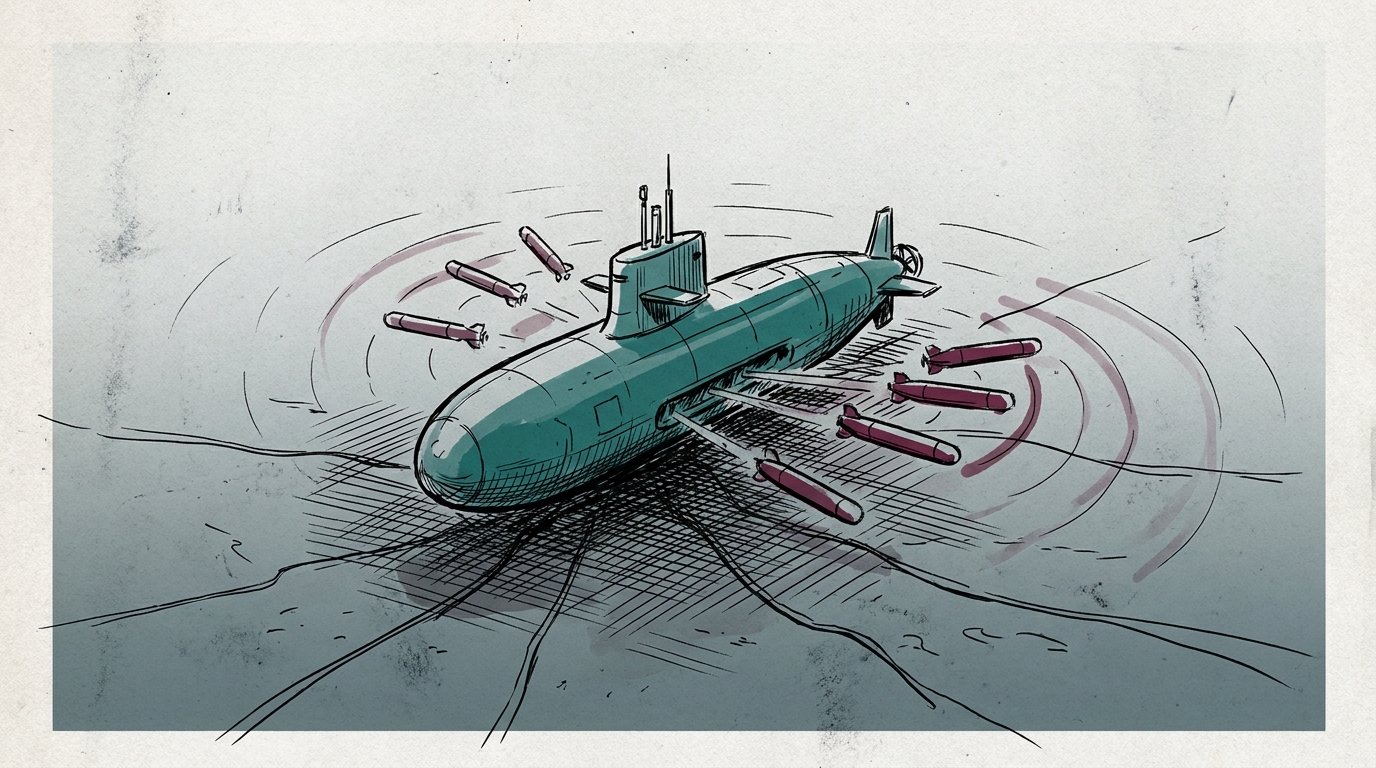
At the Combined Naval Event from 19 to 21 May in Farnborough, the American shipbuilder HII pushed its uncrewed underwater vehicles toward the Royal Navy through a British partner. 1 An uncrewed underwater vehicle (UUV) is a submarine-shaped robot that runs without a crew, used to hunt mines, inspect seabed cables, and scout ahead of manned ships. HII said it has delivered more than 750 REMUS UUVs to over 30 countries, and that a REMUS 600 was launched and recovered through the torpedo tube of the submarine USS Delaware. That manoeuvre lets a submerged boat send a robot ahead to scout or hunt mines without surfacing.

The UK hook is the tie-up with Britain's Babcock on the Autonomous Maritime Operations and Recovery initiative (ARMOR Force) for the Royal Navy, plus an enlarged HII facility at Portchester in Hampshire, positioned as a European hub for allied navies. Routing the pitch through Babcock and a UK site converts a US export bid into a British industrial presence that is harder to displace on sovereignty grounds, the same ground on which European buyers are pressing for home-built kit.

L3Harris said on 27 May its sub-launched Iver4 900 underwater vehicle is in delivery to the US Navy under a Defense Innovation Unit contract, a marker of how fast torpedo-tube-launched robots are reaching the fleet. 2 Both HII and L3Harris demonstrated the launch-and-recovery trick within the same window. For European navies the read is procurement urgency, since seabed cables and pipelines now sit inside the threat picture and the robots to defend them are arriving from American primes first.


Deep Analysis

In plain English

HII's REMUS family are underwater robots launched from a submarine's torpedo tube; they can search the seabed for mines, gather intelligence, or inspect undersea cables without a crew aboard. The parent submarine stays hidden while its robot scouts ahead, which is why navies pay large sums for this capability. At a UK naval conference in May, the American shipbuilder HII showed the Royal Navy its REMUS and ROMULUS underwater robots, working through its British partner Babcock. HII has already sold over 750 of these vehicles to more than 30 countries. A separate US company, L3Harris, also announced its Iver4 900 torpedo-launched robot is now being delivered to the US Navy. Both pitches are part of a push by US firms to supply the UK and European navies as demand for underwater surveillance rises.

Deep Analysis
Root Causes

The Royal Navy's receptiveness to US-origin subsea autonomy has one primary structural driver: the decommissioning of the UK's dedicated mine countermeasures and hydrographic capability at a pace that outstrips domestic procurement.

When the Batch 1 River-class offshore patrol vessels were sold, and as the Hunt and Sandown mine hunter fleets age, the gap between what the Royal Navy needs to do and what its own hulls can deliver has widened. ARMOR Force offers a faster route to subsea ISR and minehunting capability than a clean-sheet UK programme.

For HII, the strategic logic is market consolidation ahead of an expected NATO-wide increase in UUV procurement following the Red Sea cable-cutting incidents of 2023-24 and Baltic seabed infrastructure attacks. Establishing a European support hub before that procurement wave arrives creates a switching cost for Allied navies: a Royal Navy fleet using REMUS 600 for torpedo-tube operations will naturally prefer to re-order from HII's Portchester hub rather than convert to a competing system.

What could happen next?
  • Consequence

    HII's Portchester European hub and Babcock partnership create a US-origin UUV supply chain embedded in UK sovereign infrastructure, making future Royal Navy procurement of competing European platforms structurally harder.

    Medium term · Assessed
  • Risk

    French and German AUV manufacturers face a narrowing window to establish equivalent reference sales with a NATO tier-one navy before US-origin platforms set the interoperability standard for Allied submarine-launched UUV operations.

    Short term · Suggested
  • Precedent

    USS Delaware's torpedo-tube REMUS 600 demonstration is the first publicly confirmed instance of a UK-allied navy certifying a US UUV for submarine-tube launch, establishing a technical baseline for joint Allied subsea operations.

    Immediate · Assessed
First Reported In

Update #1 · UK's robot navy sails for Hormuz

Naval News· 29 May 2026
Read original
Different Perspectives
NATO (alliance demand)
NATO converted its GIUK surveillance deficit, exposed by the 2023 Balticconnector rupture and documented by the IISS as fewer than six maritime patrol sorties per day, into a standing operational requirement through Task Force X-Arctic, with DIANA selection serving as the accelerator that bridges start-up development to alliance procurement timelines.
Nautilus International and Lloyd's Register (seafarer labour and classification assurance)
Lloyd's Register's certification of Herne and RNMB Ariadne positions it as the assurance gatekeeper for UK autonomous naval systems, while Nautilus International continues to press for a human master aboard any vessel where crew are present; the FAVOR project funded by Horizon Europe is now the academic arena where that tension will be resolved into policy.
HII and L3Harris (US prime incumbents)
US primes secured the AUKUS Pillar II named-platform slots by using existing US Navy delivery contracts as qualification evidence, a certification baseline European suppliers could not match in April 2026; HII has simultaneously embedded in the UK market through Babcock's ARMOR Force initiative, establishing switching costs before European reference sales mature.
UK Ministry of Defence and Royal Navy
The Royal Navy co-signed the AUKUS naming of two US-built vehicles while simultaneously deploying the most operationally advanced Anglo-French autonomous MCM package yet assembled aboard RFA Lyme Bay; the MoD's posture is strong on operations and doctrine, with the hardware procurement gap at the AUKUS platform layer the outstanding question for the next Signature Project.
Kongsberg and DRASS (European prime suppliers)
Kongsberg and DRASS read the AUKUS Pillar II Signature Project as an opening rather than a closure, targeting the host-platform and payload slots US primes did not fill on 30 May. Their ILA Berlin timing, ten days after the naming, is a deliberate signal to procurement authorities that the competition is not settled.
EU / Horizon Europe (FAVOR regulatory programme)
The EU funded FAVOR through Horizon Europe to fill the technical and workforce gaps the MASS Code's principles-only adoption left open, with LJMU leading a consortium spanning Belgian, Dutch, and Greek partners. The timing confirms Horizon Europe's post-Brexit UK association agreement is operational: LJMU is leading an EU maritime research call for the first time since 2020.