Skip to content
You can now search across every topic, entity and event.What's new
Autonomous Systems: Land & Sea
12AUG

11 countries queue for Ukraine drones

2 min read
14:17UTC

Eleven governments — from Iran's neighbours to the United States — have formally asked Kyiv for counter-drone help, a demand curve that barely existed a fortnight ago.

TechnologyDeveloping
Key takeaway

The US formally requesting counter-drone help from Ukraine signals a capability inversion without modern precedent.

President Zelenskyy confirmed on 9 March that 11 countries have formally requested Ukrainian counter-drone assistance 1. The list spans Iran's immediate neighbours, EU member states, and the United States itself — the full geographic arc of the Iranian drone threat.

The volume of demand reflects a gap that pre-war Western procurement did not anticipate. Gulf States exhausted Patriot stocks in days. Roughly 100–150 THAAD interceptors — a quarter of the global inventory — were spent in the Iran war's first week . Lockheed Martin has agreed to quadruple THAAD production to 400 interceptors per year, but delivery at that rate will take years. Ukraine's $1,000–$2,000 interceptor drones are available now, tested against the same Shahed variants Iran is deploying, and cost less than one ten-thousandth of a PAC-3 MSE round.

Eleven formal requests in one week means eleven governments now have a material stake in the survival of Ukraine's defence industry. Any peace settlement that curtails Ukrainian weapons production has consequences beyond the bilateral war — it reduces counter-drone capacity across the Middle East and Europe. Countries that supported Kyiv through UN votes and statements of solidarity now depend on Ukrainian technology to protect their own airspace. The frozen trilateral talks resume — whenever they resume — with Kyiv offering something eleven governments need.

Deep Analysis

In plain English

When a government formally requests military assistance from another country, it is making a significant diplomatic commitment — acknowledging the other nation has something it lacks. Eleven governments have now done this with Ukraine, asking for help defending against drone attacks. The most striking entry on that list is the United States. America spends more on its military than the next ten countries combined, yet it is formally asking Ukraine — a country it has been supplying with weapons — for expertise it does not itself possess. That tells you something important about how quickly real combat experience creates knowledge gaps that money and equipment alone cannot close.

Deep Analysis
Synthesis

Washington's formal request implicitly validates Ukraine's military expertise at the institutional level. A nation that the Pentagon acknowledges as a security partner occupies a categorically different position in any peace negotiation than a supplicant receiving aid. The 11-country list is therefore not only a commercial opportunity — it is a diplomatic asset that materially strengthens Kyiv's standing as a sovereign actor with durable international relationships that a settlement cannot simply dissolve.

Root Causes

EU member states in the list — most likely the Baltic states and Poland — are studying Ukrainian methods as a direct preparedness measure against future Russian drone campaigns against NATO territory. Russia has used drone attacks on civilian infrastructure as a systematic tool in Ukraine; those states reasonably anticipate they could face similar tactics, and are building capability before the threat materialises rather than after.

What could happen next?
  • Meaning

    Eleven formal requests transform Ukraine's international position from dependent aid recipient to active security provider — a status with durable diplomatic weight in any future settlement.

    Medium term · Assessed
  • Opportunity

    Each formal assistance relationship creates bilateral ties that give partner countries an institutional incentive to support Ukraine's continued existence in any diplomatic settlement.

    Long term · Suggested
  • Risk

    If Ukraine cannot service all 11 requests simultaneously due to domestic manpower constraints, unfulfilled commitments could damage the nascent security partnerships it is trying to build.

    Short term · Suggested
  • Precedent

    An active warring state simultaneously providing military advisory services to multiple foreign governments — including the world's largest military power — establishes a new model for wartime diplomacy.

    Long term · Assessed
First Reported In

Update #4 · Ukraine pivots to drone exporter

Al Jazeera· 15 Mar 2026
Read original
Causes and effects
This Event
11 countries queue for Ukraine drones
The breadth and speed of formal requests reveal a structural gap in Western and Gulf air defences that Ukraine's low-cost interceptor technology can fill, giving Kyiv new diplomatic leverage as peace talks remain frozen.
Different Perspectives
Conservative opposition
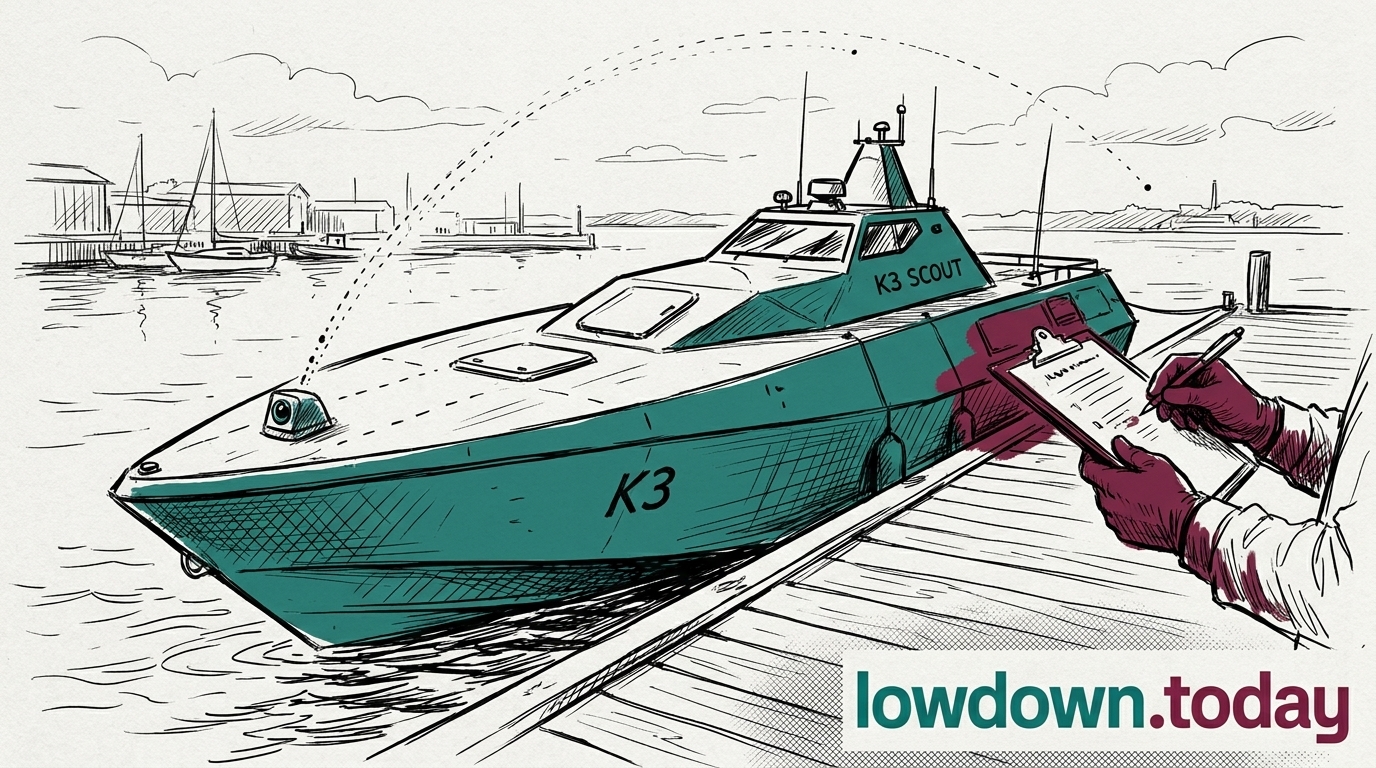
The Conservative opposition called on the Government on 9 August to 'urgently audit' equipment for hidden Chinese components, after the Telegraph's K3 SCOUT report. No named MP has been quoted on the record; the call came at party level, alongside the Ministry of Defence's own 10 August statement that no data had been compromised.
Netherlands Ministry of Defence
The Netherlands Ministry of Defence authorised Dutch Naval Design on 4 August to design 12-metre anti-submarine warfare uncrewed vessels for the Dutch-Belgian frigate programme, and to buy an adapted Compact FLASH dipping sonar from Thales Underwater Systems France. The order commits money and a named supplier while Britain's own certification body remains at the market-engagement stage.
Kraken Technology Group
Kraken Technology Group is a UK maritime-defence company based in Portsmouth that builds the K3 SCOUT, and crossed a $1bn valuation in July on a single-sourced $175m raise. The camera components reached the fleet under a third party's written security assurance, which the Platform Authority, which does not yet exist, was never positioned to check.
Navy Commercial
Navy Commercial
Navy Commercial at Whale Island published two notices on 5 August: 074032-2026, asking industry how to build a Platform Authority to certify uncrewed vessels, and 074351-2026, a GBP10m multi-role USV testbed for the Defence Chief Technology Officer. Responses on the Platform Authority close 19 August, ten days after the cameras were found transmitting to China.
Ministry of Defence
Ministry of Defence
The Ministry of Defence said on 10 August that a routine cyber vulnerability assessment found the camera fault, and a thorough investigation found no evidence that MoD data or systems had been accessed, compromised or transmitted externally. It stripped the cameras of internet connectivity but did not say whether it acted against the supplier.
Thales
Thales
Thales converted its 6 July engaging accord with Exail into a definitive combination agreement on 30-31 July, but the tender offer for Exail's remaining shares now closes by early 2028, later than July's timetable implied. Thales integrates its new undersea prime while still bidding against Kongsberg and DRASS's 2027 target for the AUKUS Pillar II contest.
