Skip to content
You can now search across every topic, entity and event.What's new
Autonomous Systems: Land & Sea
12AUG

Milrem builds THeMIS outside Estonia for Ukraine

3 min read
14:17UTC

Milrem Robotics and VDL Defentec opened a THeMIS line at Born in the Netherlands on 4 June, handing over the first of 100-plus Dutch-funded ground robots for Ukraine, the first THeMIS production beyond Estonia.

TechnologyDeveloping
Key takeaway

Milrem's first non-Estonian THeMIS line sets a cross-border surge-capacity precedent for European UGV resupply.

Milrem Robotics and its Dutch partner VDL Defentec opened a THeMIS unmanned ground vehicle (UGV) production line at Born, in the Netherlands, on about 4 June 2026, handing over the first of more than 100 units funded by the Dutch government for Ukraine 1. THeMIS, a tracked modular ground robot built by Estonia's Milrem, has operated in Ukraine since 2022. The Born plant is the first THeMIS production outside Milrem's Estonian factory, run through the company's Dutch subsidiary, and it is configured as a flexible final-assembly line built to scale capacity fast.

Ukrainian battlefield demand is pulling this geography, read here strictly as an industry leading indicator rather than a war story. That same appetite earlier pulled a fivefold production expansion from Germany's ARX Robotics ; the Born line now spreads the response across a border for the first time. A single national factory cannot deliver a 100-plus order at wartime pace, so the manufacturing answer is a second line in a second country, and that is the first confirmed cross-border dispersion of a UGV programme.

The precedent reaches past Ukraine. A modular line that can stand up quickly in an allied state is the surge-capacity model NATO ground-robot resupply has not had, and it sharpens a question hanging over the UK's institution-building: a domestic market projection is only sovereign if UK lines can match the continental surge capacity Milrem and VDL have just demonstrated, rather than buying the hardware in.

Deep Analysis

In plain English

Milrem Robotics is an Estonian company that makes the THeMIS (Tracked Hybrid Modular Infantry System), a remote-controlled tracked vehicle roughly the size of a large quad bike. THeMIS can carry a machine gun, a stretcher for casualty evacuation, a logistics load, or reconnaissance sensors. It does not carry a person; a soldier controls it from a distance. Ukraine has used THeMIS in combat since 2022. The Dutch government ordered more than 100 units for delivery to Ukraine and, instead of simply buying them from Estonia, worked with Milrem to build a second production facility in Born in the Netherlands. VDL Defentec, a Dutch defence manufacturer, operates the Born site. Moving production into a NATO member's territory with an established defence-industrial base reduces the risk that Milrem's single Tallinn factory becomes a supply chokepoint. The Born opening also demonstrates that European countries can stand up credible autonomous ground vehicle assembly lines in months rather than years.

Deep Analysis
Root Causes

Ukraine announced its intent to procure 25,000 ground robots in the first half of 2026. Milrem's Estonian factory was producing roughly 20-30 THeMIS units per year at previous rates; a single-site producer could not satisfy even a fraction of that demand. The Born line is a direct industrial response to a procurement signal whose scale exceeded single-manufacturer capacity.

European competitive pressure accelerated the decision. Germany's ARX Robotics expanded its GEREON UGV fleet fivefold for Ukraine; Turkey's Havelsan unveiled the Barkan 3 for European markets at the same time. Non-European platforms competing for Dutch and German government contracts created pressure for EU-based manufacturers to demonstrate scaling capacity visibly and quickly.

The Netherlands specifically chose Born in Limburg, a region with legacy automotive-supply-chain skills from the former DAF and VDL truck manufacturing cluster, deliberately lowering the skills-transfer cost of standing up a tracked-vehicle assembly line. Flexible final assembly in an existing precision-manufacturing region is faster than greenfield construction in a new industrial location.

What could happen next?
  • Precedent

    Born demonstrates that European governments can use procurement contract terms to mandate allied-country final assembly, establishing a template for future UGV orders where industrial resilience, not only unit cost, is a selection criterion.

    Medium term · Assessed
  • Risk

    A second production node with no published type-certificate governance framework creates a configuration-management ambiguity that could produce non-identical THeMIS variants in Dutch and Estonian production batches, complicating logistics and spare-parts interoperability for Ukraine.

    Short term · Suggested
  • Opportunity

    Other small NATO members with single-source defence-industrial capabilities, including Lithuanian laser-designator producers and Finnish explosive-ordnance-disposal robotics firms, may follow the Milrem/VDL model and seek Netherlands, Germany, or Poland-based assembly partners to scale for Ukraine demand.

    Medium term · Suggested
First Reported In

Update #2 · Britain writes the rules; AUKUS names US robots

Soldier Systems Daily· 6 Jun 2026
Read original
Different Perspectives
Conservative opposition
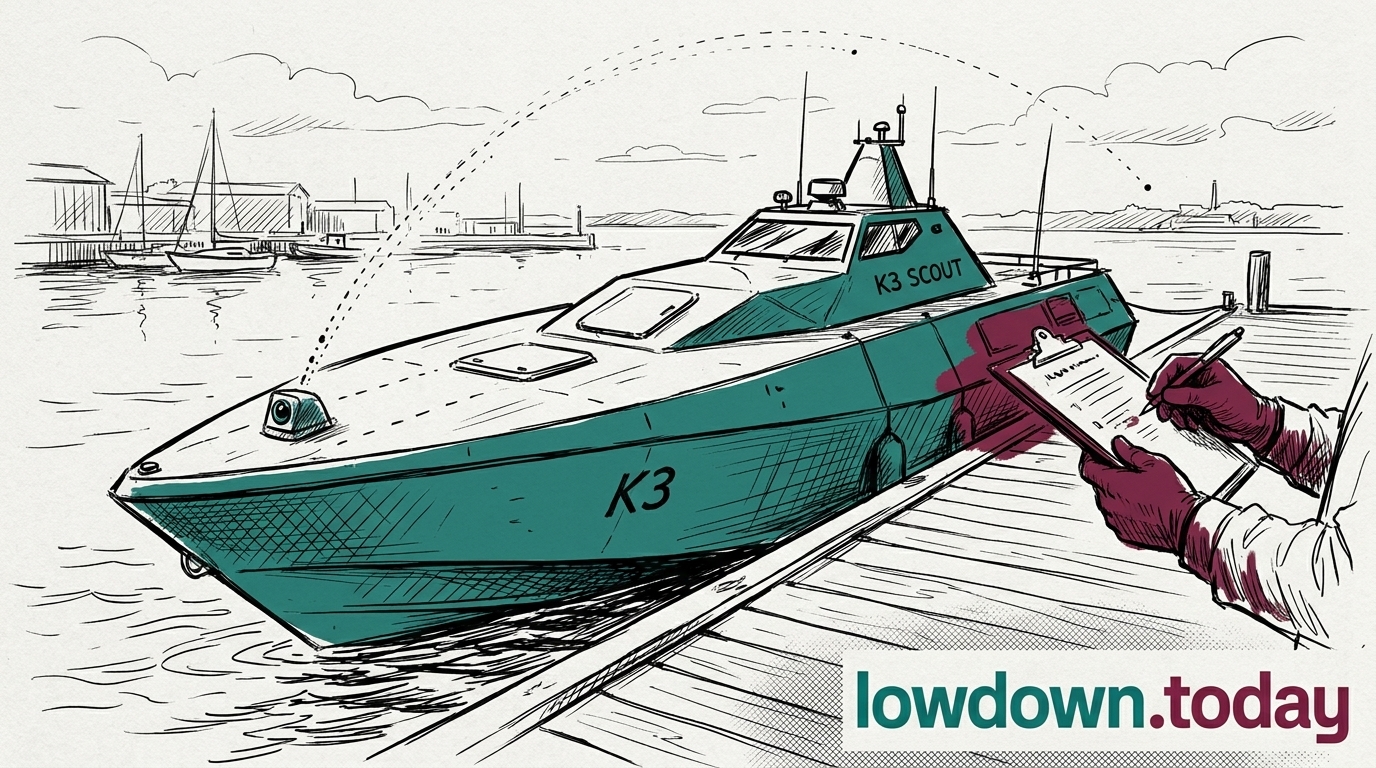
The Conservative opposition called on the Government on 9 August to 'urgently audit' equipment for hidden Chinese components, after the Telegraph's K3 SCOUT report. No named MP has been quoted on the record; the call came at party level, alongside the Ministry of Defence's own 10 August statement that no data had been compromised.
Netherlands Ministry of Defence
The Netherlands Ministry of Defence authorised Dutch Naval Design on 4 August to design 12-metre anti-submarine warfare uncrewed vessels for the Dutch-Belgian frigate programme, and to buy an adapted Compact FLASH dipping sonar from Thales Underwater Systems France. The order commits money and a named supplier while Britain's own certification body remains at the market-engagement stage.
Kraken Technology Group
Kraken Technology Group is a UK maritime-defence company based in Portsmouth that builds the K3 SCOUT, and crossed a $1bn valuation in July on a single-sourced $175m raise. The camera components reached the fleet under a third party's written security assurance, which the Platform Authority, which does not yet exist, was never positioned to check.
Navy Commercial
Navy Commercial
Navy Commercial at Whale Island published two notices on 5 August: 074032-2026, asking industry how to build a Platform Authority to certify uncrewed vessels, and 074351-2026, a GBP10m multi-role USV testbed for the Defence Chief Technology Officer. Responses on the Platform Authority close 19 August, ten days after the cameras were found transmitting to China.
Ministry of Defence
Ministry of Defence
The Ministry of Defence said on 10 August that a routine cyber vulnerability assessment found the camera fault, and a thorough investigation found no evidence that MoD data or systems had been accessed, compromised or transmitted externally. It stripped the cameras of internet connectivity but did not say whether it acted against the supplier.
Thales
Thales
Thales converted its 6 July engaging accord with Exail into a definitive combination agreement on 30-31 July, but the tender offer for Exail's remaining shares now closes by early 2028, later than July's timetable implied. Thales integrates its new undersea prime while still bidding against Kongsberg and DRASS's 2027 target for the AUKUS Pillar II contest.
