Skip to content
You can now search across every topic, entity and event.What's new
Autonomous Systems: Land & Sea
12AUG

Kremlin's Telegram Ban Backfires as War Bloggers Turn Critical

1 min read
14:17UTC

Russia's 1 April block of Telegram prompted stronger domestic backlash than the Kremlin expected, with pro-war bloggers publicly questioning whether Ukraine can ever be captured.

TechnologyAssessed
Key takeaway

Russia is dismantling its own domestic morale infrastructure by censoring the war bloggers it created to justify the war.

Russia blocked Telegram on 1 April, forcing users toward the state-controlled platform Max. The ISW assessed on 4 April that the crackdown produced harsher backlash than Moscow expected. Pro-war bloggers, who had served as nominally independent commentators reinforcing the war's justification, publicly stated that capturing Ukraine could take 100 years at the current pace.

Blocking Telegram removes the distribution infrastructure these bloggers built. Forcing migration to Max makes them officially embedded in state media, destroying the independence that gave them credibility. The backlash ISW observed is not from opponents of the war; it is from supporters who resent the loss of their preferred channel.

ISW links the censorship directly to frontline failures. Russia's spring offensive stalled against Ukraine's Fortress Belt , with daily engagements falling from 163 to 120. The bloggers who once promoted the advance are now its loudest critics. The Kremlin faces a binary choice: block them and lose the morale infrastructure, or permit them and lose the narrative.

Deep Analysis

In plain English

Russia blocked Telegram, the popular messaging app, forcing everyone to use a government-controlled alternative. But this backfired. Russian military bloggers who had been cheerleading the war for the Kremlin's benefit are now publicly saying the war could take a hundred years at this rate. The government has effectively destroyed the unofficial propaganda network it relied on to keep public support for the war high.

Deep Analysis
Root Causes

The spring offensive's stall against Ukraine's Fortress Belt — engagements falling from 163 to 120 per day — is ISW's identified proximate cause. The Kremlin's information management strategy was built on tolerating informal pro-war voices; those voices are now criticising performance rather than celebrating it.

What could happen next?
  • Consequence

    Russia loses the informal pro-war blogger network that provided credibility-by-proxy for Kremlin war narratives.

  • Risk

    Domestic information management failures compound military stalling, potentially accelerating elite dissatisfaction with war prosecution.

First Reported In

Update #11 · Russia Sells Less Oil but Earns More

Institute for the Study of War· 5 Apr 2026
Read original
Causes and effects
This Event
Kremlin's Telegram Ban Backfires as War Bloggers Turn Critical
The censorship crackdown is repressing the very voices the Kremlin built to maintain domestic war support, narrowing Russia's information management window precisely as the offensive stalls.
Different Perspectives
Conservative opposition
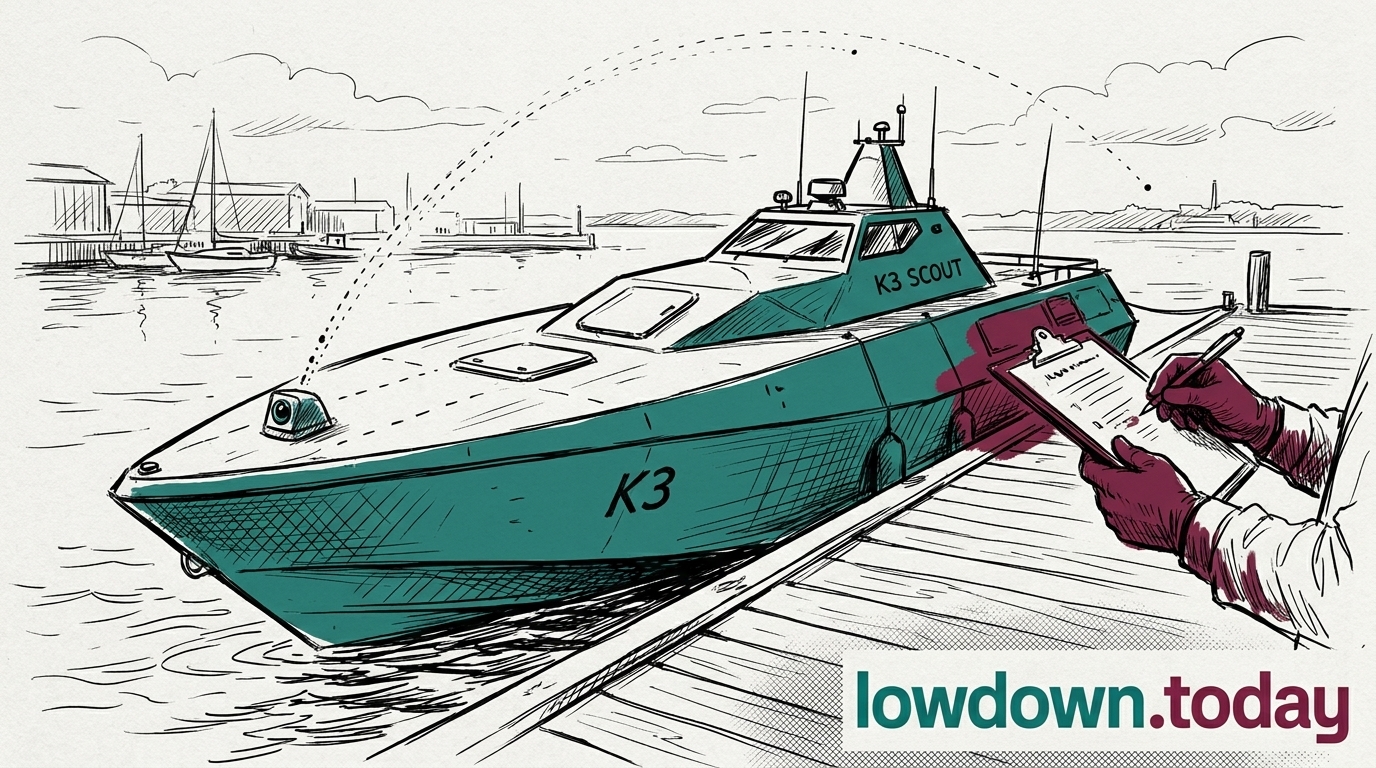
The Conservative opposition called on the Government on 9 August to 'urgently audit' equipment for hidden Chinese components, after the Telegraph's K3 SCOUT report. No named MP has been quoted on the record; the call came at party level, alongside the Ministry of Defence's own 10 August statement that no data had been compromised.
Netherlands Ministry of Defence
The Netherlands Ministry of Defence authorised Dutch Naval Design on 4 August to design 12-metre anti-submarine warfare uncrewed vessels for the Dutch-Belgian frigate programme, and to buy an adapted Compact FLASH dipping sonar from Thales Underwater Systems France. The order commits money and a named supplier while Britain's own certification body remains at the market-engagement stage.
Kraken Technology Group
Kraken Technology Group is a UK maritime-defence company based in Portsmouth that builds the K3 SCOUT, and crossed a $1bn valuation in July on a single-sourced $175m raise. The camera components reached the fleet under a third party's written security assurance, which the Platform Authority, which does not yet exist, was never positioned to check.
Navy Commercial
Navy Commercial
Navy Commercial at Whale Island published two notices on 5 August: 074032-2026, asking industry how to build a Platform Authority to certify uncrewed vessels, and 074351-2026, a GBP10m multi-role USV testbed for the Defence Chief Technology Officer. Responses on the Platform Authority close 19 August, ten days after the cameras were found transmitting to China.
Ministry of Defence
Ministry of Defence
The Ministry of Defence said on 10 August that a routine cyber vulnerability assessment found the camera fault, and a thorough investigation found no evidence that MoD data or systems had been accessed, compromised or transmitted externally. It stripped the cameras of internet connectivity but did not say whether it acted against the supplier.
Thales
Thales
Thales converted its 6 July engaging accord with Exail into a definitive combination agreement on 30-31 July, but the tender offer for Exail's remaining shares now closes by early 2028, later than July's timetable implied. Thales integrates its new undersea prime while still bidding against Kongsberg and DRASS's 2027 target for the AUKUS Pillar II contest.
