Skip to content
You can now search across every topic, entity and event.What's new
Autonomous Systems: Land & Sea
12AUG

Kongsberg sells subsea guard in secret

2 min read
14:17UTC

Kongsberg Discovery won a contract from an unnamed international customer to guard offshore platforms, subsea cables and pipelines with fused sonar, cameras and its C-Scope software, converting infrastructure-protection demand into a signed deal.

TechnologyDeveloping
Key takeaway

Commercial subsea-infrastructure protection is procuring autonomy directly, ahead of the naval-authorisation queue.

Kongsberg Discovery won a contract from an undisclosed international customer to protect offshore platforms, subsea cables, pipelines, ports and energy grids, fusing active and passive sonar, cameras and its C-Scope command software, the company said on 3 July 1. Kongsberg did not disclose the value.

Kongsberg Discovery is the subsea-sensing arm of Norway's Kongsberg group. C-Scope classifies underwater threats and can cue robots to inspect once an alert triggers; the company positions its HUGIN AUV (autonomous underwater vehicle), rated to 2,200km range and 6,000m depth, for long-duration patrol of cables and pipelines 2. The saleable core is the C-Scope fusion layer that decides when to send a robot, where the margin and the customer lock-in sit, more than the HUGIN hull itself.

Camilla Kiss, president of Kongsberg Discovery, framed the infrastructure-protection market as moving from recognising the need to implementing solutions; chief executive Eirik Lie tied the deal to protecting people and critical infrastructure 3. The refusal to name the buyer reads pointedly against the Baltic and North Sea cable-sabotage backdrop. The same seabed demand drives Kongsberg's AUKUS Pillar II bid with the Italian firm DRASS and NATO's uncrewed surveillance task force in the Greenland-Iceland-UK (GIUK) gap ; this week it took a paying commercial form, even as the liability framework for maritime autonomous systems stays unsettled .

Deep Analysis

In plain English

Kongsberg Discovery is a Norwegian company that builds sonar, cameras and underwater robots. It has won a contract, worth an undisclosed amount, from a customer it will not name, to help protect things under the sea: cables, pipelines, oil and gas platforms, ports and power grids from attack or sabotage. The system, called C-Scope, combines sonar and camera data to spot something suspicious near underwater infrastructure, and can then call in Kongsberg's own long-range underwater robot, HUGIN, to go and inspect it. This matters because it shows a company selling underwater-infrastructure protection commercially, before any government has publicly ordered a similar system for the same purpose.

Deep Analysis
Root Causes

Ownership of the assets Kongsberg is selling to protect is fragmented by design: subsea telecom cables are typically owned by consortia of private telecom operators, pipelines and platforms by energy majors, and only ports and grids sit under state control.

That fragmentation means no single procurement authority commissions subsea protection the way a navy commissions a warship, which is exactly why an unnamed commercial customer, not a government tender, is the buyer here.

What could happen next?
  • Meaning

    A commercial customer buying subsea protection today, ahead of any government mandate, suggests demand for infrastructure protection is outrunning procurement rather than following it.

    Immediate · Assessed
  • Risk

    Autonomous subsea threat-classification systems like C-Scope fall between Lloyd's Register class rules and the IMO MASS Code, and neither framework yet settles who is liable when an autonomous system misclassifies a subsea threat.

    Medium term · Suggested
  • Consequence

    Customer anonymity is itself a data point: Kongsberg's silence on who is buying subsea-cable protection lands against a live backdrop of Baltic and North Sea cable-sabotage concern.

    Immediate · Assessed
First Reported In

Update #6 · UK airdrops a robot boat; Gulf order stalls

The Telegraph· 11 Jul 2026
Read original
Different Perspectives
Conservative opposition
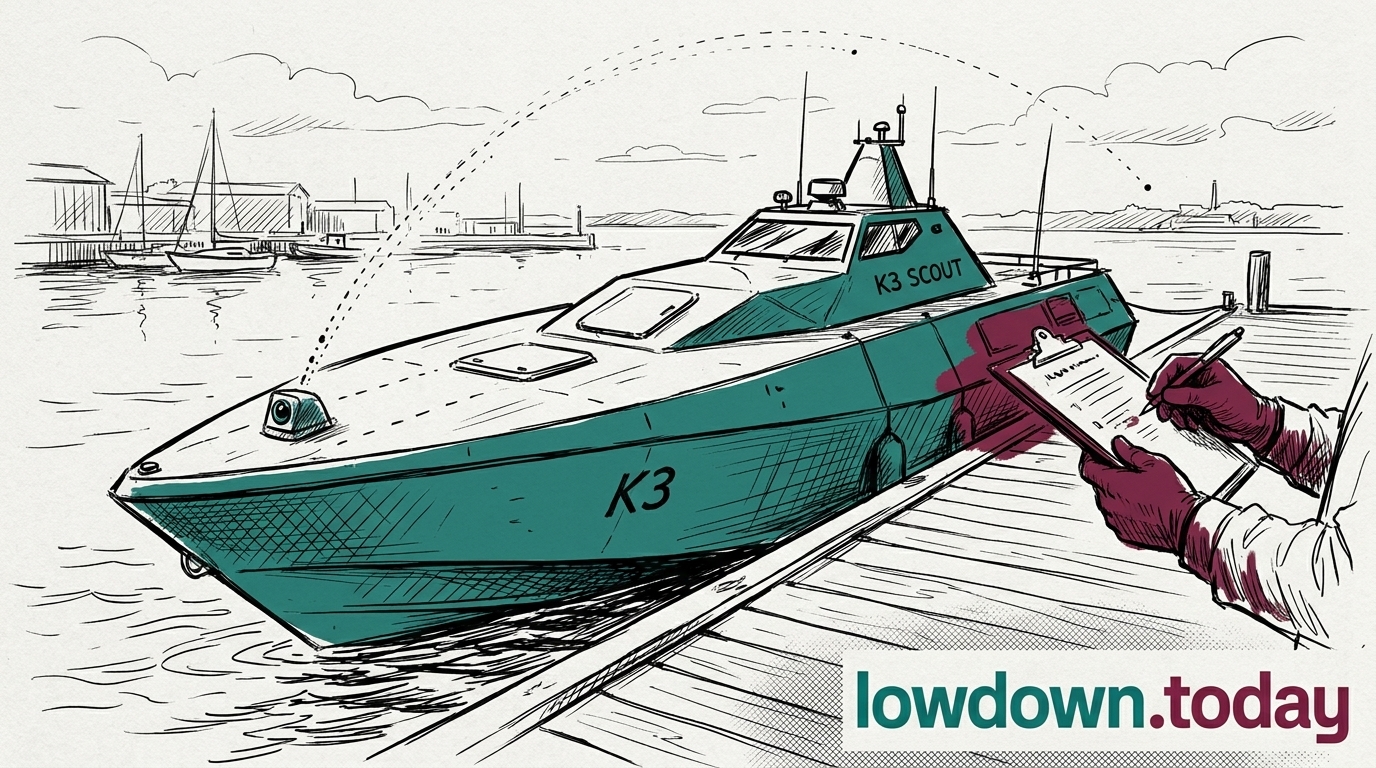
The Conservative opposition called on the Government on 9 August to 'urgently audit' equipment for hidden Chinese components, after the Telegraph's K3 SCOUT report. No named MP has been quoted on the record; the call came at party level, alongside the Ministry of Defence's own 10 August statement that no data had been compromised.
Netherlands Ministry of Defence
The Netherlands Ministry of Defence authorised Dutch Naval Design on 4 August to design 12-metre anti-submarine warfare uncrewed vessels for the Dutch-Belgian frigate programme, and to buy an adapted Compact FLASH dipping sonar from Thales Underwater Systems France. The order commits money and a named supplier while Britain's own certification body remains at the market-engagement stage.
Kraken Technology Group
Kraken Technology Group is a UK maritime-defence company based in Portsmouth that builds the K3 SCOUT, and crossed a $1bn valuation in July on a single-sourced $175m raise. The camera components reached the fleet under a third party's written security assurance, which the Platform Authority, which does not yet exist, was never positioned to check.
Navy Commercial
Navy Commercial
Navy Commercial at Whale Island published two notices on 5 August: 074032-2026, asking industry how to build a Platform Authority to certify uncrewed vessels, and 074351-2026, a GBP10m multi-role USV testbed for the Defence Chief Technology Officer. Responses on the Platform Authority close 19 August, ten days after the cameras were found transmitting to China.
Ministry of Defence
Ministry of Defence
The Ministry of Defence said on 10 August that a routine cyber vulnerability assessment found the camera fault, and a thorough investigation found no evidence that MoD data or systems had been accessed, compromised or transmitted externally. It stripped the cameras of internet connectivity but did not say whether it acted against the supplier.
Thales
Thales
Thales converted its 6 July engaging accord with Exail into a definitive combination agreement on 30-31 July, but the tender offer for Exail's remaining shares now closes by early 2028, later than July's timetable implied. Thales integrates its new undersea prime while still bidding against Kongsberg and DRASS's 2027 target for the AUKUS Pillar II contest.
