Skip to content
You can now search across every topic, entity and event.What's new
Autonomous Systems: Land & Sea
12AUG

Drone Gauntlet now judges the parts

4 min read
14:17UTC

The Pentagon's Drone Dominance Gauntlet Stage 1 closed on 20 June after testing 49 companies and 79 drones; the next round bars Chinese, Russian, Iranian and North Korean motors and batteries, enforced by physical teardown.

TechnologyDeveloping
Key takeaway

Gauntlet II's component bar makes parts provenance, not flight performance, the decisive qualifier.

The Pentagon's Drone Dominance Gauntlet Stage 1 ran 8-20 June at Camp Grayling, Michigan, testing 49 companies and 79 drones before closing on 20 June 2026 1. The Gauntlet is a Pentagon procurement competition built to qualify drone manufacturers for large-volume attritable orders, the throwaway airframes meant to be fielded in bulk. About ten vendors per mission area are expected to advance to the second round, and Ukraine's Defense Drones Tech Corp competed as a returning Phase 1 winner. An initial batch of roughly 2,000 drones was accepted on the spot.

Advancing carries a heavy demand. Each Gauntlet II finalist must field 120 drones for orders of 4,000 to 9,500 units, under price ceilings of $5,500 for long-range and $4,500 for close-quarters airframes 2. A single winning lot is therefore worth more than $40 million, and qualifying turns a prototype shop into a volume manufacturer overnight. This beat advances the stage that opened on 8 June ; the new detail is the results and the component rule attached to the next round.

The component rule decides more than flight performance does. Motors and batteries from China, Russia, Iran or North Korea are barred, enforced through bill-of-materials review and physical inspection later this summer. Many FPV assemblers built their cost advantage on Chinese motors and cells, and a drone that flies well can still fail on a teardown. The contest is moving from who builds the best drone to who can prove where every part came from, a slower and more structural reordering of the supply base than any single award.

Deep Analysis

In plain English

The Pentagon held a two-week competition at a military training base in Michigan, testing drones from 49 different companies. This was Stage 1 of the 'Drone Dominance Gauntlet', the US military's programme to buy cheap attack drones in large numbers. For the next stage, there are new rules: any drone that uses motors or batteries made in China, Russia, Iran or North Korea is disqualified. Inspectors will physically check every drone's parts. This matters because cheap Chinese components are what made it possible to build drones at the target prices the Pentagon wants. Manufacturers now have to find alternatives , and those cost more.

Deep Analysis
Root Causes

The Gauntlet II component bar addresses a structural contradiction in the Pentagon's attritable drone programme: the $4,500-$5,500 unit price targets were set assuming Chinese-sourced motors and batteries, which cost approximately 40-60% less than equivalent Western components.

Phase 1's failure to achieve full acceptance (1,040 of 2,400 Archer drones cleared, per prior reporting) was partly attributable to quality variance in Chinese-sourced components under accelerated delivery schedules. The Gauntlet II bar is thus simultaneously a national security measure and a quality-control mechanism , Chinese components under production pressure exhibited failure rates that degraded acceptance testing pass rates.

The 49 companies and 79 drones in Stage 1 also reveal a structural asymmetry: roughly 1.6 drones per company, indicating that many entrants brought a single airframe design rather than a platform family. Gauntlet II's requirement for 120 drones per qualifying company will naturally select for manufacturers with either production volume or manufacturing scalability rather than design novelty.

What could happen next?
  • Consequence

    Drone manufacturers using Chinese components at Gauntlet II price ceilings face a structural margin squeeze; those without US-aligned battery and motor supply chains will either miss the price ceiling or exit the competition.

    Immediate · Assessed
  • Opportunity

    US and allied motor and battery manufacturers face a Pentagon-mandated demand signal at scale; companies like Molicel (Canadian) and Texas Instruments' motor controller division are positioned to capture supply chain substitution orders.

    Short term · Assessed
  • Risk

    Supply chain verification that stops at tier-one finished components rather than sub-component origins replicates the known failure mode of the Pentagon's prior counterfeit electronics programme, providing compliance theatre rather than genuine security.

    Medium term · Assessed
First Reported In

Update #13 · Air Force shuts primes out of drone wingman

Inside Unmanned Systems· 25 Jun 2026
Read original
Different Perspectives
Conservative opposition
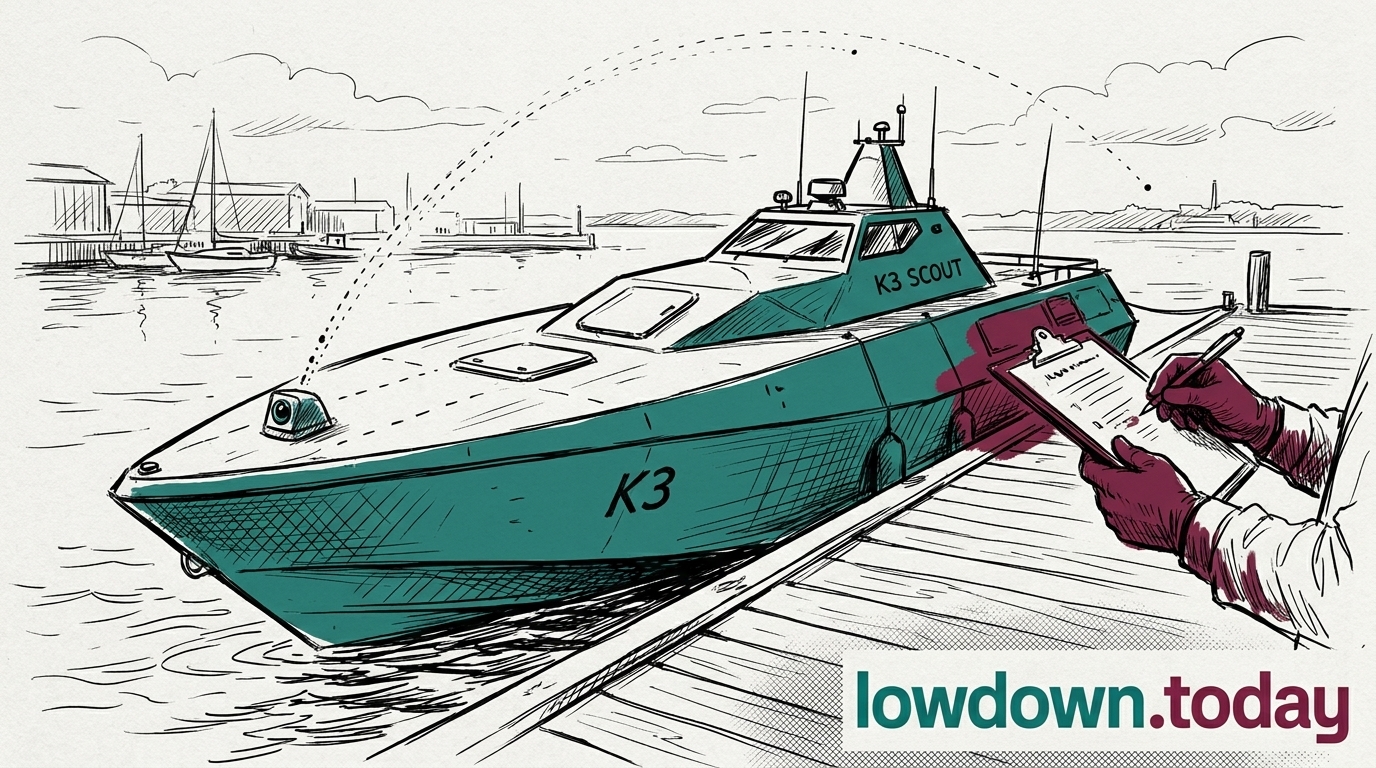
The Conservative opposition called on the Government on 9 August to 'urgently audit' equipment for hidden Chinese components, after the Telegraph's K3 SCOUT report. No named MP has been quoted on the record; the call came at party level, alongside the Ministry of Defence's own 10 August statement that no data had been compromised.
Netherlands Ministry of Defence
The Netherlands Ministry of Defence authorised Dutch Naval Design on 4 August to design 12-metre anti-submarine warfare uncrewed vessels for the Dutch-Belgian frigate programme, and to buy an adapted Compact FLASH dipping sonar from Thales Underwater Systems France. The order commits money and a named supplier while Britain's own certification body remains at the market-engagement stage.
Kraken Technology Group
Kraken Technology Group is a UK maritime-defence company based in Portsmouth that builds the K3 SCOUT, and crossed a $1bn valuation in July on a single-sourced $175m raise. The camera components reached the fleet under a third party's written security assurance, which the Platform Authority, which does not yet exist, was never positioned to check.
Navy Commercial
Navy Commercial
Navy Commercial at Whale Island published two notices on 5 August: 074032-2026, asking industry how to build a Platform Authority to certify uncrewed vessels, and 074351-2026, a GBP10m multi-role USV testbed for the Defence Chief Technology Officer. Responses on the Platform Authority close 19 August, ten days after the cameras were found transmitting to China.
Ministry of Defence
Ministry of Defence
The Ministry of Defence said on 10 August that a routine cyber vulnerability assessment found the camera fault, and a thorough investigation found no evidence that MoD data or systems had been accessed, compromised or transmitted externally. It stripped the cameras of internet connectivity but did not say whether it acted against the supplier.
Thales
Thales
Thales converted its 6 July engaging accord with Exail into a definitive combination agreement on 30-31 July, but the tender offer for Exail's remaining shares now closes by early 2028, later than July's timetable implied. Thales integrates its new undersea prime while still bidding against Kongsberg and DRASS's 2027 target for the AUKUS Pillar II contest.
