Skip to content
You can now search across every topic, entity and event.What's new
Autonomous Systems: Land & Sea
12AUG

Gauntlet II sets five-week build sprint

2 min read
14:17UTC

The Pentagon's 19 Gauntlet II finalists gather at Fort Carson, Colorado in August, each given about five weeks to build 120 lethality-payload drones, with officials expecting to order 50,000 to 60,000 more from the top performers.

TechnologyDeveloping
Key takeaway

Nineteen finalists build 120 drones each in five weeks at Fort Carson, chasing a 50,000-unit follow-on order.

The Pentagon's 19 Gauntlet II finalists will gather at Fort Carson, Colorado in August, each given about five weeks to build 120 lethality-payload drones. Gauntlet II is the US military's competitive drone build-off, run to find suppliers who can manufacture attack drones at wartime rates rather than merely demonstrate a good prototype. Fort Carson, a US Army installation, hosts the sprint that turns the contest from paper claims into hardware on a bench.

Defence officials expect to order 50,000 to 60,000 more drones from the top performers, plural. That plural is the operative word. The field was cut to 19 firms on 2 July , and spreading a 50,000-unit order across several of them rather than a single champion is the clearest operational expression of the distributed-award pattern running through the week's contracts. The buyers want many suppliers who can produce at rate, and the sprint is how they find out who actually can.

The rules carry forward from earlier stages. Gauntlet Stage 1 tested 49 companies and set a bar on Chinese-sourced motors and batteries , a supply-chain condition the Fort Carson finalists must still meet. The programme opened at Camp Grayling on 8 June , so the August sprint is the next gate in a contest designed from the start to reward manufacturing depth over a single clever design.

Deep Analysis

In plain English

The Pentagon is running a competition called Gauntlet II to find companies that can mass-produce cheap, armed drones. Out of 49 companies that originally entered, 19 finalists now have to travel to Fort Carson, an army base in Colorado, and actually build 120 of these drones in about five weeks, rather than just describe what they could build. Officials say the companies that do this well could then be asked to build 50,000 to 60,000 more. For readers, this is the US military testing suppliers by making them prove they can deliver at speed under pressure, before committing to the far bigger order that would follow.

Deep Analysis
Root Causes

The five-week Fort Carson build sprint is only reachable because of a filter the Pentagon already applied at Gauntlet II's first stage: Camp Grayling's 20 June cut from 49 to 19 finalists carried forward a requirement barring Chinese-origin components, meaning every surviving firm has already demonstrated it can source airframes and electronics without the cheaper Shenzhen-linked supply chains most commercial drone makers still depend on.

That earlier filter, not the five-week deadline itself, is what makes the sprint's 120-unit target realistic rather than aspirational.

What could happen next?
  • Meaning

    Gauntlet II's Fort Carson sprint functions as a live production audition rather than a paper evaluation, testing whether finalists can actually build at the pace a 50,000-60,000-unit order would require.

  • Consequence

    Finalists already screened for non-Chinese-origin components must now prove they can scale that supply chain under time pressure, not just source it in small volumes.

First Reported In

Update #15 · Two $500m drone deals, still no winner

The Defense Post· 14 Jul 2026
Read original
Different Perspectives
Conservative opposition
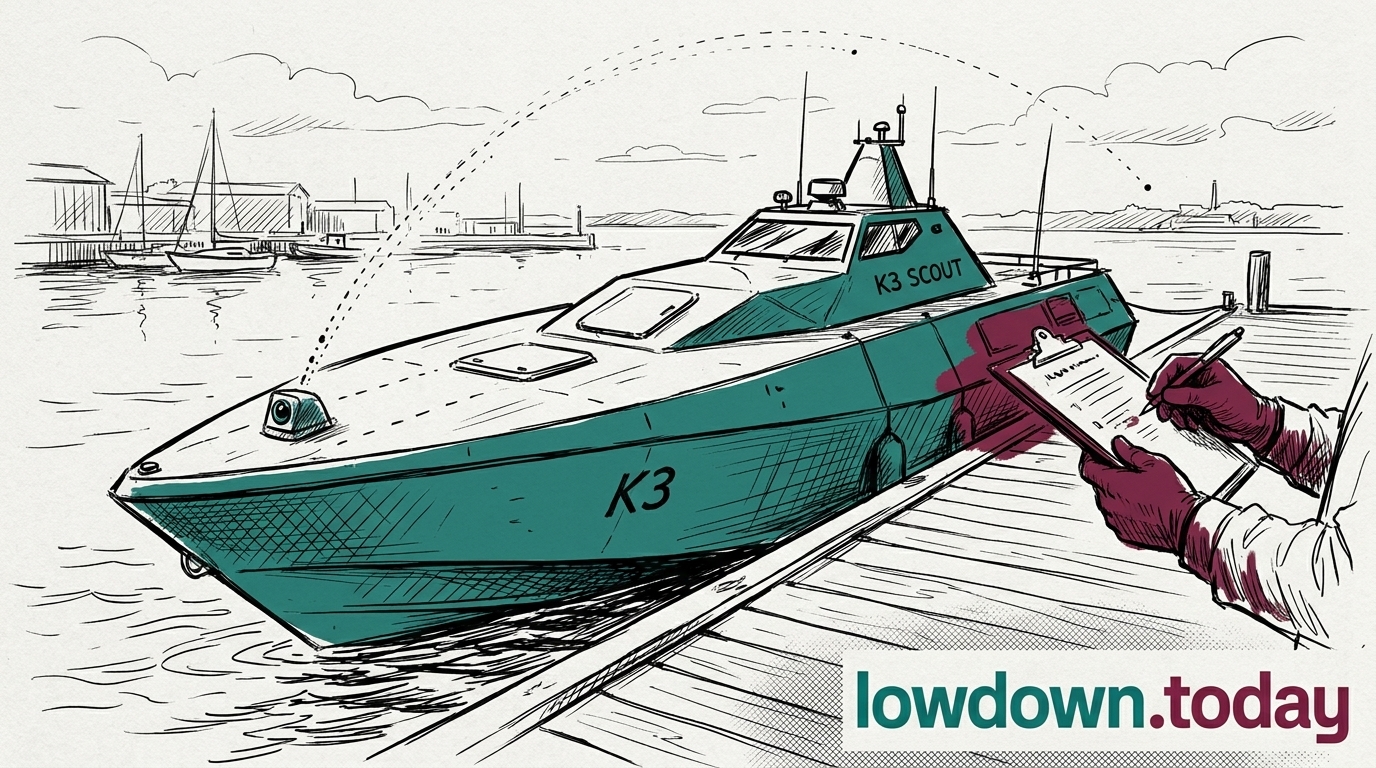
The Conservative opposition called on the Government on 9 August to 'urgently audit' equipment for hidden Chinese components, after the Telegraph's K3 SCOUT report. No named MP has been quoted on the record; the call came at party level, alongside the Ministry of Defence's own 10 August statement that no data had been compromised.
Netherlands Ministry of Defence
The Netherlands Ministry of Defence authorised Dutch Naval Design on 4 August to design 12-metre anti-submarine warfare uncrewed vessels for the Dutch-Belgian frigate programme, and to buy an adapted Compact FLASH dipping sonar from Thales Underwater Systems France. The order commits money and a named supplier while Britain's own certification body remains at the market-engagement stage.
Kraken Technology Group
Kraken Technology Group is a UK maritime-defence company based in Portsmouth that builds the K3 SCOUT, and crossed a $1bn valuation in July on a single-sourced $175m raise. The camera components reached the fleet under a third party's written security assurance, which the Platform Authority, which does not yet exist, was never positioned to check.
Navy Commercial
Navy Commercial
Navy Commercial at Whale Island published two notices on 5 August: 074032-2026, asking industry how to build a Platform Authority to certify uncrewed vessels, and 074351-2026, a GBP10m multi-role USV testbed for the Defence Chief Technology Officer. Responses on the Platform Authority close 19 August, ten days after the cameras were found transmitting to China.
Ministry of Defence
Ministry of Defence
The Ministry of Defence said on 10 August that a routine cyber vulnerability assessment found the camera fault, and a thorough investigation found no evidence that MoD data or systems had been accessed, compromised or transmitted externally. It stripped the cameras of internet connectivity but did not say whether it acted against the supplier.
Thales
Thales
Thales converted its 6 July engaging accord with Exail into a definitive combination agreement on 30-31 July, but the tender offer for Exail's remaining shares now closes by early 2028, later than July's timetable implied. Thales integrates its new undersea prime while still bidding against Kongsberg and DRASS's 2027 target for the AUKUS Pillar II contest.
