Skip to content
You can now search across every topic, entity and event.What's new
Autonomous Systems: Land & Sea
12AUG

Anduril's numbers defer profit to 2030

4 min read
14:17UTC

Anduril expects 2026 revenue near $4.3bn alongside a $1.2bn operating loss, with profitability pushed out to 2030 against a $61bn valuation set last month.

TechnologyDeveloping
Key takeaway

Anduril's $61bn valuation prices a profit path its own numbers push out to 2030.

Anduril expects 2026 revenue to roughly double to about $4.3bn, up from $2.2bn, while running an operating loss near $1.2bn, with profitability not expected until 2030 1. Anduril is the US defence-AI company behind Lattice, the command-and-control software that fuses sensors and weapons into one picture, and the $5bn raise that set its $61bn valuation closed last month . At that price the company trades on roughly 27 times current revenue, a multiple that assumes Lattice becomes the default Western counter-drone software layer and that government demand stays near-certain.

Anduril's own figures expose what the multiple rests on. A 27-times-revenue valuation on a business losing $1.2bn is not pricing today's sales; it is pricing a future monopoly on the software layer plus durable Pentagon spending. Arsenal-1, the Ohio factory, already carries more than $900m in committed spend, so Anduril is buying manufacturing capacity faster than revenue arrives. The bet is Amazon-shaped: spend now, earn the platform rents later. The demand side is real, with the Pentagon's autonomous-warfare budget line lifted to $54.6bn for the next cycle underwriting the customer base.

Both assumptions are testable, and June supplied two tests. Helsing's HX-2 clearing a US Army evaluation in Lithuania chips at the idea that Anduril is the default autonomous-strike supplier. The Pentagon's Phase 1 acceptance shortfall chips at the idea that funded demand converts cleanly into delivered units. Neither sinks the thesis on its own. Together they show the certainty the multiple needs is something the company itself is still building toward, on a profit timetable it has pushed four years out.

Deep Analysis

In plain English

Anduril is a US company that builds drone weapons and the AI software that controls them. It is not yet profitable: it expects to spend about $1.2bn more than it earns in 2026. But investors have valued it at $61bn, which is 27 times what it currently earns in revenue. That valuation assumes Anduril's AI software, called Lattice, becomes the standard system that the US military and its allies use to manage drones and counter-drone defences across all branches. If that assumption holds, the company could become extremely profitable by 2030. If rivals like Germany's Helsing win significant US contracts, or if Congress cuts the defence drone budget, the numbers look very different.

Deep Analysis
Root Causes

Anduril's loss position has two root causes that are structurally distinct from ordinary start-up losses.

First, Arsenal-1 carries more than $900m in committed capital expenditure on infrastructure that generates no revenue until production volumes reach the threshold where fixed costs per unit fall below the contract price. This is manufacturing-absorption accounting, not operating weakness: the factory must be built before the margin appears.

Anduril chose to build Arsenal-1 before winning the full contract book to fill it, a calculated bet that DoD demand would materialise faster than a build-to-order factory could respond. The $54.6bn autonomous-warfare budget line is the revenue that retroactively justifies that bet.

Second, Lattice requires continuous integration investment to remain the DoD counter-UAS default. The $87m Army IDIQ task order (the first under the $20bn vehicle) specifies Lattice as the C2 platform for counter-UAS operations across the entire Department of Defense.

Sustaining that position requires Anduril to outpace every potential competitor's software investment on each renewal cycle. The $1.2bn operating loss partially funds that competition for the software layer as well as the hardware production ramp.

What could happen next?
  • Risk

    The FY2027 $54.6bn autonomous-warfare budget request faces Congressional appropriations review. A 30-40% cut, consistent with prior large DoD innovation budget trimming, would reduce Anduril's addressable market and make the 2030 profitability target harder to reach without accelerating international sales.

    Short term · Assessed
  • Consequence

    Arsenal-1's $900m committed capital spend locks Anduril into producing at scale before revenue confirms the demand. If order volume in Phase 2 remains below 30,000 units due to acceptance-rate issues, the factory's fixed-cost absorption model fails to generate the margin the valuation assumes.

    Medium term · Assessed
  • Opportunity

    If Lattice is mandated as the DoD-wide counter-UAS command layer by 2027 following the Army IDIQ, Anduril gains a recurring software-licence income that compounds independently of hardware production, bringing the 2030 profitability target within reach even if hardware margins disappoint.

    Long term · Assessed
First Reported In

Update #12 · Pentagon's drone buy lands a third short

Yahoo Finance· 15 Jun 2026
Read original
Different Perspectives
Conservative opposition
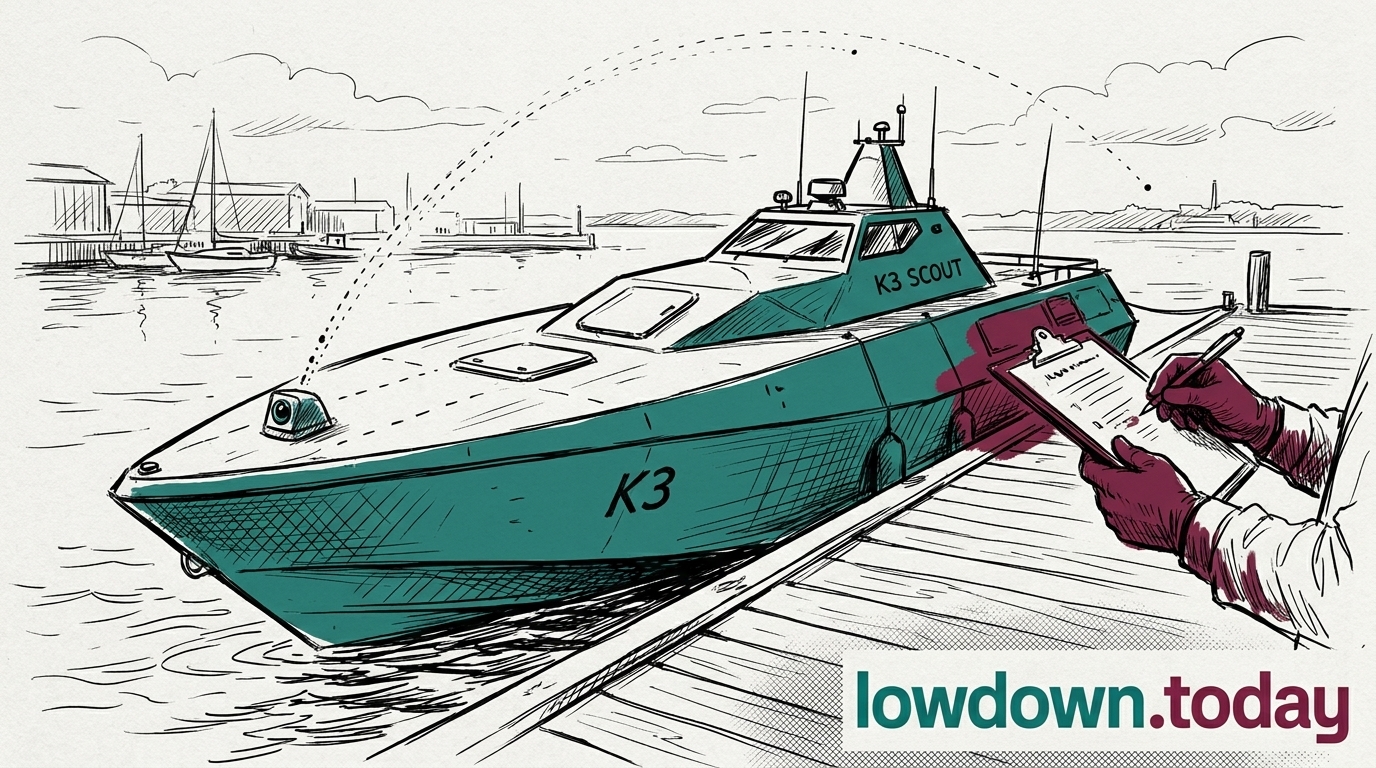
The Conservative opposition called on the Government on 9 August to 'urgently audit' equipment for hidden Chinese components, after the Telegraph's K3 SCOUT report. No named MP has been quoted on the record; the call came at party level, alongside the Ministry of Defence's own 10 August statement that no data had been compromised.
Netherlands Ministry of Defence
The Netherlands Ministry of Defence authorised Dutch Naval Design on 4 August to design 12-metre anti-submarine warfare uncrewed vessels for the Dutch-Belgian frigate programme, and to buy an adapted Compact FLASH dipping sonar from Thales Underwater Systems France. The order commits money and a named supplier while Britain's own certification body remains at the market-engagement stage.
Kraken Technology Group
Kraken Technology Group is a UK maritime-defence company based in Portsmouth that builds the K3 SCOUT, and crossed a $1bn valuation in July on a single-sourced $175m raise. The camera components reached the fleet under a third party's written security assurance, which the Platform Authority, which does not yet exist, was never positioned to check.
Navy Commercial
Navy Commercial
Navy Commercial at Whale Island published two notices on 5 August: 074032-2026, asking industry how to build a Platform Authority to certify uncrewed vessels, and 074351-2026, a GBP10m multi-role USV testbed for the Defence Chief Technology Officer. Responses on the Platform Authority close 19 August, ten days after the cameras were found transmitting to China.
Ministry of Defence
Ministry of Defence
The Ministry of Defence said on 10 August that a routine cyber vulnerability assessment found the camera fault, and a thorough investigation found no evidence that MoD data or systems had been accessed, compromised or transmitted externally. It stripped the cameras of internet connectivity but did not say whether it acted against the supplier.
Thales
Thales
Thales converted its 6 July engaging accord with Exail into a definitive combination agreement on 30-31 July, but the tender offer for Exail's remaining shares now closes by early 2028, later than July's timetable implied. Thales integrates its new undersea prime while still bidding against Kongsberg and DRASS's 2027 target for the AUKUS Pillar II contest.
