Skip to content
You can now search across every topic, entity and event.What's new
Autonomous Systems: Land & Sea
12AUG

Anduril raises USD 5B at USD 61B

3 min read
14:17UTC

Anduril Industries raised USD 5 billion in a Series H round at a USD 61 billion valuation, doubling from USD 30.5 billion approximately twelve months ago on revenue that doubled to USD 2.2 billion in 2025.

TechnologyDeveloping
Key takeaway

Anduril's 27x revenue valuation demands rapid profit growth to hold at public-market prices.

Anduril Industries raised USD 5 billion in a Series H round at a USD 61 billion valuation, doubling from approximately USD 30.5 billion twelve months prior. Revenue doubled to USD 2.2 billion in 2025, producing a 27x revenue multiple that compares with Lockheed Martin's 1.6x.

Anduril's expanding alliance presence underpins the growth narrative: the Netherlands counter-drone deal, Project NYX selection, Arsenal-1 production, and Golden Dome participation span counter-drone, collaborative combat aircraft, and space-based interceptors simultaneously. That portfolio configuration took heritage primes three decades to build; Anduril assembled it in under nine years.

The valuation demands rapid profit growth to justify at public-market multiples. A confidential S-1 filing is plausible within 12 to 18 months at this revenue trajectory. The Helsing comparison is instructive: at USD 18 billion, Helsing trades at a fraction of Anduril's multiple despite holding combat-proven status and a EUR 1.46 billion framework. The gap reflects the depth of US government contract vehicles (the USD 20 billion Lattice enterprise contract, DAWG line at USD 54.6 billion) that European defence budgets cannot yet match.

Deep Analysis

In plain English

Anduril, the US defence-tech company behind the Lattice drone-command system, raised USD 5 billion from investors who now value the company at USD 61 billion. For comparison, Lockheed Martin, which makes the F-35, is worth about USD 150 billion despite having 30 times Anduril's revenue. Investors are betting that Anduril's software approach to defence is worth much more per dollar of revenue than traditional defence companies. That bet will only be proven right if Anduril keeps growing fast enough and becomes profitable enough to justify the price tag at a stock market listing.

Deep Analysis
Root Causes

Anduril's USD 61 billion valuation reflects four structural factors: the $20 billion Lattice DoD enterprise contract creates a recurring government revenue foundation; Arsenal-1 production scale enables hardware margin at software-company growth rates.

The Golden Dome and CCA programme selections validate Anduril as a peer-tier defence prime; and the geopolitical defence spending surge from 2022 onward created a market environment where defence-tech was priced as a growth category.

What could happen next?
  • Consequence

    The USD 5 billion raise funds Anduril's European expansion (UK Project NYX, Dutch Lattice, potential Project Corvus bid) from a capital base that no European competitor can match. Helsing's USD 1.2 billion round (18x smaller) is the closest European equivalent, and even Helsing operates at a fraction of Anduril's capital deployment capacity. The capital asymmetry will widen as Anduril approaches IPO.

First Reported In

Update #10 · NATO shoots down drone over Estonia

Tekever· 29 May 2026
Read original
Causes and effects
This Event
Anduril raises USD 5B at USD 61B
At a 27x revenue multiple, Anduril's valuation reflects a bet that software-defined defence commands a technology premium over traditional primes at 1.6x; every subsequent quarter either validates or erodes that gap ahead of a probable IPO.
Different Perspectives
Conservative opposition
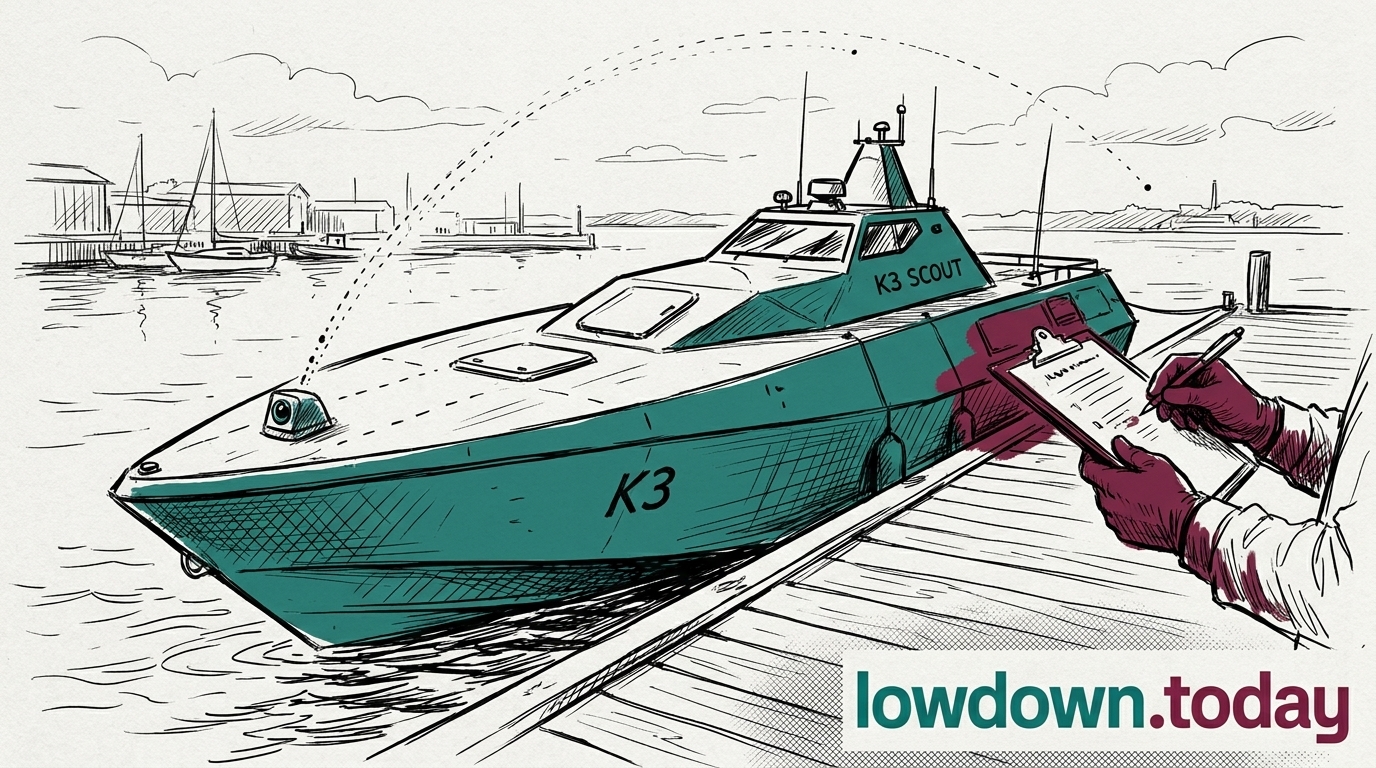
The Conservative opposition called on the Government on 9 August to 'urgently audit' equipment for hidden Chinese components, after the Telegraph's K3 SCOUT report. No named MP has been quoted on the record; the call came at party level, alongside the Ministry of Defence's own 10 August statement that no data had been compromised.
Netherlands Ministry of Defence
The Netherlands Ministry of Defence authorised Dutch Naval Design on 4 August to design 12-metre anti-submarine warfare uncrewed vessels for the Dutch-Belgian frigate programme, and to buy an adapted Compact FLASH dipping sonar from Thales Underwater Systems France. The order commits money and a named supplier while Britain's own certification body remains at the market-engagement stage.
Kraken Technology Group
Kraken Technology Group is a UK maritime-defence company based in Portsmouth that builds the K3 SCOUT, and crossed a $1bn valuation in July on a single-sourced $175m raise. The camera components reached the fleet under a third party's written security assurance, which the Platform Authority, which does not yet exist, was never positioned to check.
Navy Commercial
Navy Commercial
Navy Commercial at Whale Island published two notices on 5 August: 074032-2026, asking industry how to build a Platform Authority to certify uncrewed vessels, and 074351-2026, a GBP10m multi-role USV testbed for the Defence Chief Technology Officer. Responses on the Platform Authority close 19 August, ten days after the cameras were found transmitting to China.
Ministry of Defence
Ministry of Defence
The Ministry of Defence said on 10 August that a routine cyber vulnerability assessment found the camera fault, and a thorough investigation found no evidence that MoD data or systems had been accessed, compromised or transmitted externally. It stripped the cameras of internet connectivity but did not say whether it acted against the supplier.
Thales
Thales
Thales converted its 6 July engaging accord with Exail into a definitive combination agreement on 30-31 July, but the tender offer for Exail's remaining shares now closes by early 2028, later than July's timetable implied. Thales integrates its new undersea prime while still bidding against Kongsberg and DRASS's 2027 target for the AUKUS Pillar II contest.
