Skip to content
Welcome, thoughtbot's Giant Robots listeners!Start here
Autonomous Systems: Land & Sea
29MAY

The mothership Britain has not bought

3 min read
08:47UTC

Navy Lookout put a number on the hull the Royal Navy's mine-hunting programme needs on 11 August: at least 1,000 square metres of working deck, against the roughly 600 the existing mothership offers.

TechnologyAssessed
Key takeaway

MHC Block 2 needs 1,000 square metres of deck and has seed money, not construction money.

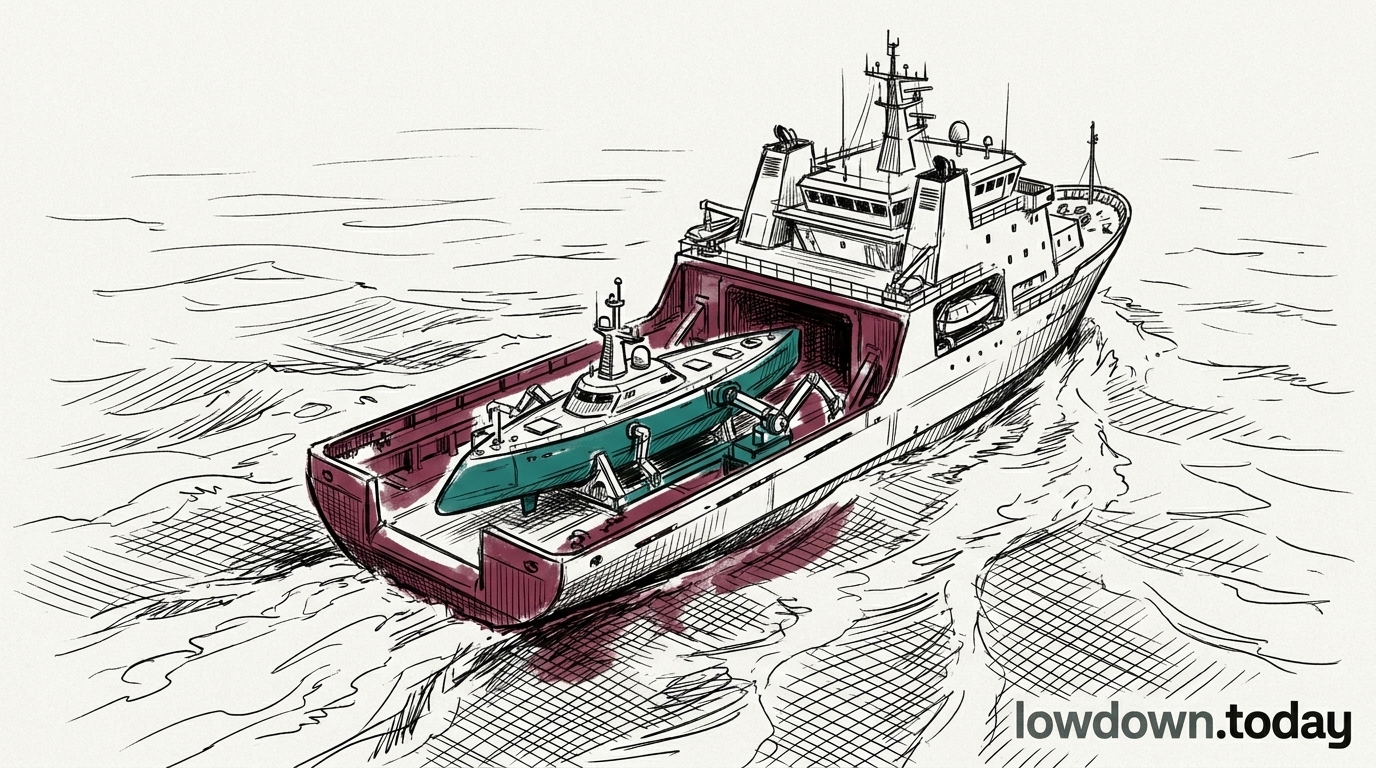
Navy Lookout published a technical read of Mine Hunting Capability (MHC) Block 2 on 11 August and set the requirement in square metres: an offshore support vessel (OSV) with at least 1,000 square metres of working deck, enough to host three or more uncrewed surface vessels, uncrewed underwater vehicles and their control gear⁠1. HMS Stirling Castle, the mothership the Royal Navy already runs, offers roughly 600. That shortfall of at least 400 square metres separates carrying one minehunting system from carrying the three the programme is built around.

The money splits awkwardly. £1.3bn sits inside June's Defence Investment Plan for MHC Block 2 across 2026 to 2030, and the £90m Britain earmarked with Norway in July buys the start of OSV development rather than any steel. Navy Lookout reads that as a minimum initial tranche, written on an assumption that larger sums follow to complete a three-vessel build once estimated at roughly £330m⁠2. Development money buys drawings. A mine countermeasures drone does not deploy without a hull to launch, recover, refuel and command it. The remaining Hunt-class minehunters must leave service by 2032, and HMS Chiddingfold already went in July after 42 years.

The hull requirement itself belongs to a Norwegian programme. Norway's parliament has approved 28 standardised vessels, 18 coastal and 10 ocean-going, built on an "as civilian as possible, as military as necessary" philosophy, and Britain formally joined under the December 2025 Lunna House Agreement⁠3. Kongsberg's Vanguard Solution family appears in the programme material as an illustration of that philosophy, not as a selected design. Buying into a 28-hull production run costs less per vessel than a bespoke British class, and is correspondingly harder to vary once joined.

The trade runs both ways. Norway chose at least five UK-built Type 26 frigates in 2025, a deal the UK government valued at around £10bn, with DE&S (Defence Equipment and Support) citing strategic offset programmes in the follow-on cooperation, meaning investment a seller nation commits to the buyer's industry as part of a defence sale⁠4. Britain has already proved the difficult part of the concept: the autonomous minehunter RNMB Ariadne docked inside RFA Lyme Bay off Gibraltar at the first attempt on 27 May, the first at-sea recovery of a crewless Royal Navy minehunter into a mothership. Recovery works. Norway's production run is where Britain now intends to buy the deck it happens on.

Deep Analysis

In plain English

The Royal Navy is replacing its old mine-hunting ships, called the Hunt-class, with a new approach: instead of one crewed ship doing everything, a mothership carries and launches small robot boats and submarines that do the actual mine-hunting. But the Navy's current mothership, HMS Stirling Castle, used to be a support ship for oil rigs, and it only has about 600 square metres of deck space. The new robot systems need at least 1,000 square metres to work properly, so Stirling Castle is too small for the job it has been given, at least until purpose-built replacements arrive.

Deep Analysis
Root Causes

HMS Stirling Castle began as an offshore support vessel, not a warship, and offshore support vessels are built to service oil and gas platforms, not to launch, recover and stow autonomous systems at the density mine-countermeasures work now requires. Converting her was quicker and cheaper than commissioning a purpose-built mothership, but the deck-space shortfall is the bill for that shortcut.

The £90m Norway development funding sits inside a roughly £330m full three-hull build estimate, which means the Royal Navy is already budgeting for purpose-built replacements while Stirling Castle is still in service. That is a tacit admission that conversion was a stopgap, not the end state, ahead of the Hunt-class's mandated exit by 2032.

What could happen next?
  • Risk

    The Hunt-class must leave service by 2032, and if the Norway-funded purpose-built hulls slip, Stirling Castle's deck-space shortfall becomes the fleet's binding constraint rather than a temporary gap.

  • Consequence

    Every uncrewed system procured for mine countermeasures now has to fit Stirling Castle's constrained deck footprint until the purpose-built hulls arrive, which shapes vehicle size choices industry-wide.

First Reported In

Update #11 · Chinese cameras in the Navy's robot boats

Navy Lookout· 12 Aug 2026
Read original →
Different Perspectives
Kongsberg
Kongsberg
Kongsberg offered Arctic Hunter, an uncrewed ship of commercial Arctic design, for Britain's Type 92 submarine-hunter requirement, Naval News reported. It puts a civil hull design forward for a Royal Navy submarine-hunting role.
Swedish Defence Materiel Administration (FMV)
FMV gave Teledyne Gavia a SEK 13.67m follow-on for portable mine-hunting robots on 19 November, with no prior call for competition. Sweden is adding to an earlier Gavia order rather than opening the buy to rivals.
Royal Netherlands Army (MatLogCo)
The Dutch tender of 23 November sets €160m aside for at least seven mine-breaching ground robots. Its stated aim is to add an uncrewed option to existing breaching kit and protect personnel, the engineers who would otherwise drive in first.
Tesla Gigafactory Berlin-Brandenburg (Andre Thierig)
The plant director announced a Cybercab building at Grünheide, with production from 2029 and a hoped-for ramp to up to 1 million a year. Tesla self-certified the car, which has no steering wheel or pedals; NHTSA has alleged no breach.
WeRide
WeRide
WeRide told US investors that more than 90% of its robotaxi revenue now comes from outside China, with about 600 cars in the Middle East. It claims "positive unit economics" in Guangzhou but discloses no cost basis for the claim.
HD Hyundai
HD Hyundai
HD Hyundai built ASV ALPHA with Anduril before any order, and Choi Tae-bok says it will enter the prototype if a US tender comes out next year. The group aims to lift its naval revenue five- to tenfold within a decade, iNews24 reports.

Written with AI from Lowdown's published reporting. Not individually reviewed by an editor. Editorial standards.