Skip to content
Briefings are running a touch slower this week while we rebuild the foundations.See roadmap
AI: Jobs, Power & Money
16APR

Goldman counts 25,000 jobs lost monthly

3 min read
13:29UTC

A bottom-up displacement model from Goldman Sachs calculates AI is eliminating three times more jobs per month than appear in any official tally.

EconomicDeveloping
Key takeaway

Announced AI layoffs undercount actual displacement by roughly three to one.

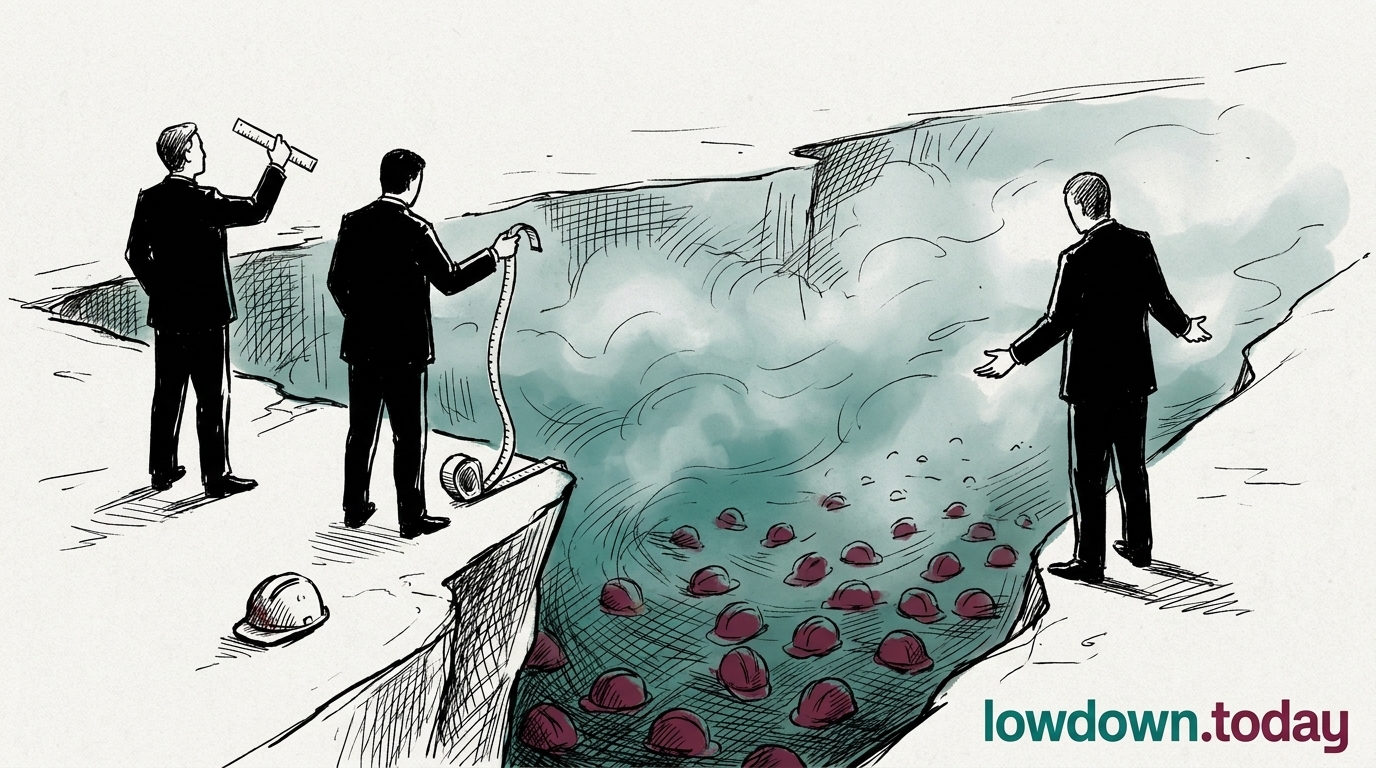
Goldman Sachs published research on 6 April calculating that AI substitutes 25,000 US jobs per month and creates roughly 9,000 through augmentation, a net loss of 16,000 positions monthly 1. Over twelve months that implies approximately 300,000 actual substitutions, against the 107,094 cumulative AI-attributed cuts that Challenger, Gray & Christmas has counted since 2023 . The gap is roughly three to one: for every job cut that appears in the public tally, Goldman's model suggests two more disappear without a press release.

Goldman's bottom-up model resolves a contradiction this topic has tracked since Update #3. The Atlanta Fed projected 502,000 AI-attributed cuts for 2026 , while the NBER found 90% of firms report zero employment impact . Goldman explains the gap: most displacement runs through attrition, contract non-renewal, and restructured job descriptions rather than announced layoffs. Workers vanish from roles that are never re-posted.

The mechanism falls hardest on entry-level positions. A study of 62 million resumes found AI-adopting firms cut entry-level postings by 15% while senior roles held flat ; the Dallas Fed confirmed the losses concentrate among workers under 25 through collapsed job-finding rates, not firing . Fortune and Columbia University research showed 75% of displaced Americans never file for unemployment insurance , meaning three quarters of the newly unemployed are invisible to the claims system policymakers depend on.

Deep Analysis

In plain English

There are two ways to count jobs lost to AI. The first is to count the announcements: when a company says publicly that it is cutting jobs because of AI. These announcements have now topped 107,000 since 2023. Goldman Sachs has tried to count the second way: how many jobs are actually disappearing through quieter means. Workers whose contracts are not renewed. Roles that are quietly restructured. Positions that open up when someone leaves and are then never re-posted. Goldman's estimate is 25,000 per month are being replaced by AI, with about 9,000 new positions created elsewhere, leaving a net loss of 16,000 every month. If Goldman is right, the announced figure of 107,000 total is roughly one-third of the real number. The other two-thirds disappear without a press release.

Deep Analysis
Root Causes

Goldman's model identifies attrition as the primary transmission mechanism: when workers leave roles that AI can perform, those positions are quietly closed rather than re-posted. Dell's annual report documented this precisely, shedding 27% of its workforce from 133,000 to 97,000 over three years through attrition and limited hiring rather than public announcements .

The measurement gap has structural causes. Challenger, Gray & Christmas counts only layoffs where companies explicitly cite AI as the reason, which is roughly 25% of total announced cuts in March 2026. Companies have legal and reputational incentives to attribute cuts to 'restructuring' or 'efficiency' rather than AI: it avoids triggering AI-specific disclosure requirements and reduces union mobilisation risk.

A Hamilton Project synthesis (2026) noted that job posting declines in AI-exposed occupations began in 2022, before ChatGPT's November 2022 release, correlating with rising interest rates. This complicates causal attribution: the attrition Goldman measures may partly reflect a rate cycle rather than pure AI substitution.

What could happen next?
  • Consequence

    If Goldman's 3:1 ratio between actual and announced displacement holds, cumulative AI-driven job losses since 2023 may already exceed 300,000, not the 107,000 in the Challenger dataset.

  • Risk

    Policy responses calibrated to the Challenger headline figure may be addressing one-third of actual displacement, leaving the majority invisible to labour market interventions.

First Reported In

Update #5 · The model they won't release

Fortune (reporting Goldman Sachs research)· 10 Apr 2026
Read original
Different Perspectives
TSMC and Taiwan chip supply chain
Nvidia's 17% headcount growth to 42,000 on $81.6 billion in quarterly revenue depends on TSMC's CoWoS advanced packaging capacity constraining H100 and B200 supply, sustaining margins above 70%. The AI build-out's sole headcount-growth story runs through a Taiwan supply chain that has no parallel in downstream software.
Displaced tech workers globally
CrowdStrike's SEC disclosure puts AI attribution on a material regulatory record for the first time, but Oracle's Massachusetts WARN clock expired unfiled after up to 14 workers were logged as remote despite office proximity. The legal apparatus cannot enforce what it cannot see: hybrid reclassification, GCC transfers, and hires never made.
UK workforce and policymakers
ONS recorded UK vacancies at 705,000, below the pre-pandemic baseline for the first time, as payrolled employment fell 210,000 year on year with real wage growth at 0.1%. The Bank of England's AI worst case assumed 500,000 additional unemployed from a baseline above 730,000; the UK is already below that floor, and ONS still publishes no AI-exposure breakdown.
India IT workforce and graduates
NASSCOM's FY2026 data shows net sector growth of 140,000, but entry-level hiring fell 20-25% as the growth concentrated in in-house GCC offices requiring mid-career specialists. Indian graduates who previously entered through TCS, Infosys and Wipro fresher programmes find that channel closing at both ends: outsourcers cutting and GCCs not hiring at the junior level.
IG Metall and European trade unions
European labour bodies see the market reward pattern, cuts on record revenue, as investor preference for short-term margin extraction over validated AI productivity. They note the EU Digital Omnibus provisional deal has dropped binding employer AI-literacy obligations at the precise moment the ILO-NASK index has quantified that 3.3% of global workers are in the highest AI exposure category.
Federal Reserve Board
Governor Cook told Stanford's SIEPR on 27 May that speculative-grade software bond spreads have widened on AI-disruption concern, moving AI displacement from a labour observation into the Fed's financial-stability mandate. The Fed cannot resolve structural labour transformation through rate policy, so Cook routed the concern through the one channel the Fed does control.
