Skip to content
Briefings are running a touch slower this week while we rebuild the foundations.See roadmap
AI: Jobs, Power & Money
10APR

The model they won't release

3 min read
16:54UTC

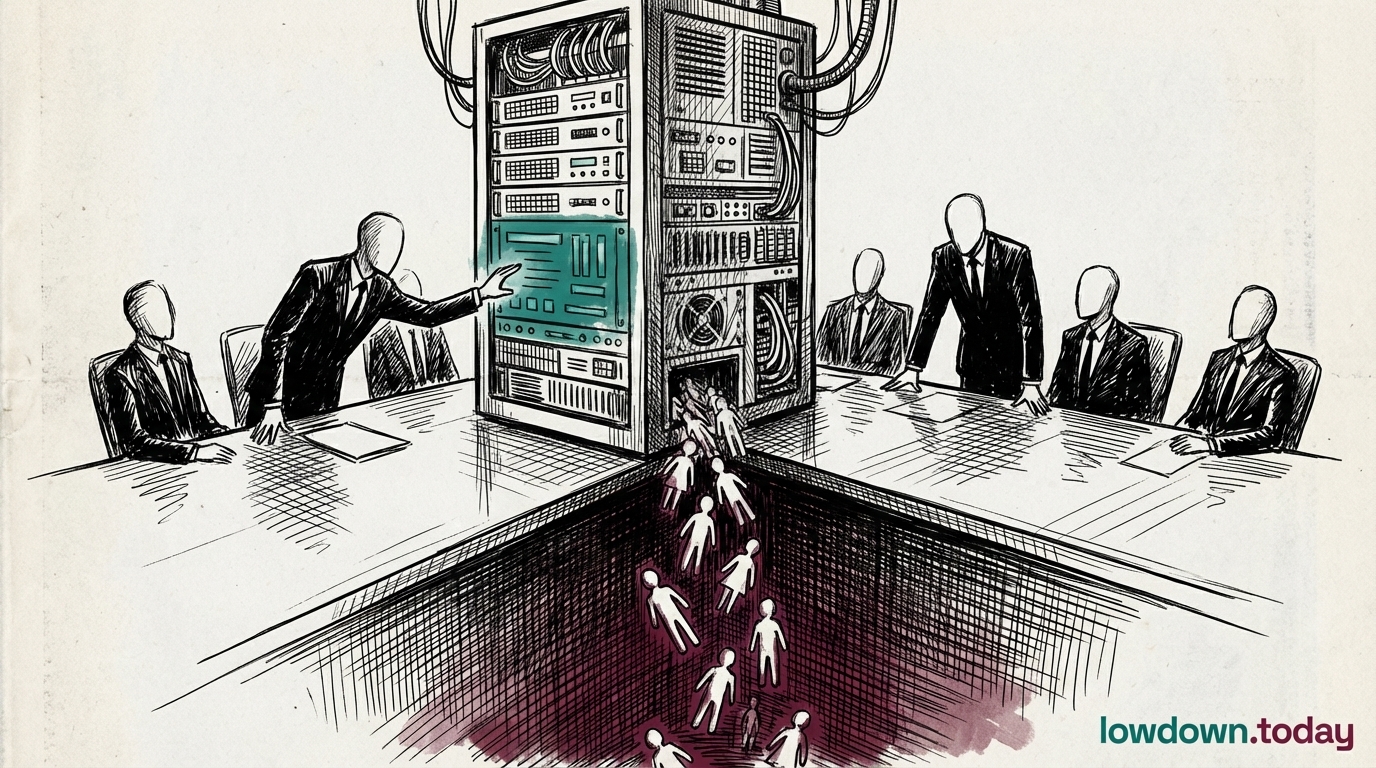
Anthropic's Claude Mythos Preview, a frontier AI model deliberately withheld from public deployment, triggered the first emergency convening of bank CEOs by the US Treasury and Federal Reserve over a single AI capability.

Key takeaway

Regulators moved in 48 hours on an AI cybersecurity threat but not three years of displacement data.

This briefing mapped
Loading map…
Regulatory
Competitive
Economic
Legal
Domestic

The first emergency meeting convened by US regulators over a single AI model's capabilities drew five Wall Street CEOs to Treasury headquarters.

Sources profile:This story draws on centre-left-leaning sources from United States
United States

Treasury Secretary Scott Bessent and Federal Reserve Chair Jerome Powell summoned the CEOs of Citigroup, Morgan Stanley, Bank of America, Wells Fargo, and Goldman Sachs to an emergency meeting at Treasury headquarters on 8 April 2026 to discuss Anthropic's Claude Mythos Preview — the first recorded instance of The Fed and Treasury convening Wall Street leadership specifically over a frontier AI system's capabilities.

Federal regulators responded to an AI capability threat within 48 hours, a speed never applied to three years of documented AI workforce displacement. 

Sources:Bloomberg
Briefing analysis

The pattern of institutional emergency response for financial stability paired with institutional inertia on workforce protection has a direct precedent. In September 2008, the US Treasury and Federal Reserve convened bank CEOs within 72 hours of Lehman Brothers' collapse, producing a $700 billion rescue package (TARP) within two weeks. The foreclosure crisis that displaced 10 million American homeowners from 2007 to 2012 produced the Home Affordable Modification Program only in March 2009, six months after the bank rescue, and ultimately reached fewer than a third of eligible borrowers.

The structural parallel is precise. Financial system instability triggers emergency federal convening with named officials, specific participants, and rapid institutional response. Household instability triggers programmes that are slower, less well-funded, and reach fewer of the affected. The Bessent-Powell meeting over Mythos follows this template: a frontier AI capability that threatens bank infrastructure produced an emergency convening within 48 hours. Three years of AI displacement crossing 100,000 attributed cuts (and likely far more) has produced bipartisan letters, proposed bills that die in committee, and data collection requests to agencies with no mandate to act.

Anthropic's most capable model scored 83.1% on vulnerability reproduction but will not be released publicly, going instead to twelve partners through a $100 million restricted programme.

Anthropic released Claude Mythos Preview exclusively to twelve partner organisations through Project Glasswing on 8 April 2026, with $100 million in model usage credits, after the model scored 83.1% on the CyberGym vulnerability reproduction benchmark versus 66.6% for Anthropic's previous top model and autonomously identified thousands of zero-day vulnerabilities including a 27-year-old OpenBSD flaw.

The first frontier AI model deliberately withheld from public deployment establishes a precedent for capability-gated release in the industry. 

Sources:Anthropic

A bottom-up displacement model from Goldman Sachs calculates AI is eliminating three times more jobs per month than appear in any official tally.

Sources profile:This story draws on mixed-leaning sources from United States
United States
LeftRight

Goldman Sachs published research on 6 April 2026 calculating that AI substitutes 25,000 US jobs per month and creates roughly 9,000 through augmentation, yielding a net loss of 16,000 positions monthly — implying approximately 300,000 actual substitutions over twelve months against the 107,094 cumulative AI-attributed cuts in the Challenger dataset.

Goldman's model is the first to quantify the gap between announced AI layoffs and actual displacement through attrition and contract non-renewal. 

Goldman's 40-year historical analysis reveals that workers displaced between 25 and 35 never fully recover their earnings trajectory.

Sources profile:This story draws on mixed-leaning sources from United States
United States
LeftRight

Goldman Sachs' 40-year historical analysis, published 6 April 2026, found that workers aged 25 to 35 displaced early in their careers face real earnings 10 percentage points lower than never-displaced peers over the following decade, with Gen Z recovering faster due to occupational mobility and AI literacy but facing widening immediate unemployment gaps.

The scarring data transforms the displacement debate from a cyclical jobs story to a generational earnings crisis concentrated on workers entering the labour market during the AI transition. 

AI led all stated reasons for US job cuts in March for the first time on record, pushing the cumulative tally past 100,000.

The cumulative count of AI-attributed US job cuts since 2023 crossed 107,094 in April 2026, with the Challenger data confirming the 100,000 threshold was breached this month — the attribution share having jumped from approximately 10% in February to 25% in March 2026.

The 100,000 threshold and the jump from 10% to 25% AI attribution in a single month mark the sharpest acceleration in the Challenger dataset since tracking began. 

Fewer than 1,100 of Oracle's up to 30,000 cut positions appear in US disclosure filings, with Massachusetts producing no filing at all.

Sources profile:This story draws on neutral-leaning sources

Oracle's WARN Act filings remained incomplete as of early April 2026: Massachusetts had no filing despite Oracle's Burlington offices, while Washington state filed 491 positions and Missouri filed 539 — meaning total US WARN filings cover less than 4% of the up-to-30,000 affected workforce, with law firms investigating potential violations.

Oracle's sparse WARN Act compliance demonstrates a template for circumventing US workforce disclosure law: concentrate cuts offshore and minimise domestic filings. 

A technical review found Anthropic's marketing relied on 198 manual reviews to support claims of thousands of severe vulnerabilities.

Sources profile:This story draws on neutral-leaning sources

Tom's Hardware published a critical review of Anthropic's Mythos claims noting that the 'thousands of zero-days' assertion rested on only 198 manual reviews and that many flagged vulnerabilities were in outdated software no longer in active use.

Independent scrutiny of Mythos's capability claims introduces uncertainty about the model's actual security impact, even as regulators acted on the headline numbers. 

Beijing is building the workforce pipeline while the US and EU debate whether to measure displacement at all.

Sources profile:This story draws on neutral-leaning sources

China's Ministry of Human Resources and Social Security recognised 42 new AI-related occupations in April 2026, each projected to require 300,000 to 500,000 workers, as the ministry prepared a dedicated AI employment policy covering 12.7 million graduates.

China's state-directed AI employment strategy, covering 12.7 million graduates, creates a structural contrast with the US and EU approaches of market-led adjustment and delayed regulation. 

Closing comments

Escalating on the capability side; stalled on the protection side. The CyberGym benchmark jump from 66.6% to 83.1% in a single model generation, combined with the Treasury-Fed emergency response, signals the AI capability curve is accelerating faster than institutional frameworks anticipated. Financial sector AI adoption growing 127% year-on-year confirms the deployment pace is matching the capability pace. On workforce protection, the trend is flat to negative. The EU delayed its binding workplace AI rules by 16 months. The Sanders-AOC moratorium was killed by the Democratic caucus. The only surviving federal action is a bipartisan data-collection letter with no enforcement mechanism. The DOL apprenticeship AI training initiative is the most concrete positive action but addresses a narrow cohort. The 55% leader-regret finding and Klarna's public reversal introduce a market correction signal that policy has not produced. If the pattern generalises, some over-correction will reverse without intervention. The Goldman scarring data suggests the workers already displaced during the correction period will carry the earnings loss regardless of whether the macro trend moderates.

Different Perspectives
US Treasury and Federal Reserve
Bessent and Powell convened five Wall Street bank CEOs within 48 hours of learning of Mythos's cybersecurity capabilities, while the same banks now hold privileged Glasswing access and Goldman simultaneously publishes data showing AI eliminates a net 16,000 US jobs per month. The regulatory urgency applied to AI capability has no parallel in three years of displacement data.
Klarna and European fintech
CEO Sebastian Siemiatkowski publicly admitted Klarna's AI customer service cuts went too far and announced rehiring under a hybrid model, the first major company to reverse an AI-driven workforce reduction and confirm what 55% of surveyed leaders already reported: the cuts were wrong.
China
China
China's Ministry of Human Resources and Social Security recognised 42 new AI occupations each requiring up to 500,000 workers, and is preparing an employment policy covering 12.7 million graduates, treating the transition as a state workforce management problem rather than a market phenomenon.
UK workers and policymakers
UK firms suffered net AI-driven job losses of 8% over the past year, double the international average despite identical productivity gains to US peers, while the OBR has modelled 500,000 additional unemployed in a worst-case scenario the Bank of England plans to stress-test in its banking assessments.
EU regulators
EU regulators
The EU voted 101 to 9 to delay AI Act workplace rules by 16 months, stripped employer AI literacy obligations from Parliament's position, and faces a final trilogue on 28 April where the binding worker rights language remains contested, leaving EU workers without enforceable protections as AI deployment accelerates.
Researchers and academic economists
The Hamilton Project and PIIE finding that entry-level hiring declines preceded ChatGPT's launch introduces a fundamental causal question: if rising interest rates drove the initial slowdown, AI is being used as ex-post cover for cuts with a different origin, complicating both the displacement count and the policy response.