Skip to content
AI: Jobs, Power & Money
16APR

Stanford: AI costs 34 hires per layoff

4 min read
13:29UTC

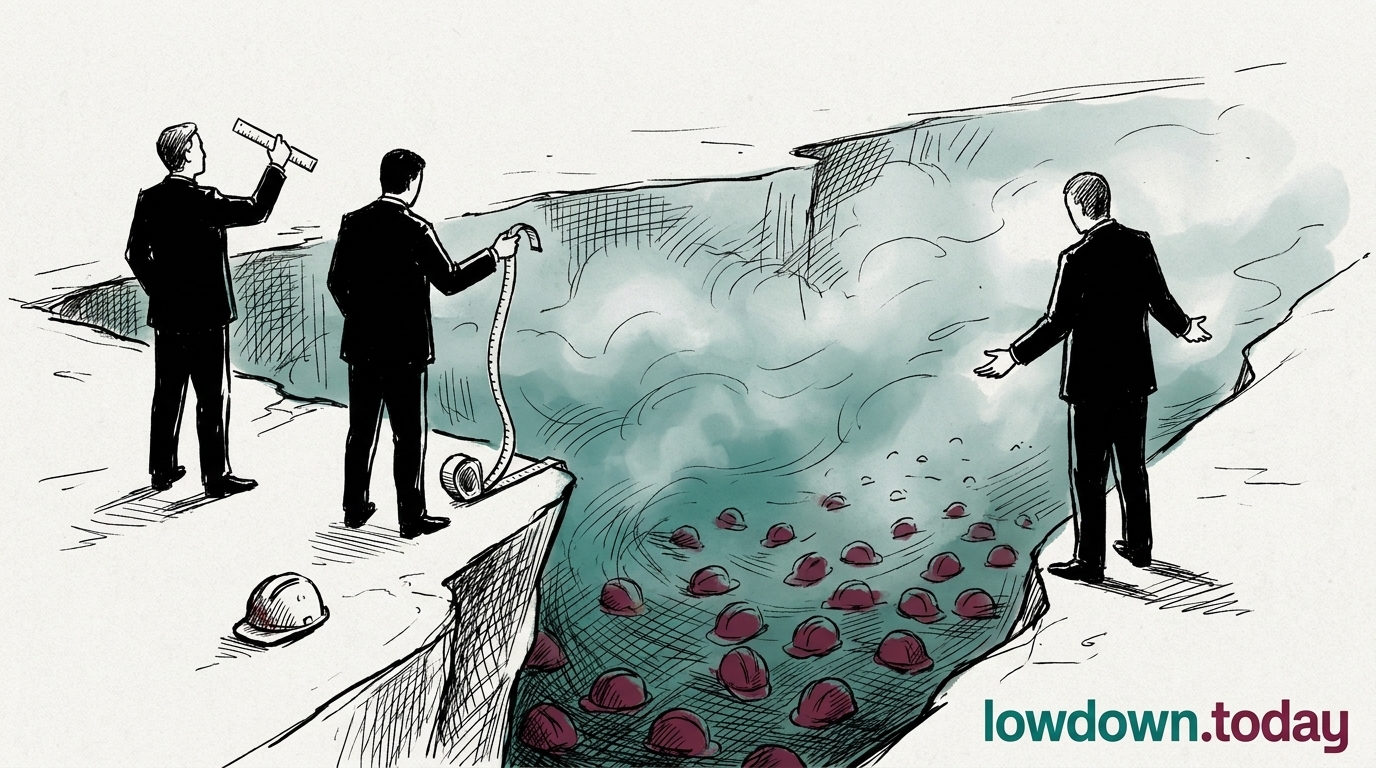
Erik Brynjolfsson's Stanford Digital Economy Lab applied the JOLTS hiring rate to the nonfarm workforce and found roughly a million annual hires are not happening. Against the declared AI layoff count, the ratio is 34 to 1.

EconomyAssessed
Key takeaway

The declared AI layoff count captures one-thirty-fourth of the real labour impact; the dominant channel is hires that never happen.

The Stanford Digital Economy Lab, led by economist Erik Brynjolfsson, published a JOLTS-based analysis on 10 April 2026 concluding that AI is preventing roughly 950,000 to 1 million American hires per year against the 2023 pace. The Job Openings and Labor Turnover Survey hiring rate fell to 3.1% in February 2026, the lowest reading since April 2020. Applied to the 158.6 million nonfarm workforce, the 0.6 percentage-point gap against the 2023 baseline produces an annualised shortfall of roughly one million hires. Against Challenger, Gray & Christmas's cumulative AI-attributed layoff tally of 27,645 through March, the ratio is approximately 34 to 1.

JOLTS is a Bureau of Labor Statistics monthly survey of job openings, hires and separations; its hiring rate measures how many workers were hired in a month as a share of total employment. Stanford's reading is that the rate has collapsed not because firms are cutting declared roles but because they are quietly choosing not to replace departing workers and not to open new entry-level requisitions. That is the channel through which most AI displacement actually runs, and it is the channel to which Washington's primary labour instrument, unemployment-insurance claims, is deliberately blind.

Workers aged 22 to 25 in AI-exposed occupations have seen 16% employment decline since late 2022, while colleagues over 30 in the same occupations are up between 6% and 12%. That age profile is the strongest evidence that AI is the mechanism rather than interest rates or cyclical slack. Young software developers sit 20% below their 2022 peak. That age asymmetry matches the SSRN large-scale resume study showing entry-level postings at AI-adopting firms fell sharply , and the Fortune/Columbia finding that most unemployed Americans never file for benefits . Goldman Sachs's own 25,000-per-month substitution model priced the unannounced displacement at roughly three times the Challenger count; Stanford moves that multiple to 34.

Announced layoffs drive the headline count that regulators and Congress respond to; Brynjolfsson's analysis argues the response has been calibrated to a number that captures one thirty-fourth of the real impact. Hires-not-made do not trigger WARN Act filings, do not register as unemployment claims, and do not appear in any official federal AI workforce dataset. They surface years later as cohort scarring, when the young workers who never entered the pipeline emerge as the mid-career shortage the 1980s manufacturing automation literature documented.

The Stanford figure is an analytical derivation rather than a direct measurement, and is sensitive to the 2023 baseline assumption; Brynjolfsson's causal inference rests on the occupation-by-age asymmetry that is hard to explain through general macro channels. Even if the true multiple turns out to be half or double Brynjolfsson's figure, the order-of-magnitude point is that the declared number on which policy has relied since 2023 is not close to describing the labour-market impact of AI deployment.

Deep Analysis

In plain English

When a company fires someone, it often announces it. When a company decides not to hire someone to fill a role, that decision is invisible. Researchers at Stanford found that AI is suppressing hiring on a massive scale (roughly 950,000 to 1,000,000 fewer people hired per year than you would expect) while only about 28,000 layoffs have been officially attributed to AI. That is a 34-to-1 gap. The people most affected are young workers, especially those in their early 20s trying to enter tech and office careers.

Deep Analysis
Root Causes

The 34-to-1 ratio between hires-not-made and declared layoffs reflects two structural asymmetries in how US labour law and corporate reporting work. WARN Act disclosure requires firms to report terminations above a threshold; it has no mechanism to require disclosure of hiring pauses or reductions. So the dominant AI displacement channel (firms freezing entry-level headcount) generates no mandatory data trail.

The second structural condition is the age concentration: workers aged 22-25 in AI-exposed occupations show a 16% employment decline since late 2022. Entry-level positions are the first cut because they are the most fungible; the tasks are well-documented, output is measurable, and replacement cost is low.

Mid-career and senior roles require contextual judgment that current models cannot reliably replicate. This means the impact accumulates at the bottom of the talent pipeline before it is visible in aggregate payroll data.

What could happen next?
  • Consequence

    The 34:1 ratio means aggregate payroll data will continue to appear healthy while the talent pipeline for knowledge-work sectors empties out, creating a mid-career shortage 5-10 years from now.

  • Risk

    Policy calibrated against declared layoff figures of ~27,000 will be undersized by a factor of 34 if Stanford's methodology is correct; retraining and safety-net spending is structurally inadequate.

First Reported In

Update #6 · Three federal surveys, one 34-to-1 gap

ProCap Insights / Stanford Digital Economy Lab· 16 Apr 2026
Read original
Different Perspectives
Oxford Economics
Oxford Economics
Concluded AI's role in recent layoffs is 'overstated,' finding companies are not replacing workers with AI at scale. Identified slowing growth, weak demand, and cost pressure as the actual drivers.
Ambrish Shah, Systematix Group
Warned AI coding tools will erode Indian IT firms' labour-arbitrage growth model by reducing enterprise dependency on large vendor teams.
South Korean government
Enacted the world's second comprehensive AI law, choosing an innovation-first framework over prescriptive employment protections — a deliberate contrast to the EU's regulatory approach.
Corporate executives executing AI-driven cuts
Frame workforce reductions as existential necessity. Crypto.com CEO Kris Marszalek and Block CEO Jack Dorsey both described AI adoption as a survival imperative, with equity markets reinforcing the message through immediate share-price gains.
Chinese government (Wang Xiaoping)
Positions AI as a job-creation engine to absorb 12.7 million annual graduates and offset 300 million retirements, directly contradicting domestic economist Cai Fang's warning that AI job destruction precedes creation.
Klarna and companies reversing AI cuts
Klarna's public reversal — rehiring the human agents it replaced with AI after customer satisfaction collapsed — validates Gartner's prediction that half of AI-driven service cuts will be undone by 2027.
