Skip to content
Briefings are running a touch slower this week while we rebuild the foundations.See roadmap
AI: Jobs, Power & Money
22MAR

Dell quietly cut 36,000 over three years

3 min read
12:34UTC

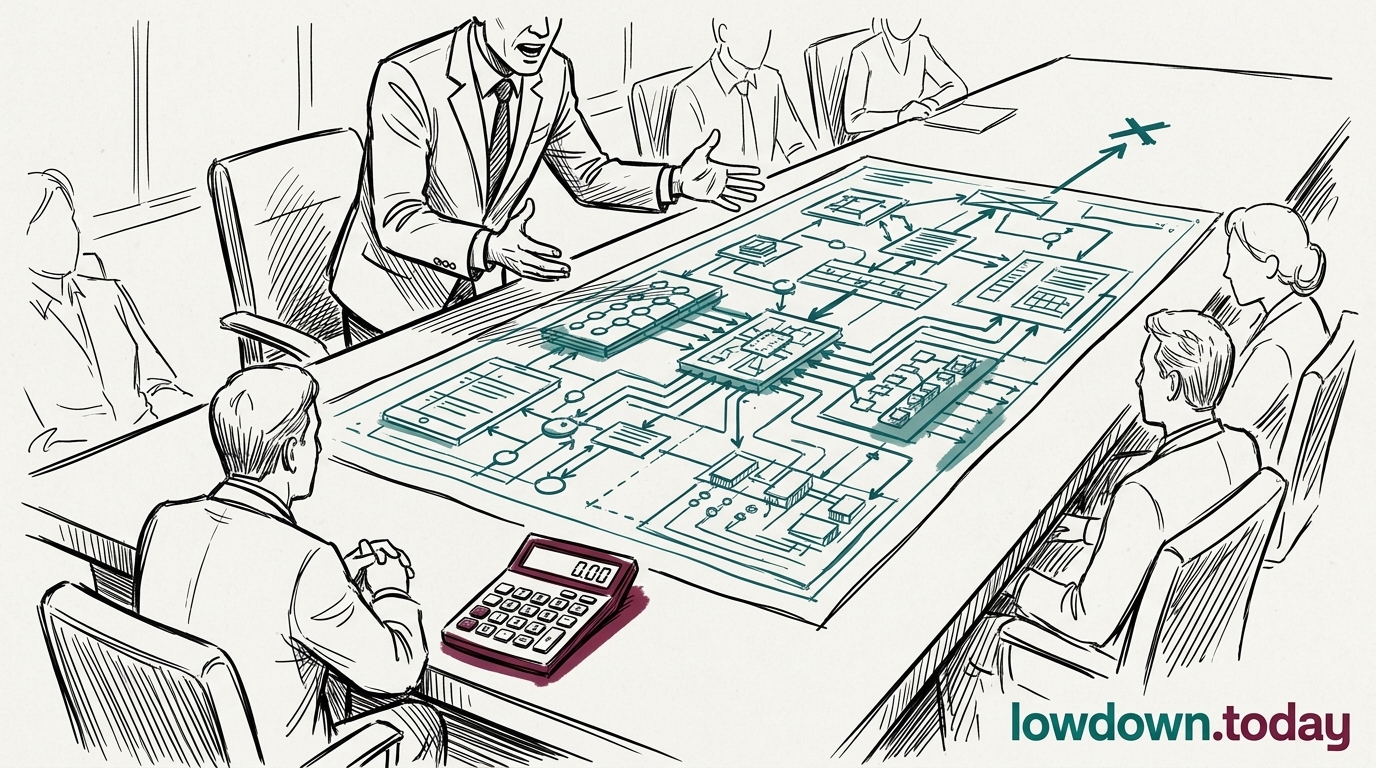
While Block and Meta made headlines with AI-justified layoffs, Dell quietly cut 27% of its workforce across three years through attrition and restructuring — spending $569 million on severance in the latest fiscal year alone.

EconomicAssessed
Key takeaway

Dell's quiet three-year attrition avoids the announcement-day backlash cycle that triggers premature rehiring.

Dell's annual report, filed in March, disclosed what three years of quarterly earnings calls had obscured: the company reduced its workforce from 133,000 to approximately 97,000 since fiscal 2023 — a net loss of roughly 36,000 positions 1. No single announcement triggered the scrutiny that Block's 40% cut attracted or the speculation around Meta's reported 20% reduction . Dell achieved comparable scale through limited hiring, internal restructuring, and natural attrition — methods that generate no headlines and no market-moving press releases.

The financial filings tell a dual story. Dell spent $569 million on severance in its latest fiscal year 2 while projecting AI-optimised server revenue of $50 billion by fiscal 2027. Dell sits on both sides of the AI labour equation: cutting positions it considers redundant while manufacturing and selling the physical infrastructure that enables automation elsewhere. It is a primary beneficiary of the $650–690 billion AI infrastructure spending wave committed to by the five largest US technology firms .

The three-year cadence — roughly 10% annually, executed without public declarations — raises the question Yale Budget Lab has framed as "AI washing" . Dell's reductions began when PC demand collapsed post-pandemic, well before most enterprise AI tools reached production deployment. Oxford Economics concluded in January that firms do not appear to be replacing workers with AI at significant scale . A company cutting 10% a year for three consecutive years looks less like technology-driven transformation than conventional restructuring that acquired an AI label as the narrative shifted.

The quiet method has a structural consequence for tracking displacement. RationalFX's Q1 2026 count of 45,363 confirmed global tech layoffs relies on public announcements and filings. Dell's cumulative 36,000 exceeds Amazon's 30,000 corporate cuts but never appeared in a single quarter's layoff tracker. The Challenger data showing 108,000 US job cuts in January captures announced reductions. attrition-based shrinkage — positions eliminated by not filling them — falls outside these mechanisms entirely. If Dell's approach becomes the template, headline figures will systematically undercount the actual pace of workforce contraction.

Deep Analysis

In plain English

Dell did not hold a press conference to announce mass redundancies. Over three years, the company simply hired fewer people and let natural turnover do the work. The result — 36,000 fewer employees — is identical to a dramatic announcement in scale, but it generated no headlines, no union mobilisation, and no share-price volatility from investor regret. The company is now betting that AI-optimised server sales will reach fifty billion dollars by 2027, which is the business model the workforce reduction is meant to fund.

Deep Analysis
Synthesis

Dell's attrition model creates a structural blind spot in aggregate displacement data. A company that stops hiring does not appear in layoff tracking figures, yet its contribution to entry-level hiring suppression is structurally identical to the mechanism the Dallas Fed documents (Event 7). If this model spreads, the Q1 AI-cited layoff statistics (Event 6) already represent a significant undercount of actual AI-driven displacement — and the policy instruments being calibrated to those figures are correspondingly misdirected.

Root Causes

Dell's hardware margins have been compressed by hyperscalers — Amazon, Microsoft, Google — building proprietary server infrastructure and custom silicon, reducing their dependence on external vendors. The AI-optimised server pivot targets the segment hyperscalers still partially outsource. Attrition rather than formal restructuring also reduces legal exposure under the US WARN Act, which requires 60 days' advance notice for layoffs affecting 50 or more workers at a single site; equivalent obligations apply in Australia and India, where 70% of cuts fell.

What could happen next?
  • Precedent

    Quiet multi-year attrition establishes a template for AI-era workforce reduction that avoids WARN Act triggers, union scrutiny, and announcement-day share-price reversal risk.

    Medium term · Assessed
  • Risk

    If Dell's AI server revenue target misses, the company has no redeployable labour reserve — reversing the Klarna pattern is structurally harder when reductions occurred through attrition rather than identifiable role categories.

    Short term · Suggested
  • Consequence

    Widespread adoption of the attrition model would systematically undercount AI-driven displacement in both layoff statistics and unemployment data, suppressing political pressure for policy response.

    Medium term · Assessed
First Reported In

Update #2 · 45,000 tech layoffs, half may be reversed

Fox Business· 22 Mar 2026
Read original
Different Perspectives
UK financial regulators (BoE FPC / FCA)
The Bank of England's April FPC directive on agentic AI in payments was scoped around one frontier model; AISI confirmed a second model cleared the same 32-step threshold on 1 May. The supervisory architecture is one model behind the capability it was built to contain.
Indian IT sector workers (TCS, Infosys, Wipro)
TCS posted its first annual revenue decline in the modern era, Infosys shed 8,400 workers in a quarter, and Wipro hit its zero-fresher target. Western Big Tech's AI automation is cannibalising the offshored-services model that employs roughly five million Indian IT workers.
Chinese workers (Hangzhou and Beijing plaintiffs)
Workers Zhou and Liu won cases that established a two-court doctrinal chain: AI adoption is the employer's deliberate strategy, placing the cost of displacement on the employer rather than the worker. Any Chinese employee facing AI-driven dismissal now has a citable legal route that American, British, and European counterparts do not.
Chinese government, courts, and domestic employers
The Hangzhou rulings were released on Workers' Day eve alongside the Ministry of Human Resources' recognition of 42 new AI occupations. Domestic firms now face mandatory retraining obligations; the Orgvue estimate of 8-14 months added to displacement timelines will feature in employer compliance briefings throughout 2026.
EU regulators and European Parliament
The second Digital Omnibus trilogue collapsed without agreement on 28 April; the third is scheduled for 13 May with the binding employer AI-literacy obligation still contested. Brussels is arguing over a non-binding encouragement clause while Beijing's courts have already bound employers.
US legislators (Warner, Rounds, Hawley, Sanders)
Warner and Rounds produced the Economy of the Future Commission Act, the most concrete federal vehicle still moving, endorsed by the companies it would notionally regulate. The Sanders-AOC moratorium was killed by Democratic senators; the Hawley-Warner disclosure bill remains in committee with no floor date.
