Skip to content
Briefings are running a touch slower this week while we rebuild the foundations.See roadmap
AI: Jobs, Power & Money
10APR

Goldman counts 25,000 jobs lost monthly

3 min read
16:54UTC

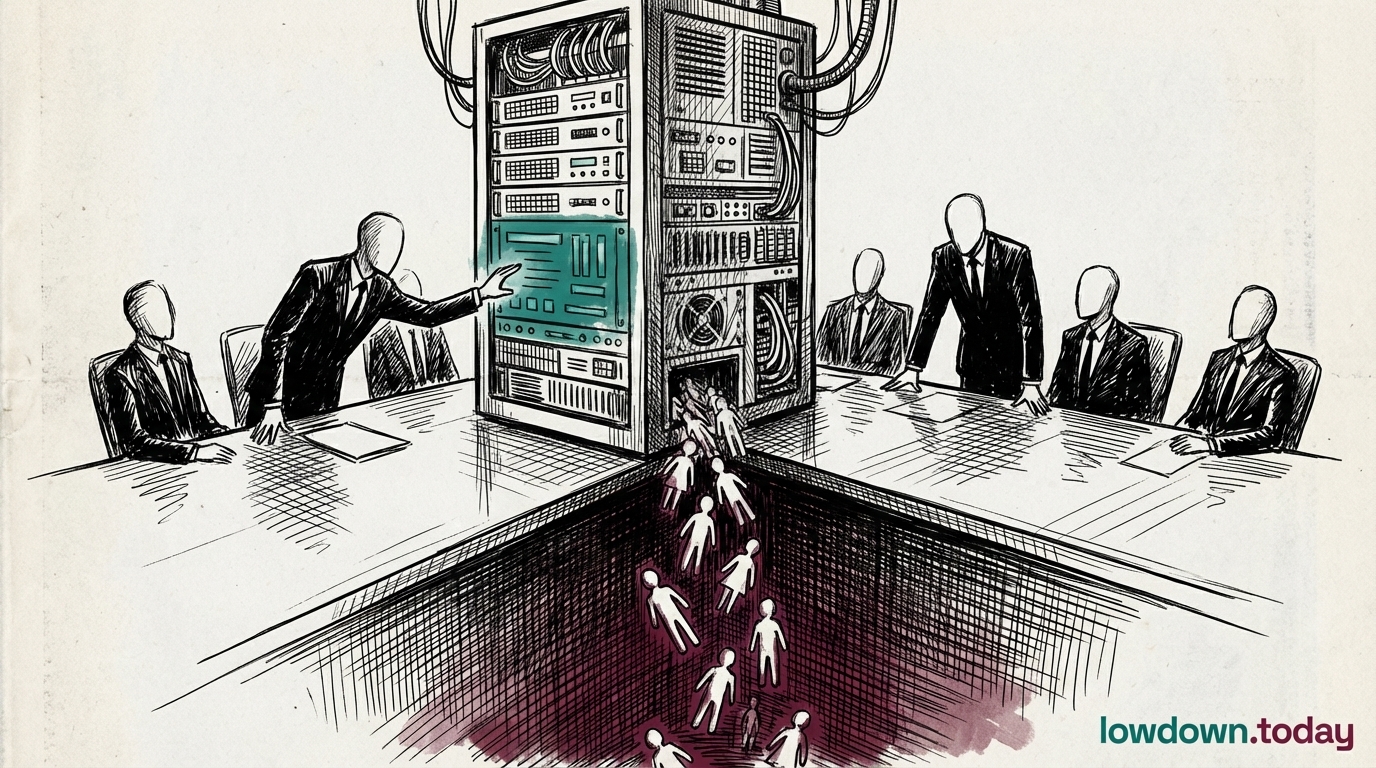
A bottom-up displacement model from Goldman Sachs calculates AI is eliminating three times more jobs per month than appear in any official tally.

EconomicDeveloping
Key takeaway

Announced AI layoffs undercount actual displacement by roughly three to one.

Goldman Sachs published research on 6 April calculating that AI substitutes 25,000 US jobs per month and creates roughly 9,000 through augmentation, a net loss of 16,000 positions monthly 1. Over twelve months that implies approximately 300,000 actual substitutions, against the 107,094 cumulative AI-attributed cuts that Challenger, Gray & Christmas has counted since 2023 . The gap is roughly three to one: for every job cut that appears in the public tally, Goldman's model suggests two more disappear without a press release.

Goldman's bottom-up model resolves a contradiction this topic has tracked since Update #3. The Atlanta Fed projected 502,000 AI-attributed cuts for 2026 , while the NBER found 90% of firms report zero employment impact . Goldman explains the gap: most displacement runs through attrition, contract non-renewal, and restructured job descriptions rather than announced layoffs. Workers vanish from roles that are never re-posted.

The mechanism falls hardest on entry-level positions. A study of 62 million resumes found AI-adopting firms cut entry-level postings by 15% while senior roles held flat ; the Dallas Fed confirmed the losses concentrate among workers under 25 through collapsed job-finding rates, not firing . Fortune and Columbia University research showed 75% of displaced Americans never file for unemployment insurance , meaning three quarters of the newly unemployed are invisible to the claims system policymakers depend on.

Deep Analysis

In plain English

There are two ways to count jobs lost to AI. The first is to count the announcements: when a company says publicly that it is cutting jobs because of AI. These announcements have now topped 107,000 since 2023. Goldman Sachs has tried to count the second way: how many jobs are actually disappearing through quieter means. Workers whose contracts are not renewed. Roles that are quietly restructured. Positions that open up when someone leaves and are then never re-posted. Goldman's estimate is 25,000 per month are being replaced by AI, with about 9,000 new positions created elsewhere, leaving a net loss of 16,000 every month. If Goldman is right, the announced figure of 107,000 total is roughly one-third of the real number. The other two-thirds disappear without a press release.

Deep Analysis
Root Causes

Goldman's model identifies attrition as the primary transmission mechanism: when workers leave roles that AI can perform, those positions are quietly closed rather than re-posted. Dell's annual report documented this precisely, shedding 27% of its workforce from 133,000 to 97,000 over three years through attrition and limited hiring rather than public announcements .

The measurement gap has structural causes. Challenger, Gray & Christmas counts only layoffs where companies explicitly cite AI as the reason, which is roughly 25% of total announced cuts in March 2026. Companies have legal and reputational incentives to attribute cuts to 'restructuring' or 'efficiency' rather than AI: it avoids triggering AI-specific disclosure requirements and reduces union mobilisation risk.

A Hamilton Project synthesis (2026) noted that job posting declines in AI-exposed occupations began in 2022, before ChatGPT's November 2022 release, correlating with rising interest rates. This complicates causal attribution: the attrition Goldman measures may partly reflect a rate cycle rather than pure AI substitution.

What could happen next?
  • Consequence

    If Goldman's 3:1 ratio between actual and announced displacement holds, cumulative AI-driven job losses since 2023 may already exceed 300,000, not the 107,000 in the Challenger dataset.

  • Risk

    Policy responses calibrated to the Challenger headline figure may be addressing one-third of actual displacement, leaving the majority invisible to labour market interventions.

First Reported In

Update #5 · The model they won't release

Fortune (reporting Goldman Sachs research)· 10 Apr 2026
Read original
Different Perspectives
Directors Guild of America
The DGA opened AMPTP talks on 12 May seeking AI training-use royalties that SAG-AFTRA and the WGA both settled without winning. France's SACD and European creative unions watch the DGA outcome as the US template for their own pending AI-training royalty negotiations with streaming platforms.
German IG Metall and European trade unions
German unions led by IG Metall have pushed for binding co-determination rights on AI deployment since 2024; the Digital Omnibus literacy-duty weakening directly undercuts their model, which depends on a statutory information floor before works councils can challenge AI systems affecting members.
Chinese Ministry of Human Resources (MOHRSS)
China's MOHRSS recognised 42 new AI occupations in April 2026 while Hangzhou courts upheld bans on AI-driven dismissal without retraining under the Labour Contract Law. Beijing's regulatory posture contrasts directly with Colorado's retreat: Chinese courts are adding employment liability for AI-driven redundancy while US courts remove state-level AI worker protection.
UK workers and Bank of England
The ONS May 2026 bulletin showed payrolled employment down 210,000 year on year with no AI-specific breakdown, while the Bank of England's stress scenario used 500,000 additional unemployed as its AI-displacement worst case. UK workers are approaching that threshold through a dataset that cannot name its own cause.
India's IT sector workforce and NASSCOM
NASSCOM's FY2026 data shows India's sector at 5.9 million while entry-level hiring fell 20 to 25%. GCC expansion by JPMorgan, Goldman Sachs and Apple benefits mid-career workers while closing the graduate entry pathway, replicating the under-25 displacement the NY Fed documented in US AI-exposed occupations.
European Parliament and Council (Digital Omnibus)
The Digital Omnibus trilogue concession on AI-literacy duties reflects the Draghi report's argument that compliance overhead suppresses EU AI adoption. The Council traded the binding literacy mechanism for employer flexibility, leaving the December 2027 high-risk employment deadline without the worker-facing transparency layer Parliament had built around it.
