Skip to content
You can now search across every topic, entity and event.What's new
AI: Jobs, Power & Money
27JUL

AI job losses concentrate in under-25s

4 min read
10:02UTC

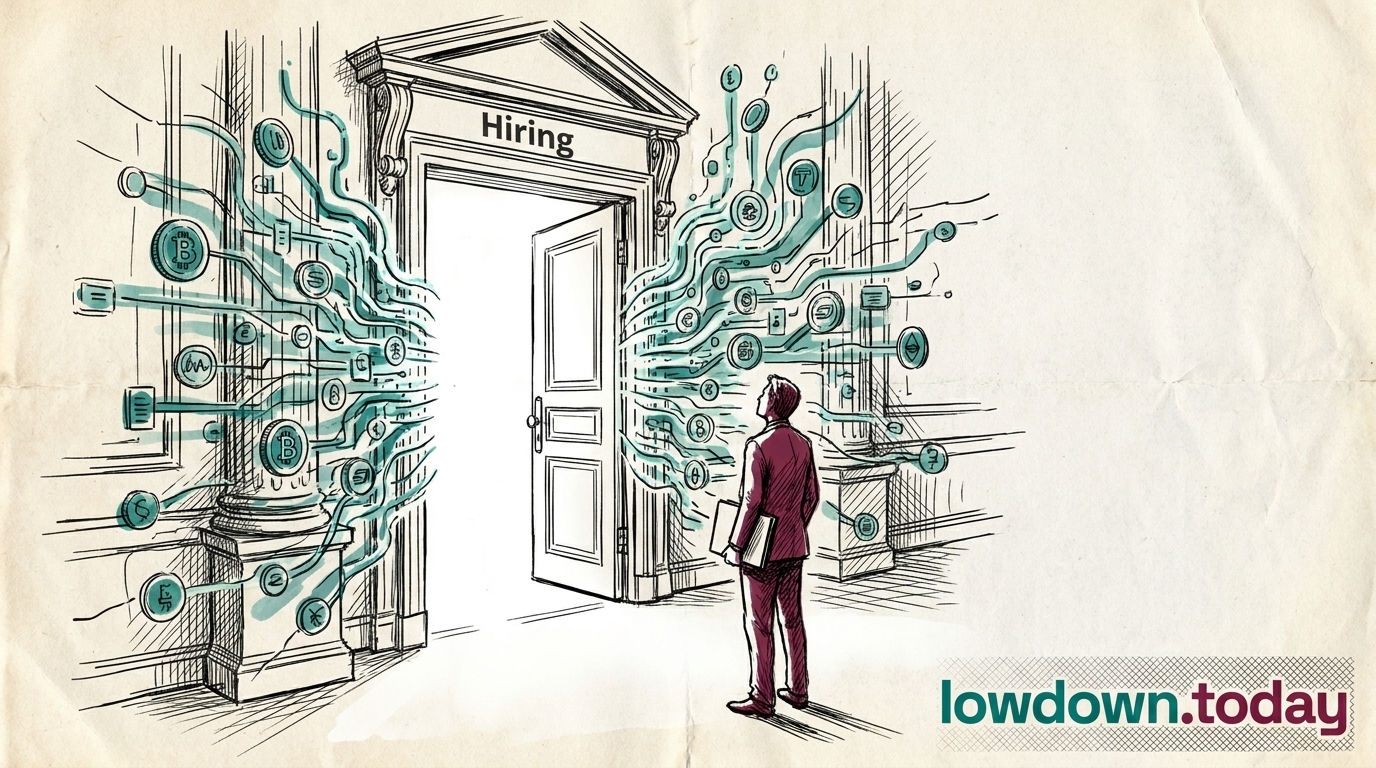
The Federal Reserve Bank of Dallas finds the jobs vanishing from AI-exposed industries belong overwhelmingly to workers who never held them — entry-level positions that simply stopped being posted.

EconomicAssessed
Key takeaway

AI is eliminating the career ladder's bottom rung through hiring suppression, making youth displacement statistically invisible.

The Federal Reserve Bank of Dallas found employment down approximately 1% in the top 10% of AI-exposed industries while the broader economy continued to add jobs 1. The decline landed mostly on workers younger than 25. The mechanism is not mass termination but collapsed job-finding rates — positions that stopped being advertised rather than workers who were dismissed.

A separate Dallas Fed paper provides the structural explanation 2. It distinguishes between "codified knowledge" — textbook procedures, the kind of work that can be documented and therefore automated — and "tacit knowledge", the hands-on expertise built through years of practice that AI cannot readily replicate. Entry-level workers possess mostly the former. Returns to experience are rising in AI-exposed occupations: seasoned workers are gaining pay rises in the same sectors where doors are closing for new entrants.

The pattern has independent corroboration from multiple directions. Year-to-date hiring fell 56% compared with the same period in 2025 , with UBS chief economist Arend Kapteyn attributing record-low white-collar turnover partly to "AI fear." Nonfarm payrolls dropped by 92,000 in February against a consensus estimate of +50,000 . Anthropic's own research, by Maxim Massenkoff and Peter McCrory, found no systematic unemployment increase among heavily exposed occupations since late 2022 but identified "suggestive evidence" of slowing hiring of younger workers 3 — a finding the Dallas Fed data NOW independently confirms. ServiceNow CEO Bill McDermott's projection that college graduate unemployment could reach the "mid-30s" within a couple of years 4 may be hyperbolic, but the directional trend in the Dallas Fed's data does not contradict the underlying concern.

The long-term risk is structural. If companies stop bringing in junior workers, the pipeline that produces the experienced professionals AI currently complements dries up within a generation. The labour market is not shedding workers in a visible, politically legible way — it is quietly narrowing the entrance. Aggregate employment figures do not register a crisis that is happening in who gets hired rather than who gets fired, which means the policy responses NOW taking shape in Washington — the Warner-Rounds commission , Sanders's proposed robot tax, California's SB 951 — are calibrated to displacement through firing, not displacement through the slow closure of the entry-level door. The Dallas Fed's data suggests the actual mechanism may already be outrunning the policy framework designed to address it.

Deep Analysis

In plain English

Economists at the Dallas Federal Reserve studied industries most exposed to AI — software development, financial services, data analysis, office administration. They found that overall employment in those sectors fell roughly 1% even while the broader economy was adding jobs. But companies were not firing people in large numbers. Instead, they simply stopped hiring young workers. Graduates and under-25s could not get their foot in the door. This matters because it will not appear in standard unemployment figures — those workers are not classified as unemployed, they are simply not yet employed.

Deep Analysis
Synthesis

The 'collapsed job-finding rate' mechanism is the most fiscally dangerous form of AI displacement: it generates no unemployment claims, no severance costs, no union triggers, and no identifiable individual stories for press coverage. It is systematically invisible to every standard labour metric. Connected to the Brookings finding that approximately 75% of federal tax revenue derives from labour taxation (Event 17), quiet youth hiring suppression represents a slow fiscal haemorrhage with no political alarm mechanism — the deficit impact will only become measurable after cohort scarring is already advanced and partially irreversible.

Root Causes

Large language models are most capable at precisely the tasks historically assigned to entry-level workers: drafting, summarising, basic research synthesis, data entry, and routine analysis. Prior automation waves displaced specific tasks but created adjacent entry-level roles requiring new skills. LLMs remove the training function of junior roles — the mechanism through which tacit knowledge and professional judgement are acquired — not merely the labour cost. This structurally distinguishes the current wave from every prior automation event on which long-run optimism about job creation is empirically based.

What could happen next?
  • Consequence

    Youth hiring suppression will not appear in headline unemployment data for years, systematically reducing political urgency until cohort scarring has compounded to the point of irreversibility.

    Medium term · Assessed
  • Risk

    If the Japan 'employment ice age' parallel holds, the current under-25 cohort faces permanently lower lifetime earnings and elevated welfare dependency regardless of subsequent macroeconomic recovery.

    Long term · Suggested
  • Meaning

    The 'not-hiring' mechanism severs the entry-level training function through which tacit knowledge is acquired — the very knowledge Dallas Fed identifies as AI-resistant — creating a self-reinforcing cycle of reduced human capability in AI-exposed sectors.

    Medium term · Assessed
  • Risk

    Suppressed entry-level hiring reduces payroll tax receipts without generating unemployment claims, creating a fiscal gap that is invisible to standard budget forecasting models and incompatible with the Brookings labour-tax-dependency analysis.

    Short term · Suggested
First Reported In

Update #2 · 45,000 tech layoffs, half may be reversed

Federal Reserve Bank of Dallas· 22 Mar 2026
Read original
Causes and effects
This Event
AI job losses concentrate in under-25s
The Dallas Fed isolates a displacement mechanism invisible in aggregate statistics — entry-level positions vanishing from AI-exposed industries through hiring freezes rather than terminations. If sustained, this closes the pipeline that produces the experienced workers AI currently complements.
Different Perspectives
European Commission
European Commission
The European Commission's draft Annex III guidelines, closed for comment on 23 July, treat algorithmic scoring in recruitment, pay and termination as high-risk regardless of whether a human signs off, echoing Spain's Audiencia Nacional ruling 101/2026 on concealed scheduling algorithms. Brussels is shifting the fight from counting AI job losses to assigning legal liability for the tools themselves.
Office for National Statistics
The Office for National Statistics recorded UK vacancies rising to 712,000 on 21 July, the first quarterly increase this beat has tracked, with payrolled employment down 85,000 on the year against May's 210,000 fall. The bulletin names no AI cause anywhere, and that is the point: nothing in the release confirms the displacement story it gets cited to support.
Christian Klein, SAP
Christian Klein told investors on 23 July that SAP's research headcount will not grow for twelve months because AI agents and their token costs are absorbing the work, not because SAP is cutting jobs. He frames it as commercial arithmetic: the cost of AI-assisted coding tokens plus the salaries specialist AI hires command, not people being replaced by machines.
Betsey Stevenson, University of Michigan
Betsey Stevenson argued that the 187,000 jobless-claims reading describes a market that hires little and fires little, not one AI is emptying. She said the real damage hides in eligibility rules and suppressed job postings, not in the headline layoff counts employers keep denying.
Comisiones Obreras, UGT and Concentrix's A Coruña works committee
Comisiones Obreras, UGT and Concentrix's A Coruña works committee blamed Microsoft's push toward AI self-service for the 80 redundancies unions signed off on 22 July, not unavoidable business cause. A second Coruña procedure covering 80 more jobs runs to a 31 August deadline, and the unions want the state, not the employer, setting the pace of AI-driven cuts.
Stanford's 'We Must Act Now' signatories
More than 200 academics, including 16 Nobel laureates, published a 13 July letter warning of AI-driven labour disruption, citing Daron Acemoglu's NBER estimate that AI's total factor productivity gain stays under 0.66% over ten years. The letter's own cited economics sit well below Goldman Sachs Research's 1.5-percentage-point estimate published the same week.