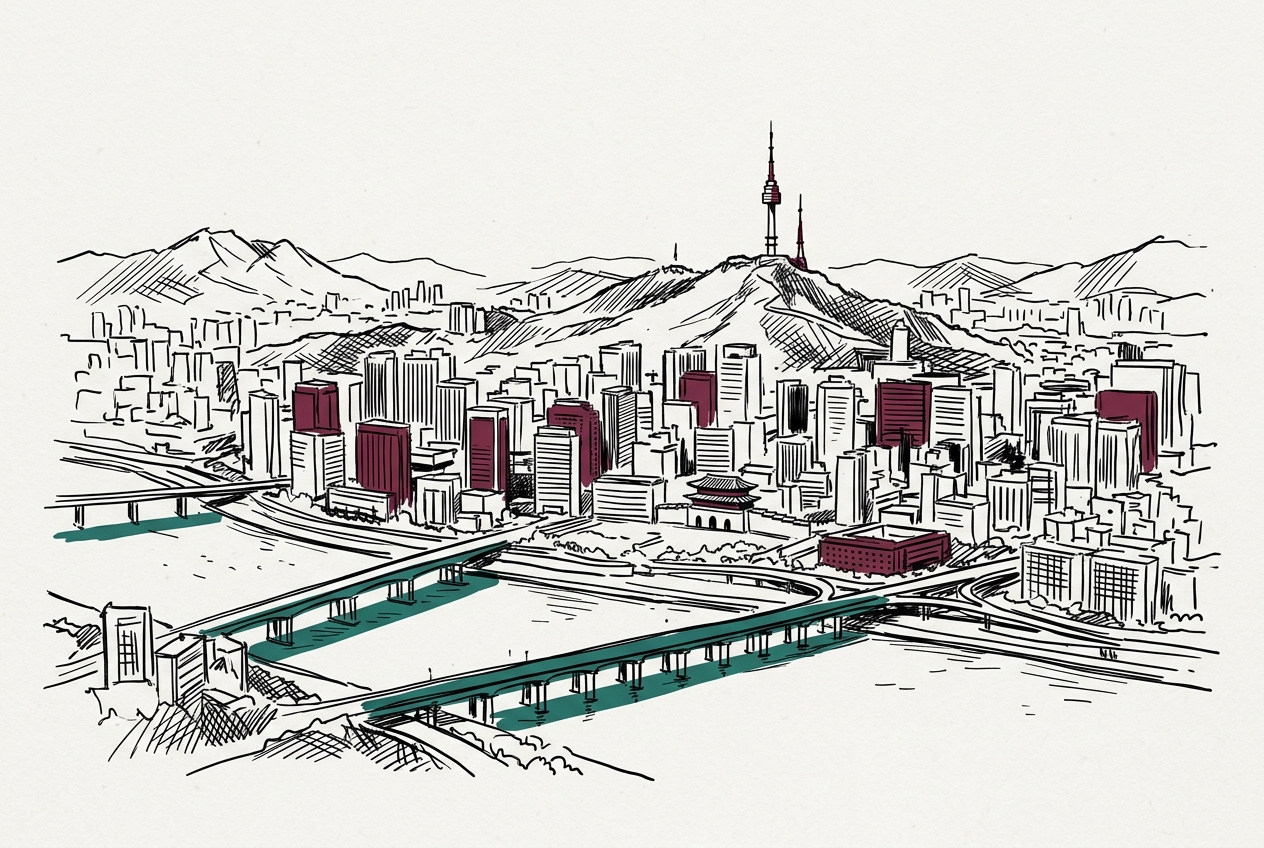
Seoul
South Korea's capital; a global finance hub whose markets seize when The Gulf burns.
South Korea's F-1-D workation visa, made permanent on 30 June 2026, gives young foreigners a lower income bar only if they settle outside Seoul, Incheon and Gyeonggi Province, steering newcomers away from the capital region.
Last refreshed: 3 October 2026 · Appears in 1 active topic
Will the Gulf war drain the missile stock that Seoul relies on for its own defence?
Timeline for Seoul
Mentioned in: Canberra puts backpacker visas to ballot
Nomads & CommunitiesMentioned in: DAPA approves VTOL drone for Korean army
Drones: Industry & DefenceMentioned in: Luxembourg takes equity in Mistral round
European Tech SovereigntyMentioned in: Taiwan votes down NT$210bn drone budget
Drones: Industry & DefenceMentioned in: Korea splits power prices into 11 zones
Data Centres: Boom and BacklashBackground
Seoul is South Korea's capital and its main financial and corporate centre, home to national institutions, the stock market and the head offices of the country's largest technology companies.
National policy now tries to spread that weight. On 26 August 2026 the energy ministry and state utility KEPCO proposed eleven electricity pricing zones with lower industrial rates outside southern Seoul and southern Gyeonggi, to steer new chip plants and AI data centres away from the capital's congested grid. On 21 August the planning and budget ministry announced a Future Response Fund to ring-fence above-trend tax revenue from the chip and AI boom, which analysts put at 60 to 150 trillion won, with youth employment among its priorities.
South Korea's AI Basic Act took effect in January 2026 without pre-deployment safety checks, a lighter regime than other large jurisdictions apply. The capital's markets also carry outside shocks: the KOSPI fell 12% on 4 March 2026 during the Gulf crisis, its worst single-day fall.
Seoul sits outside the regional visa discount
South Korea made its F-1-D workation visa permanent on 30 June 2026, ending a pilot that had run since January 2024, and raised the maximum stay from two years to three. The lower bar, about US$36,963 or the country's per-Capita gross national income, now applies to under-35s from age 18 WHO base themselves beyond the capital, Incheon and Gyeonggi Province, rather than the pilot's flat bar of twice that figure.
A nomad WHO settles in the capital region gains no such discount. Justice minister Jung Sung-ho framed the scheme in June around foreigners voluntarily putting down roots, and the design places those roots in depopulating provinces. For Seoul, the Visa is one more national policy built to spread growth beyond it.
What is Seoul?
Why did the KOSPI crash in March 2026?
How far is Seoul from North Korea?
How does the Iran war affect South Korea's economy?
Does the Iran war affect South Korea's missile defences?
Does Seoul qualify for South Korea's cheaper workation visa route?


