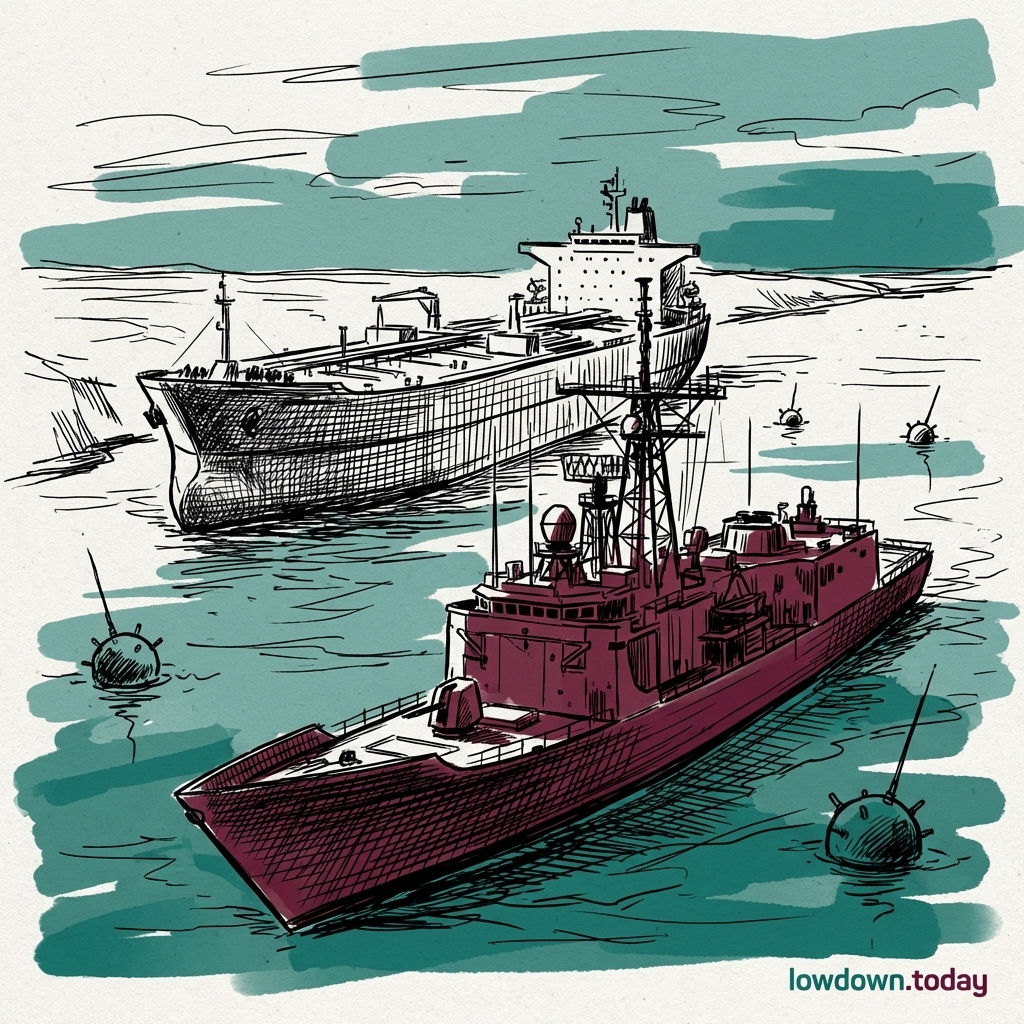
Operation Earnest Will
1987-88 US Navy escort of reflagged Kuwaiti tankers through Hormuz during the Iran-Iraq Tanker War.
Last refreshed: 20 May 2026 · Appears in 1 active topic
Reagan committed warships and absorbed casualties — why won't the 2026 coalition publish rules of engagement?
Timeline for Operation Earnest Will
Mentioned in: US Army Apache goes down near Hormuz
Iran Conflict 2026Mentioned in: No Iran signature for nearly 100 days
Iran Conflict 2026Mentioned in: Kuwait invokes Article 51 after strike
Iran Conflict 2026Mentioned in: US threatens Oman, its oldest Iran link
Iran Conflict 2026Mentioned in: Hormuz coalition: 8 days deployed, no rules published
Iran Conflict 2026- What was Operation Earnest Will?
- Operation Earnest Will (1987-88) was the US Navy's escort of reflagged Kuwaiti tankers through the Strait of Hormuz during the Iran-Iraq War's Tanker War phase. It is the primary historical precedent cited in 2026 coverage of the current Hormuz closure.
- Why is Operation Earnest Will relevant in 2026?
- Iran's 2026 Hormuz closure and attacks on tankers directly mirror the 1987 pattern that triggered Earnest Will. A 26-nation Coalition deployed in May 2026 without published rules of engagement, a governance gap that has no equivalent in the 1987 operation.Source: event
- Did the US repeat Operation Earnest Will in 2026?
- Not yet. Trump proposed a Coalition escort mission modelled on Earnest Will, but no country committed warships as of late March 2026. Twenty-two nations issued a joint statement demanding free passage without pledging any naval presence to enforce it.Source: event
- How did Operation Earnest Will end?
- The operation succeeded in keeping Hormuz open; Iran accepted a Ceasefire under UN Resolution 598 in August 1988, within months of the US Navy reaching full escort tempo. The campaign cost 37 US sailors' lives and led to the accidental shootdown of Iran Air Flight 655.
- What ships were involved in Operation Earnest Will?
- Key vessels included the USS Stark (hit by an Iraqi Exocet missile, 37 killed), USS Samuel B. Roberts (mined), and USS Vincennes (which shot down Iran Air Flight 655). Eleven Kuwaiti tankers were reflagged and escorted under the Stars and Stripes.
Background
Operation Earnest Will ran from July 1987 to September 1988. The United States Navy reflagged eleven Kuwaiti tankers under the Stars and Stripes and escorted them through the Strait of Hormuz during the Iran-Iraq War's Tanker War phase. Iran had mined the strait and attacked neutral shipping to pressure Gulf States supplying Iraq. The USS Stark (hit by an Iraqi Exocet missile, 37 sailors killed), USS Samuel B. Roberts (mined), and USS Vincennes (which shot down Iran Air Flight 655, 290 civilians killed) all became part of the operation's contested legacy. Iran accepted a Ceasefire under UN Resolution 598 in August 1988, within months of the operation reaching full tempo.
Operation Earnest Will is the most-cited historical precedent in 2026 Hormuz crisis coverage. When Iran declared the strait closed to non-compliant shipping and CENTCOM described the resulting conditions as the most complex maritime threat the Navy had faced, analysts and officials reached immediately for the 1987 playbook. Trump's call for a multinational escort Coalition drew direct comparisons with Reagan's reflagging programme . The parallel deepened in May 2026 when a 26-nation Coalition deployed naval assets without publishing any rules of engagement — exactly the governance gap that dogged Earnest Will's early phase.
The operational contrast between 1987 and 2026 is as instructive as the similarity. Earnest Will succeeded because Reagan committed warships, absorbed casualties, and maintained continuous escort rather than outsourcing deterrence to multilateral declarations. The 2026 Coalition has deployed assets from Belgium, Germany, France, Italy, Australia, and the UK, but as of 20 May no member had published rules of engagement — and Lloyd's of London conditioned reopening war-risk cover on exactly that document. The gap between historical precedent and present Coalition governance is itself a signal in current coverage.
