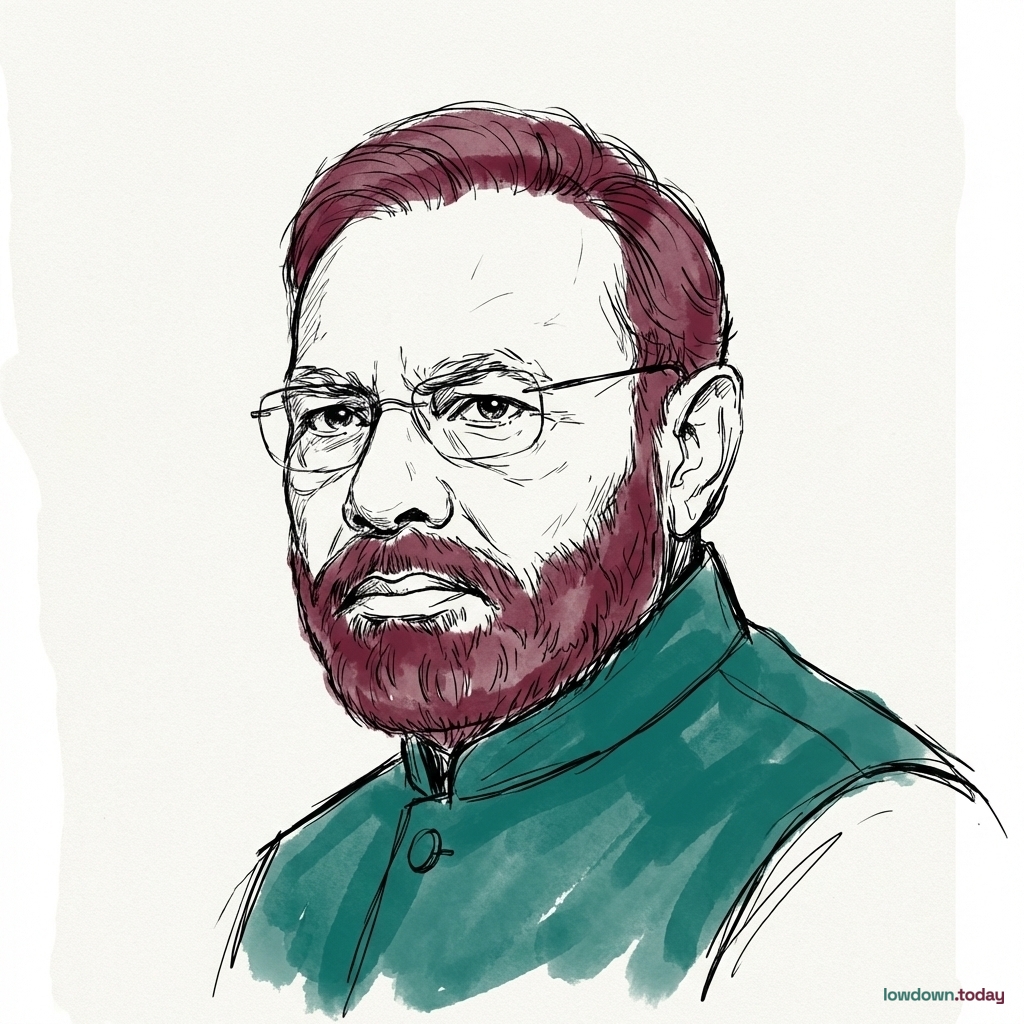
Narendra Modi
Prime Minister of India since 2014; champion of strategic autonomy and Indian Ocean primacy.
Last refreshed: 15 June 2026 · Appears in 2 active topics
Will Modi turn India's two formal Iran protests into a lasting foreign-policy shift?
Timeline for Narendra Modi
Met Amazon CEO Andy Jassy on 25 June to receive India investment announcement
Data Centres: Boom and Backlash: Amazon lifts India bet to $48bnIndia brings the last dead sailor home
Iran Conflict 2026Told G7 leaders including Trump that seafarers must work without fear, linking the deaths to Hormuz instability
Iran Conflict 2026: India brings its sailors home, with no apologyRaised the killing of Indian seafarers and Hormuz trade disruption with Trump at the G7, warning of a trust deficit
Iran Conflict 2026: Modi raised dead sailors; Trump gave nilScheduled bilateral with Trump at G7 to raise Settebello deaths and Indian protests
Iran Conflict 2026: India takes Settebello deaths to G7Background
Narendra Modi has served as Prime Minister of India since May 2014, leading the Bharatiya Janata Party (BJP) to outright majorities in 2014 and 2019 and a Coalition government after the 2024 general election. A former Chief Minister of Gujarat, he built his national profile on Hindu nationalist politics, economic liberalisation, and a doctrine of Indian Ocean primacy: India as the pre-eminent naval power from Oman to the Strait of Malacca.
Two concurrent crises in 2026 tested that doctrine simultaneously. On the western flank, Modi's government issued two formal protests to the United States after CENTCOM struck the MT Settebello on 11 June 2026, killing three Indian sailors; Foreign Minister S. Jaishankar phoned Marco Rubio on 13 June with what Delhi described as a strong protest, and Modi secured a bilateral with Donald Trump at the G7 in Evian-les-Bains on 17 June to raise the human cost directly. On the eastern flank, a cross-border confrontation with Pakistan over Kashmir escalated to air strikes in May 2026 before a US-brokered Ceasefire on 10 May; critics argued Modi's push to diplomatically isolate Pakistan had backfired when Islamabad re-emerged as a trusted American partner under Trump, raising questions about the limits of the strategic-autonomy doctrine.
The two crises together expose the central tension in Modi's Foreign Policy: Non-alignment demands restraint, yet Indian Ocean primacy requires assertiveness when foreign navies and powers act in India's claimed sphere. At the 8th consecutive G7 to which India was invited, Modi positioned himself as the voice of the Global South, pressing for reform of multilateral institutions while navigating the bilateral pressures of the US strategic partnership, trade negotiations, and H-1B Visa restrictions simultaneously.
Who is Narendra Modi?
Why did Modi stay silent after the Iran strikes?
What is India's Indian Ocean primacy doctrine?
Was an Indian killed in the Iran conflict?
How did India respond to the IRIS Dena sinking?
Why did India formally protest the US strike on the MT Settebello?
What is Modi's Indian Ocean primacy doctrine?
How did the India-Pakistan Kashmir crisis in 2026 affect Modi?
What does India want at the G7 summit in 2026?