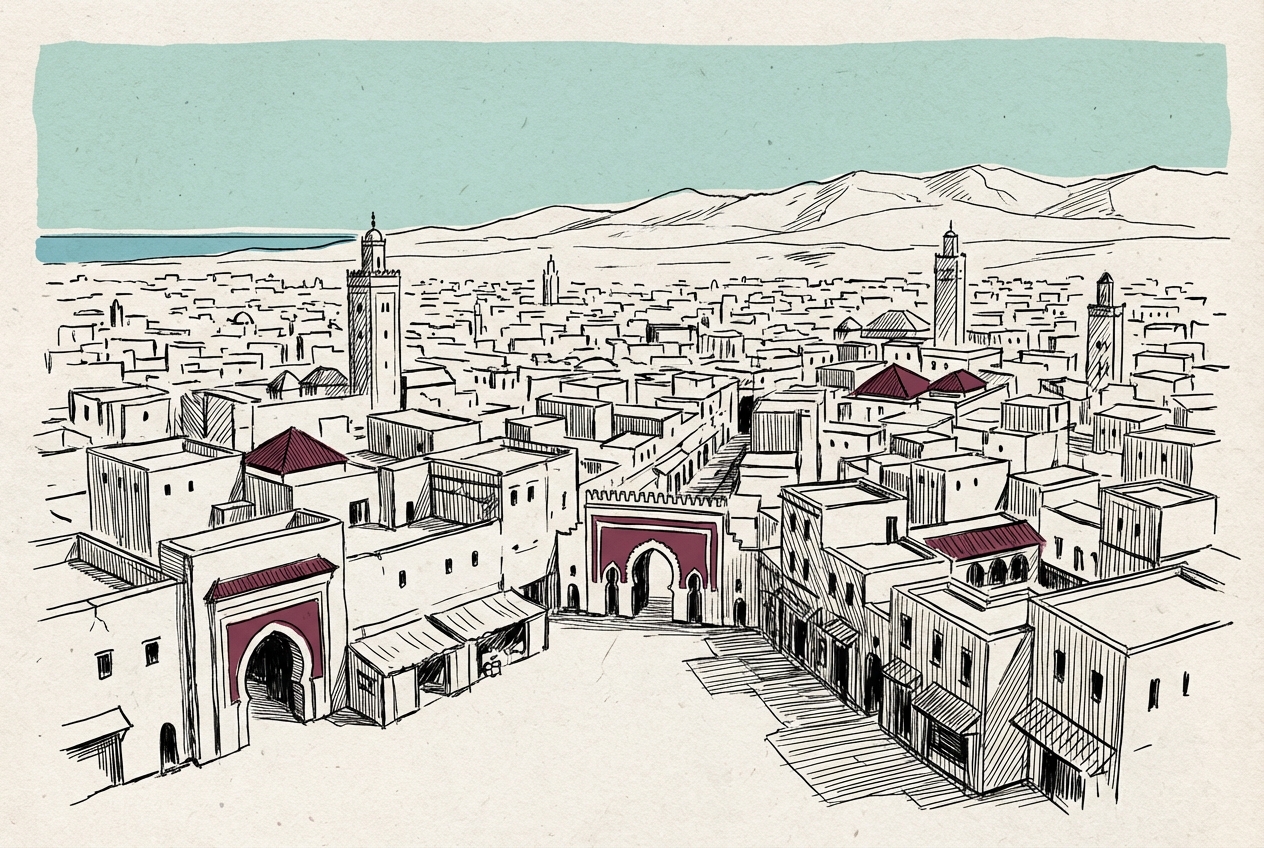
Morocco
North African kingdom; 2022 semi-finalists facing Brazil on 13 June; 2030 World Cup co-host.
Morocco wants Casablanca's Grand Stade Hassan II to stage the 2030 World Cup final, a claim that surfaced on 23 July against a Spanish push for Madrid's Santiago Bernabéu, two weeks after its own side went out in the 2026 quarter-finals.
Last refreshed: 3 October 2026 · Appears in 1 active topic
Can Morocco reach another semi-final and cement African football's 2022 breakthrough as no fluke?
Timeline for Morocco
Mentioned in: UN Tourism cuts 2026 arrivals forecast
Nomads & CommunitiesMorocco and Spain clash over 2030 final
2026 FIFA World CupMentioned in: Transfermarkt lifts Yamal and Cubarsi after the final
2026 FIFA World CupMentioned in: Mbappe takes World Cup career scoring record from Messi
2026 FIFA World CupMentioned in: Atlanta's rail win, its police bill
2026 FIFA World CupBackground
Morocco is a North African constitutional monarchy of about 38 million people. Rabat serves as its capital and Casablanca as its largest city. It has a large diaspora in France and Spain and around 100,000 nationals in the United Arab Emirates. It signed the Abraham Accords in 2020, normalising relations with Israel.
Football carries much of Morocco's international profile. In 2022 it became the first African nation to reach a World Cup semi-final, and it will co-host the 2030 tournament with Spain and Portugal. At the 2026 World Cup it reached the quarter-finals before losing to France on 9 July.
In the 2026 Iran war, Morocco balanced its Abraham Accords alignment against Gulf trade ties and its diaspora in the UAE. It took no formal public position in April 2026, when Iranian missiles and drones were striking the Emirates, in line with a long habit of keeping Gulf, European and Israeli relationships apart.
Morocco claims the 2030 final
Morocco co-hosts the 2030 World Cup with Spain and Portugal, and on 23 July the fight over its showpiece match came into the open. Rabat wants the final at the Grand Stade Hassan II, the stadium being built outside Casablanca, while a Spanish petition backs the Santiago Bernabéu in Madrid.
The dispute runs alongside a proposed 64-TEAM, 128-match format that FIFA has under study but has not ratified. A larger tournament would raise the number of matches each co-host stages, and so the value of the final as the prize in the split. A final in Casablanca would be the first World Cup final played in North Africa.
Morocco outlasted every other African side
Under Mohamed Ouahbi, appointed coach in March 2026, Morocco drew 1-1 with Brazil on 13 June and finished second in Group C. On 29 June they knocked out the Netherlands in the Round of 32, winning a shoot-out 3-2 after Issa Diop's 91st-minute equaliser. They then beat co-host Canada 3-0 in Houston on 4 July.
France ended the run 2-0 in Boston on 9 July. Yassine Bounou saved a Kylian Mbappé penalty before Mbappé and Ousmane Dembélé scored. Morocco were the last survivors of a record ten-nation African entry, beaten by the same opponent and scoreline as in the 2022 semi-final.
How far did Morocco get in the 2026 World Cup?
Who does Morocco play first at the 2026 World Cup?
Can Moroccan fans attend the 2026 World Cup?
Was a Moroccan killed in the UAE strikes?
Will Morocco host the 2030 World Cup?
How far did Morocco get at the 2022 World Cup?
Why is Morocco's World Cup squad considered a golden generation?
Does Morocco support Israel or Iran?
