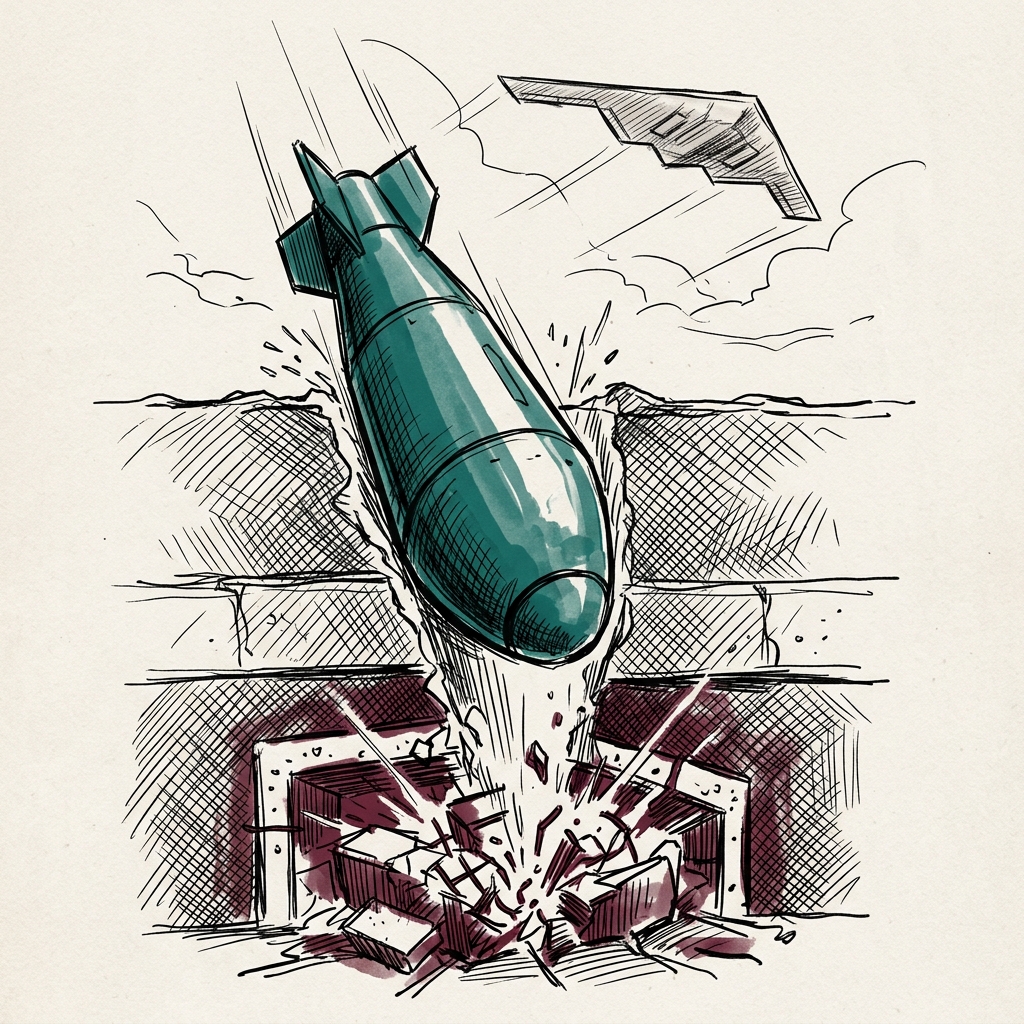
GBU-57 Massive Ordnance Penetrator
The 30,000lb US bunker-busting bomb designed to destroy hardened underground facilities, delivered only by the B-2 Spirit.
Last refreshed: 30 March 2026 · Appears in 1 active topic
Did the 30,000lb bunker-buster actually destroy Iran's buried nuclear halls at Fordow?
Timeline for GBU-57 Massive Ordnance Penetrator
Mentioned in: Fordow inoperable since June 2025 bunker-busters
Iran Conflict 2026Mentioned in: CENTCOM: 8,000 targets, 130 ships in 22d
Iran Conflict 2026Mentioned in: Hegseth: US has struck 7,000 targets in Iran
Iran Conflict 2026Mentioned in: $1.9bn a day, no bill to Congress
Iran Conflict 2026Mentioned in: 80 aircraft, 230 bombs hit IRGC academy
Iran Conflict 2026Background
The GBU-57 Massive Ordnance Penetrator is the largest conventional weapon in the US arsenal, weighing 30,000 pounds (13,600 kg). Its hardened Eglin-steel casing penetrates up to 200 feet of earth or 60 feet of reinforced concrete before detonating a 5,300-pound payload. Developed by Boeing under a programme accelerated after 2003, the MOP can only be carried by the B-2 Spirit stealth bomber, which holds two simultaneously.
The GBU-57 became central to the Iran conflict when CSIS placed its per-unit cost at approximately $3.5 million within a $3.7 billion total for the first 100 hours of Operation Epic Fury. B-2s flew confirmed sorties against Fordow and Natanz Fuel Enrichment Plant, Iran's most deeply buried nuclear sites. Defence analysts noted early in the campaign that MOP use had not been independently confirmed; only GBU-31 penetrating munitions were initially identified.
The Fordow strikes exposed the central question the MOP was built to answer: whether any conventional bomb can destroy a facility inside mountain rock. The IAEA confirmed structural damage to Natanz entrance buildings but could not verify the underground halls. That ambiguity places the MOP at the threshold of conventional and nuclear coercion.
What is the GBU-57?
How much does the GBU-57 cost?
How deep can the GBU-57 penetrate?
Was the GBU-57 used against Iran in 2026?
What is the difference between the GBU-57 and GBU-31?


