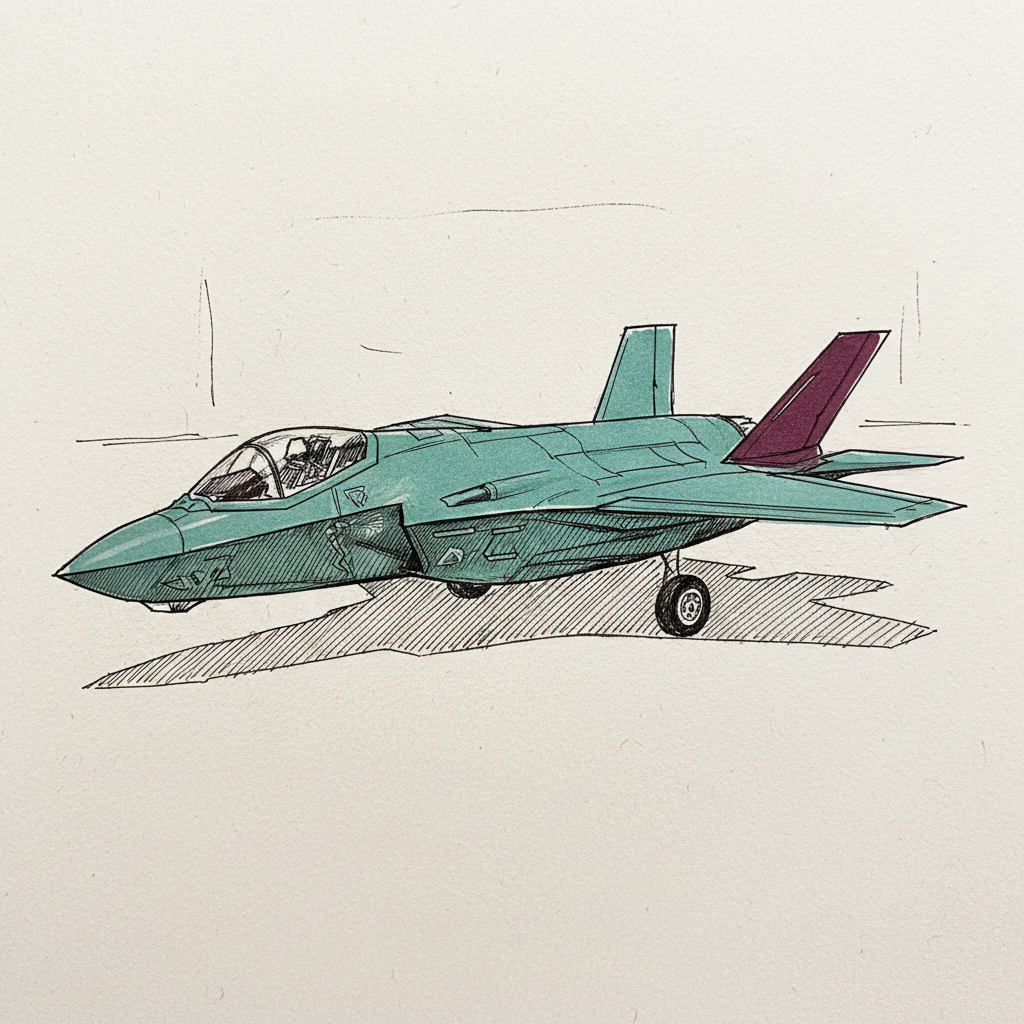
F-35
Lockheed Martin fifth-generation stealth multirole fighter; the US and allied standard for contested-airspace operations.
First delivered to US forces in 2015, the F-35 now flies with 17 nations and carries an estimated lifecycle cost above $1.7 trillion, the priciest weapons programme in history, even as autonomous wingman drones challenge its cost logic.
Last refreshed: 24 July 2026 · Appears in 2 active topics
Has Iran really managed to engage a US F-35, or is every claim so far unverified?
Timeline for F-35
Mentioned in: Netanyahu takes his case to Washington
Iran Conflict 2026Mentioned in: CENTCOM pauses as Trump warns of more
Iran Conflict 2026Washington flies fighters into the Gulf
Iran Conflict 2026Mentioned in: AeroVironment banks $580.5m in a day
Drones: Industry & DefenceManned fighter used as cost reference for CCA unit price comparison
Drones: Industry & Defence: Mentioned in: Air Force hands robot fighter to upstartsBackground
The F-35 Lightning II is Lockheed Martin's fifth-generation stealth multirole fighter, built in three variants sharing one airframe: the conventional F-35A, the short take-off F-35B flown by the US Marine Corps and the UK, and the carrier-based F-35C. It pairs low-observable shaping with an active electronically scanned array radar and sensor fusion, entering US service in 2015 and reaching 17 operator nations since. Average unit cost runs to roughly $78 million at Lot 15, against a programme lifecycle cost estimated above $1.7 trillion.
On 22 July 2026 Washington relocated additional F-35 squadrons from European bases into The Gulf, part of a wider fighter and tanker build-up, with some aircraft routed to Israeli bases. That followed months of unverified Iranian claims against the type, including an IRGC assertion on 26 May that it had fired on an F-35 over the Gulf.
The platform's core proposition, a radar cross-section low enough to defeat systems such as Iran's Bavar-373, now faces pressure from a different direction: the US Air Force's first funded autonomous wingman contracts went to Anduril and General Atomics rather than Lockheed Martin, targeting unit costs under $30 million.
Reference
How much does an F-35 fighter jet cost?
What is the difference between the F-35 and the F-35I?
Why did the US move F-35 jets to the Middle East in July 2026?
What happened at Jordan's Azraq airbase in June 2026?
Did Iran really shoot down a US F-35 fighter jet?
Did Iran shoot down or hit an F-35 on 26 May 2026?

