Skip to content
Welcome, thoughtbot's Giant Robots listeners!Start here
COSCO
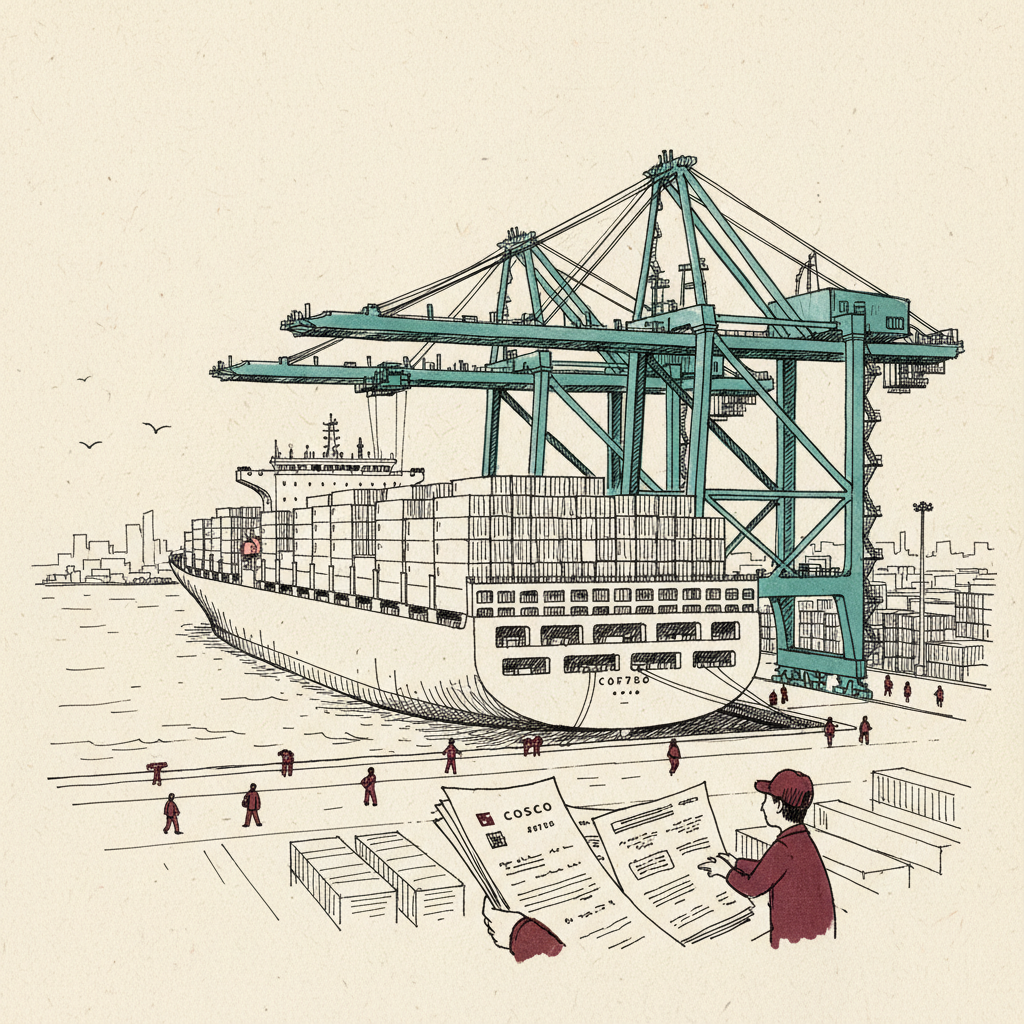
AI-generated illustration
OrganisationCN

COSCO

Chinese state-owned marine transport and logistics conglomerate, supervised by SASAC.

On 21 October, Gulf-to-Asia crude freight exceeded $37 a barrel, making route cost a direct constraint for COSCO's state-owned tanker and logistics network.

Last refreshed: 22 October 2026 · Appears in 1 active topic

Key Question

How much Iranian oil is China absorbing through COSCO-linked tankers under US sanctions?

Timeline for COSCO

View full timeline →

Background

China COSCO Shipping Corporation is a state-owned maritime transport and logistics group headquartered in Shanghai. It was formed in 2016 from the merger of China Ocean Shipping Company and China Shipping Group. China's State Council owns it, and the state-assets commission supervises it.

The group operates container, dry-bulk, tanker, terminal and logistics businesses. Its scale connects Chinese trade and energy demand to ports and sea lanes far outside China. That reach also exposes it to sanctions, war-risk insurance and chokepoint disruption. During the Hormuz crisis, the price of cover and freight became as material to its tanker routes as the legal status of individual ships.

Key Issues
Tanker freight

COSCO faces record route costs

The cost of moving Gulf crude to Asia exceeded $37 a barrel by mid-October, five times the pre-war rate, the International Energy Agency said on 21 October. That route is central to COSCO's tanker business and to Chinese refiners served by its state-owned network.

The daily rate for a Very Large Crude Carrier from Ras Tanura to Ningbo had already passed $1.2 million in The Week to 25 September. For COSCO, the compounding cost sits in hire, insurance and each transit, even when crude prices move in the opposite direction.

Common Questions

Reference

When was COSCO Shipping formed?
In January 2016, when China's State Council approved the merger of China Ocean Shipping Company and China Shipping Group. The combined group is headquartered in Shanghai.Source: https://en.wikipedia.org/wiki/COSCO_Shipping
Has COSCO been sanctioned over Iranian oil?
Yes, in part. The United States designated COSCO Shipping Tanker (Dalian) in September 2019 for carrying Iranian crude to China, then delisted it in January 2020. A related Dalian ship management entity remained designated.Source: https://www.steptoe.com/en/news-publications/international-compliance-blog/ofac-removes-secondary-sanctions-on-cosco-division-targeted-for-iran-oil-imports.html
Who owns COSCO?
The Chinese state. China COSCO Shipping Corporation is owned by the State Council and supervised by the State-owned Assets Supervision and Administration Commission.Source: https://en.wikipedia.org/wiki/COSCO_Shipping
What is COSCO Shipping Corporation?
COSCO is the world's largest state-owned shipping conglomerate, headquartered in Shanghai. It was formed in 2016 from the merger of China Ocean Shipping Company and China Shipping Group, operating over 1,300 vessels globally.
How does Iran sell oil to China if it is sanctioned?
Sanctioned Iranian crude reaches China via a network of Shell companies in Hong Kong, the UAE, and Oman that serve as intermediaries, moving cargoes through COSCO-affiliated and other tanker operators. OFAC designated twelve of these individuals and entities on 15 May 2026.Source: OFAC
Is COSCO shipping Iranian oil despite sanctions?
COSCO-affiliated tankers are among the principal carriers of Iranian crude to Chinese buyers, estimated at 1-1.4 million Barrels Per Day. The US has repeatedly sanctioned intermediary companies in COSCO's logistics chain rather than COSCO directly.Source: OFAC; analyst estimates
Why does China keep buying Iranian oil?
Beijing does not enforce United States secondary sanctions, so Chinese buyers and Chinese-operated tankers remain the main outlet for Iranian crude.
Source Material

Written with AI from Lowdown's published reporting. Not individually reviewed by an editor. Updated 22 October 2026. Editorial standards.
