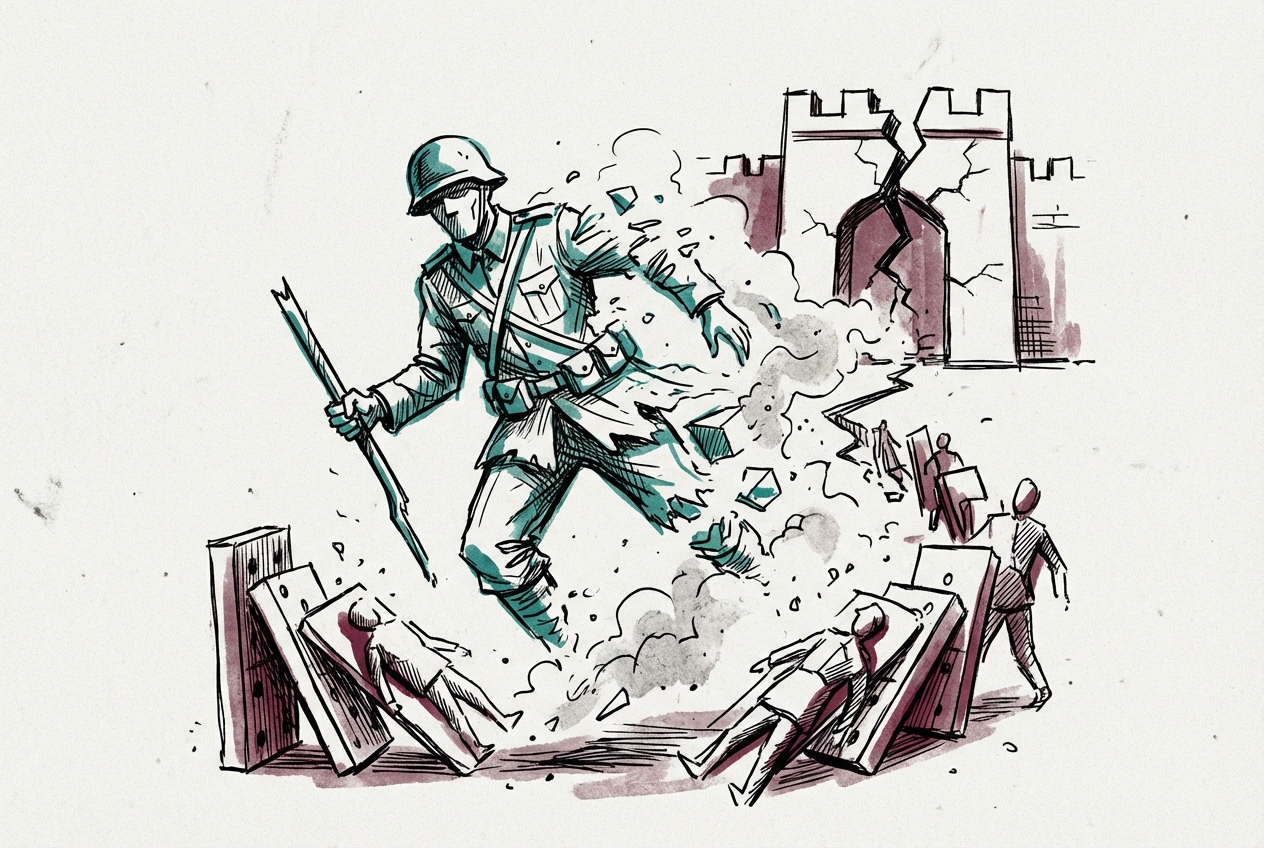
Basij
IRGC paramilitary militia; Iran's primary instrument of domestic coercion and wartime enforcement.
On 10 August 2026, Basij remained IRGC paramilitary militia; Iran's primary instrument of domestic coercion and wartime enforcement.
Last refreshed: 11 August 2026 · Appears in 1 active topic
Can the Basij still enforce domestic order after losing 300 commanders in a week?
Timeline for Basij
Received Hossein Taeb as head
Iran Conflict 2026: Khamenei signs six decrees in a single dayMentioned in: Iran's parliament turns on its signatory
Iran Conflict 2026Marched on the foreign ministry at night to oppose the US-Iran deal
Iran Conflict 2026: Iran hardliners revolt against the dealMentioned in: Kurdish protester Mehrab Abdollahzadeh hanged at Urmia
Iran Conflict 2026Mentioned in: ACLED Says Only Government Change Brings Victory
Iran Conflict 2026Background
Founded by Ayatollah Khomeini in 1979 as a mass infantry militia for the Iran-Iraq War, the Basij operates under IRGC command and has evolved into Iran's primary instrument of domestic control. Its full name is Sazman-e Basij-e Mostazafin (Organisation for the Mobilisation of the Oppressed). The force suppressed the 2009 Green Movement, the 2019 November uprising, and the 2022 Mahsa Amini protests, each time acting as the street-level enforcement Arm when regular police capacity was exceeded. Under the IRGC's "Decentralised Mosaic Defence" doctrine, the force has been restructured into 31 autonomous provincial commands, each capable of operating if central command is destroyed. The Basij lost approximately 300 field commanders in a single week of Israeli strikes in March 2026, alongside its six-year commander Gholamreza Soleimani and intelligence deputy Esmail Ahmadi. The Decapitation campaign targeted the domestic enforcement layer that keeps the Islamic Republic in power.
Hengaw documented Basij forces relocating into civilian spaces: schools, dormitories, and mosques in the days following. By June 2026, hardliner Basij militia members marched on Iran's foreign ministry in the early hours of 15 June to oppose the Ceasefire deal, demonstrating that the organisation remains capable of collective political action despite its officer losses. The Basij is structurally central to post-Khamenei succession politics. Supreme Leader Mojtaba Khamenei's position rests on Basij and IRGC loyalty; analyst assessments describe the Guards as controlling him rather than answering to him. If the Basij cannot maintain domestic order, the security architecture that installed Mojtaba collapses. Its.
Reference
What is the Basij and what does it do in Iran?
Did the Basij protest against Iran's ceasefire deal?
How many Basij commanders were killed by Israel in 2026?
What is the Basij's role in Iran's succession after Khamenei?
Why is the Basij important to Iran's new Supreme Leader?
What protests has the Basij suppressed?