Skip to content
You can now search across every topic, entity and event.What's new
US Midterms 2026
14JUN

DOJ stakes voter-data fight on appeal

3 min read
11:52UTC

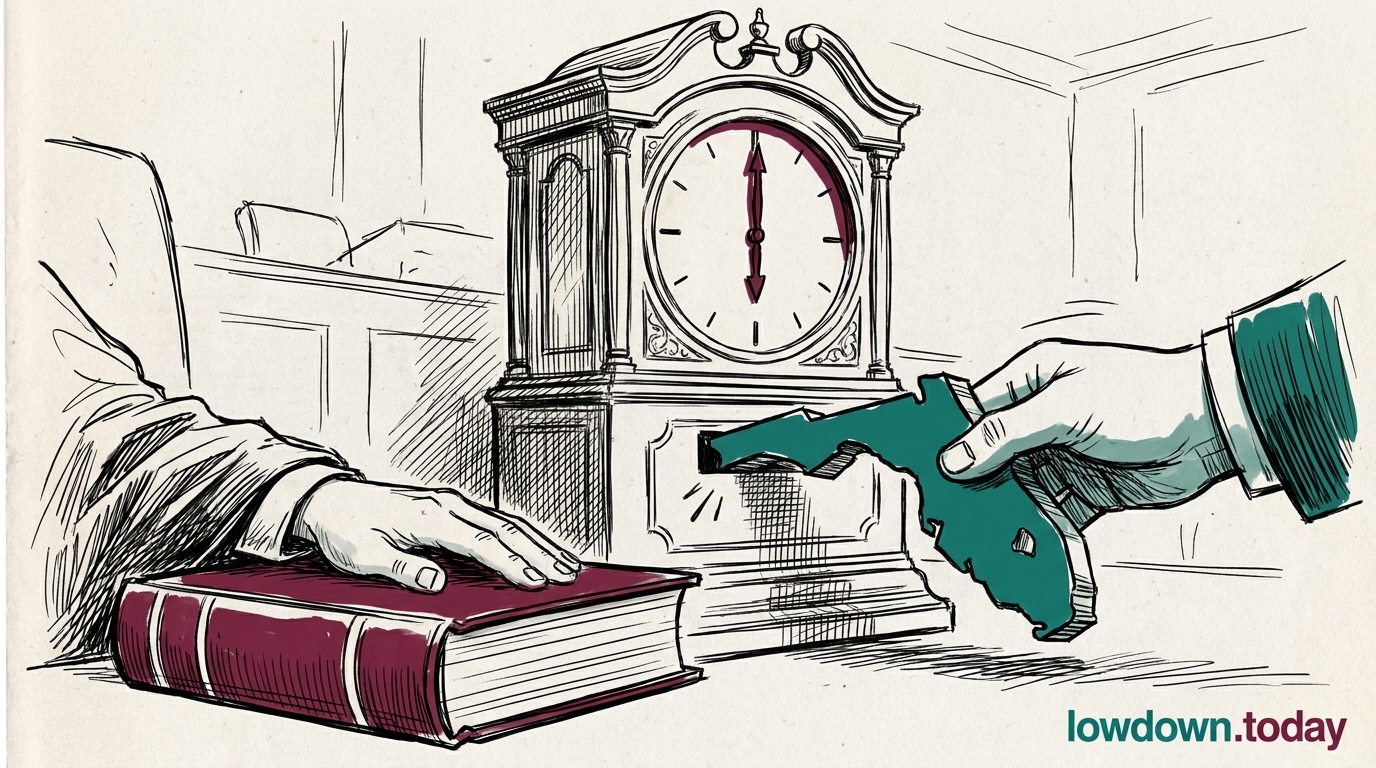
The Justice Department has appealed all eight voter-data dismissals it lost, folding a string of trial-court defeats into a single bet on the circuit benches. Roughly 22 states and DC remain in active litigation.

PoliticsDeveloping
Key takeaway

The DOJ has consolidated a losing trial record into one appellate gamble on the 9th and 6th Circuits.

The Department of Justice has appealed all eight of the voter-data dismissals it has lost, in California, Oregon, Michigan, Massachusetts, Rhode Island, Arizona, Wisconsin and Maine, per the University of Wisconsin State Democracy tracker dated 16 June 1. On 2 June the count stood at six appeals alongside a dropped national case ; the department has since folded the rest into one appellate effort. Roughly 22 states and DC remain in active litigation, and a Georgia judge recused on 15 June, sending that case to reassignment.

The trial courts dismissed these suits for failing to state the statutory authority behind the DOJ's demands, reasoning narrow enough that any active-litigation state could cite it . By appealing every loss rather than refiling, the Department of Justice converts a scattered defensive position into a single offensive one. A favourable circuit ruling would revive the whole programme; an adverse one would turn portable trial-court reasoning into binding precedent across multiple states.

Two forums hold the leverage. The 9th Circuit heard the Oregon appeal on 19 May and the 6th Circuit heard Michigan on 13 May. Neither has handed down a decision, and either could be the ruling that sets the precedent for the rest. The DOJ has chosen to wager its remaining record on those benches rather than keep litigating state by state in courts that have already ruled against it.

Deep Analysis

In plain English

The Department of Justice has been suing states to force them to hand over their complete voter registration files. The legal basis is a 1960 law called the Civil Rights Act of 1960, not the more recent Voting Rights Act. Federal district courts in eight states, including California, Oregon and Michigan, dismissed these lawsuits using the same legal reasoning: the DOJ's complaints did not specify which provision of that 1960 law gave them the authority to demand the data. The DOJ has now appealed all eight of those dismissals rather than fight each state separately. Two federal appellate courts heard arguments in May 2026, one in Oregon and one in Michigan, and neither has issued a ruling yet. If the appellate courts uphold the dismissals, the DOJ's voter-data programme effectively ends in those states and potentially nationwide if the Supreme Court does not intervene. About 22 other states are still in active court battles over the same question. The outcome of the Oregon and Michigan appeals will give those states a preview of which way the law is leaning.

Deep Analysis
Root Causes

Eight district courts applied the Massachusetts portable dismissal reasoning against the DOJ in California, Oregon, Michigan, Massachusetts, Rhode Island, Arizona, Wisconsin and Maine, leaving the department no district-level path forward. Each appeal presents the same legal question: whether the Civil Rights Act of 1960 authorises the DOJ's voter-data demands. The department cannot fix this at the district level; it must either win at the appellate level or reach the Supreme Court.

The Georgia recusal on 15 June adds a complication specific to that case: a recusal-driven reassignment can delay scheduling by several months, potentially pushing the Georgia case into 2027 regardless of the appellate outcome. With 22 states plus DC still in active litigation, the strategic value of winning one or two circuits is limited to the geographic scope of those circuits' binding authority.

The University of Wisconsin Law School State Democracy Research Initiative tracker confirms the SAVE Act amendment also failed its third Senate vote on 5 June, foreclosing the legislative path. The DOJ's appeal bet is now the sole remaining federal mechanism for advancing the voter-data collection programme.

What could happen next?
  • Risk

    A 9th Circuit ruling upholding the portable dismissal reasoning would establish binding precedent covering California, Oregon, Arizona and Nevada, where roughly 30% of the DOJ's remaining active cases are concentrated, effectively foreclosing those states absent Supreme Court review.

    Short term · Assessed
  • Opportunity

    A 9th Circuit reversal would give the DOJ a viable theory to refile corrected complaints in all previously dismissed states and would accelerate its appellate consolidation strategy by providing a favourable circuit precedent to present to the Supreme Court.

    Short term · Suggested
  • Consequence

    With the Georgia case delayed by a 15 June recusal-driven reassignment, the SAVE Act failed a third Senate vote on 5 June, and the appellate path now bearing the full weight of the voter-data programme, a dual circuit loss in Oregon and Michigan would effectively end the programme before November 2026.

    Medium term · Assessed
First Reported In

Update #10 · Wave or grind: the measure splits

University of Wisconsin Law School State Democracy Research Initiative· 21 Jun 2026
Read original
Different Perspectives
Senate Republican leadership
Floor time is finite at 51-47 with a bipartisan funding negotiation running, and a contested procedural fight over grant conditions is not the best use of it this month. Nothing has been abandoned; the resolution keeps its place on the calendar.
South Carolina election administrators
The Commission applied section 7-11-55 as written and certified the field inside the window the statute allowed. Complaints about the compression belong to the legislature, which alone can change the formula.
Rival Republican campaigns
A nine-candidate field and a majority requirement mean nobody wins on 11 August. The endorsement guarantees a place in the runoff, not the seat, and a fortnight of consolidation afterwards is where the nomination is actually settled.
Trump-endorsed campaign operation
The President's endorsement of the interim senator settles the contest, and a former governor rejected by these voters in 2018 does not merit a second hearing. Outside spending against her is money wasted on a nomination already decided.
Senate Budget Committee under Ron Johnson
Johnson, reported to succeed the late Lindsey Graham as Budget chair on 22 July, has a record of opposing reconciliation packages on deficit grounds, a different proposition than his predecessor for carrying the $10bn voter-ID grant through the Senate on 51 votes after the House passed its version 216-214.
NRCC and Republican committee strategists
The NRCC's $92.7m cash on hand outweighs the DCCC's $79.0m by $13.7m even after Democrats out-raised them $37.4m to $35.4m in the second quarter, official FEC filings from 20 July confirmed. Strategists are banking on the reserve gap, not this quarter's receipts, to carry House races.