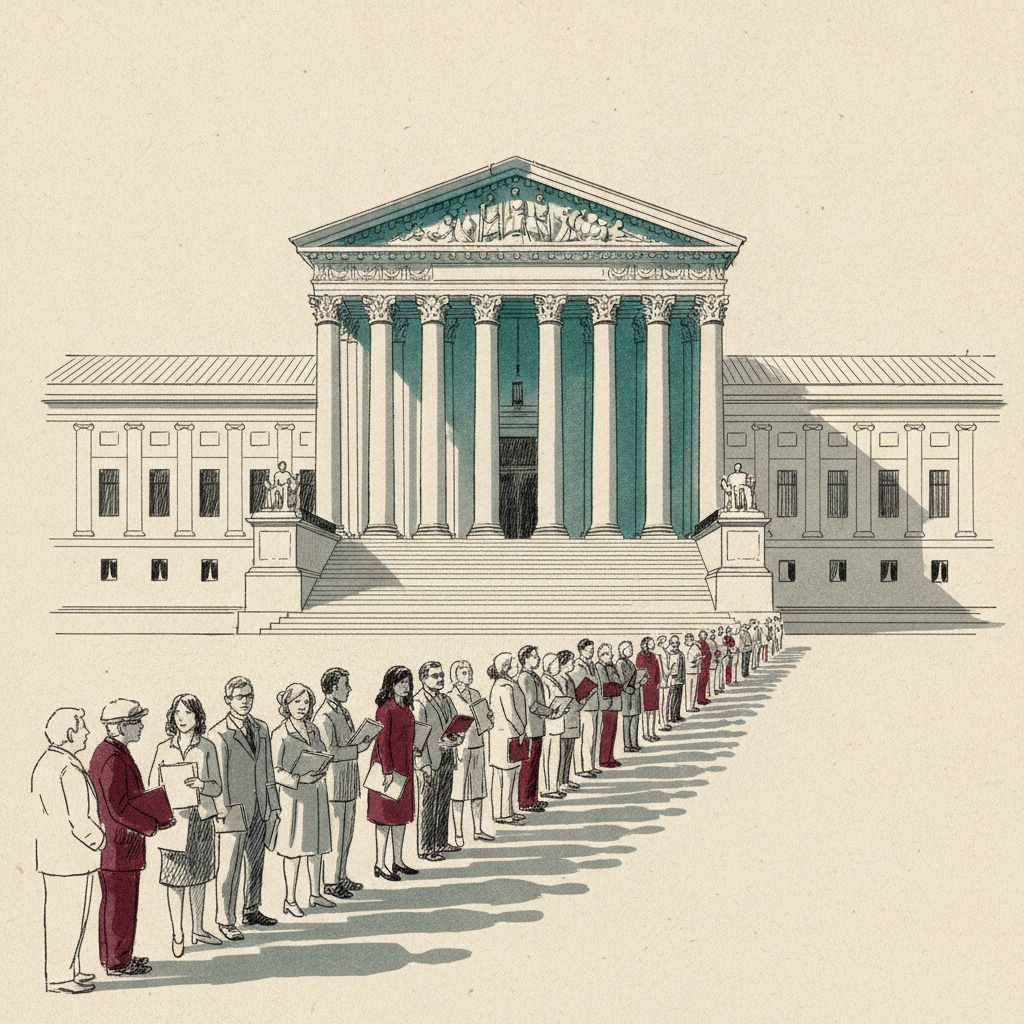
Shelby County v. Holder
2013 Supreme Court ruling that struck down the Voting Rights Act's preclearance coverage formula.
The 2013 ruling that ended the Voting Rights Act's coverage formula frames the fight over the Justice Department's plan, announced on 22 September 2026, to send about 1,000 election monitors to polling places in November.
Last refreshed: 18 October 2026
Timeline for Shelby County v. Holder
Mentioned in: NAACP sues for DOJ poll-monitor records
US Midterms 2026Mentioned in: Dhillon plans 1,000 DOJ poll monitors
US Midterms 2026Mentioned in: DOJ stakes voter-data fight on appeal
US Midterms 2026Mentioned in: Alabama voids its own primary mid-vote
US Midterms 2026Mentioned in: Callais guts VRA Section 2 mandate
US Midterms 2026Background
Shelby County v. Holder, 570 U.S. 529 (2013), is a Supreme Court of the United States ruling decided on 25 June 2013. By 5 votes to 4, in an opinion by Chief Justice John Roberts, the Court held Section 4(b) of the Voting Rights Act unconstitutional. That section held the coverage formula deciding which states and counties needed federal approval, known as preclearance, before changing their voting rules.
the Court made no ruling on Section 5, the preclearance duty itself. Without a coverage formula, though, no jurisdiction remains subject to it unless Congress passes a new one. Justice Ruth Bader Ginsburg wrote the dissent, joined by three other justices.
The ruling still shapes federal reach into polling places. Since 2013, federal access inside polling places has rested on a court order or a state's consent, the backdrop to the NAACP's 2026 suit for records on Justice Department election monitors. The question returned in September 2026, when the department planned about 1,000 monitors for the November vote.
Federal observers now need consent
The coverage formula struck down in Shelby County was what let the Justice Department send federal observers into polling places in covered states. Since 2013, federal access inside polling places has rested on a court order or a state's consent. On 22 September 2026 Harmeet Dhillon of the department's Civil Rights Division said it would send about 1,000 monitors to Nevada, Pennsylvania and Rhode Island.
The NAACP sued on 5 October for the department's records on those monitors and asked a court for a restraining order. Its aim is to put the monitors' instructions on the record before they reach polling places. The suit tests what federal monitors may do once the 2013 ruling has removed the statutory route that used to put them inside.
Shelby County was the first of three
Louisiana v. Callais, decided 6-3 on 29 April 2026, removed the Section 2 duty on states to create districts with a minority majority. That ruling places Shelby County at the head of a sequence of Roberts Court decisions on the Act.
Shelby County (2013) ended federal preclearance by striking the coverage formula. Brnovich (2021) narrowed Section 2 vote-denial claims. Callais retired the duty to draw majority-minority maps. Congress has not written a new coverage formula in the 13 years since 2013, so the nine mostly Southern states once fully covered can change voting rules without pre-approval. Callais lifted the second main constraint on those same states.
What did Shelby County v. Holder decide?
Did Shelby County v. Holder strike down Section 5 of the Voting Rights Act?
When was Shelby County v. Holder decided?
Why does Shelby County v. Holder matter for poll monitors in 2026?
Written with AI from Lowdown's published reporting. Not individually reviewed by an editor. Updated 18 October 2026. Editorial standards.