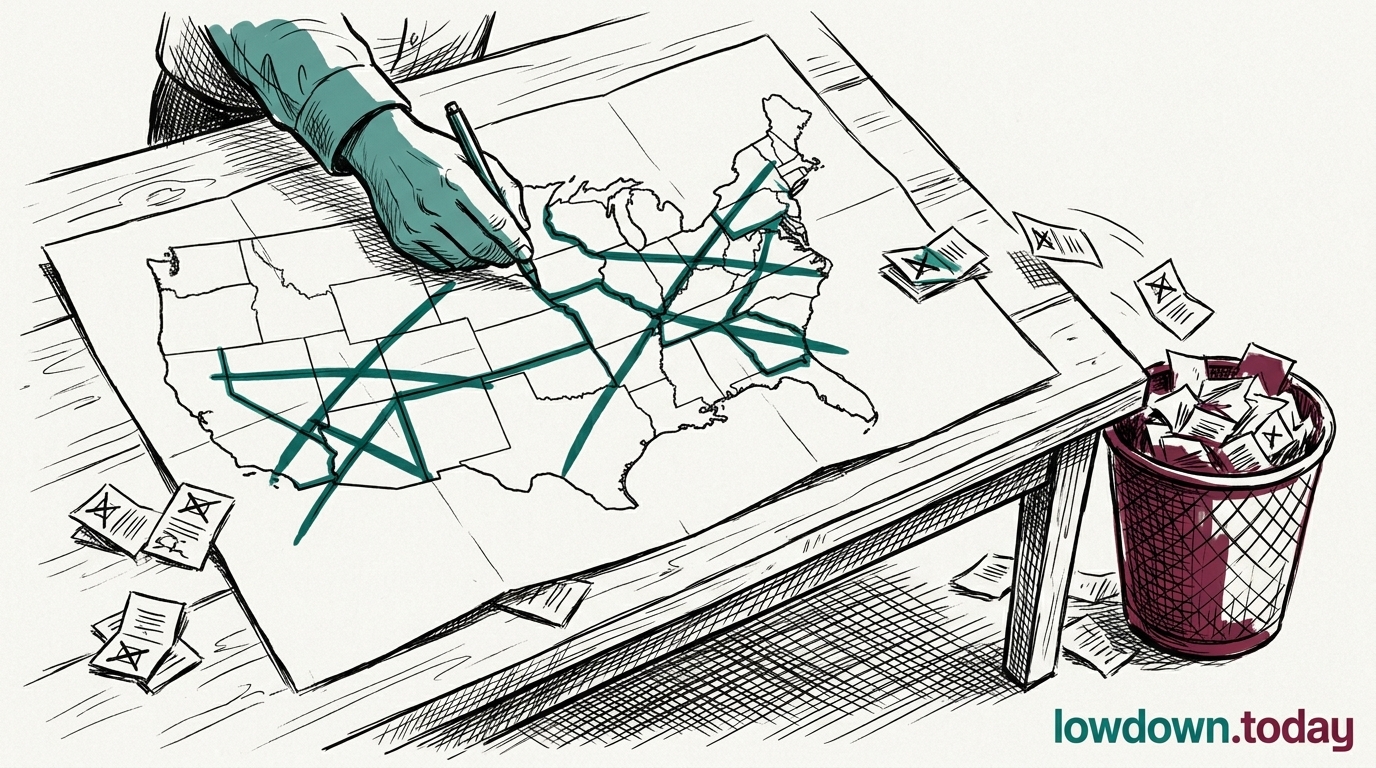
The Supreme Court of Virginia struck down the mid-decade redistricting amendment 4-3 on Friday 8 May, eleven days after the bench heard oral argument. The majority held the legislature had violated the constitution's intervening-election rule: approximately 1.3 million ballots in the 2025 general election, around 40% of the total, had been cast before legislators completed the first of two required votes on the amendment text1. The US Supreme Court declined to intervene. The procedural basis leaves no federal appeal path.
The map the Supreme Court of Virginia adopted on 28 December 2021, drawn by court-appointed special masters after the redistricting commission deadlocked, stands for the 2026 cycle. Cook Political Report's conditional move of five Virginia House seats toward Democrats, made on the day of the SCOVA arguments, is now void. The ruling completes the procedural sequence Judge Hurley began on 22 April when he voided the referendum result on equivalent timing grounds. A 50.7-49.3% popular vote and roughly $79 million of 501(c)(4) campaign spending were unwound despite the margin.
The intervening-election rule predates the partisan-redistricting fight by more than a century. SCOVA's 4-3 application of it to the 2025 general election is a doctrinally orthodox reading, severable from the political effect, which is why the federal court declined to take the case up. The dissent, written by Justice Mims, argued that the legislature's first vote satisfied the rule because the second vote was the operative ratification; on that reading, the timing of the second vote, not the first, governs.
The ruling pairs with the Maryland counter-track, dead since April after Senate President Bill Ferguson held the House-passed map off his chamber's floor. With Virginia closed, the Democratic 2026 retaliation map exists only as intent in California and Albany, and neither delivers seats by November.



