Skip to content
Briefings are running a touch slower this week while we rebuild the foundations.See roadmap
US Midterms 2026
19MAY

Every Democratic 2026 redistricting track is closed

4 min read
18:17UTC

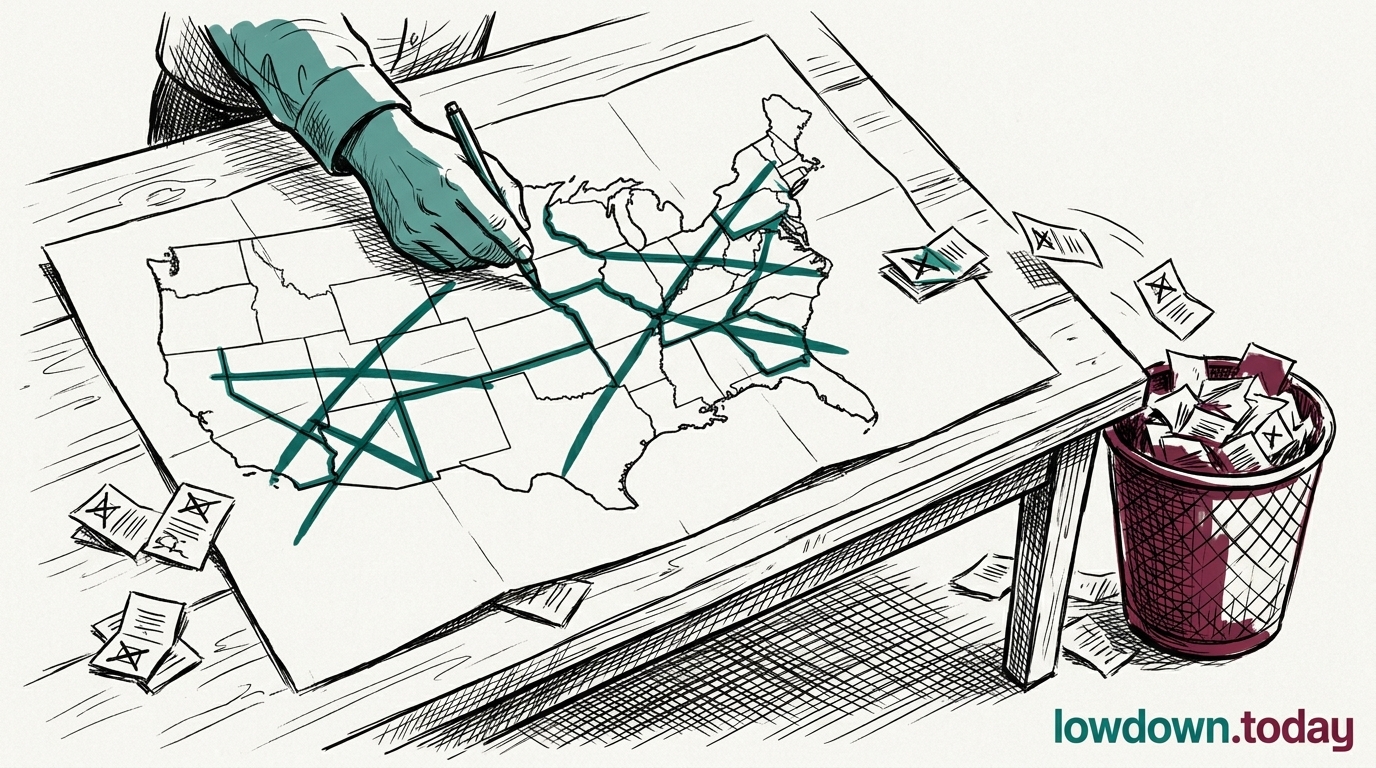
Maryland died in April, Virginia died on 8 May, New York is constitutionally foreclosed before 2028, and California's Prop 50 maps face a SCOTUS-bound challenge; no Democratic counter-map delivers seats by November.

PoliticsDeveloping
Key takeaway

The Democratic 2026 retaliation map exists only in California and Albany; neither delivers seats by November.

Every Democratic mid-decade redistricting track for 2026 is now closed. Maryland died in April when Senate President Bill Ferguson blocked the chamber's vote on the House map . Virginia died on 8 May via the SCOVA 4-3 ruling. New York is constitutionally foreclosed: any amendment to the 2014 independent commission structure requires passage by two separately elected legislatures plus a voter referendum, with the earliest possible effect in 2028 1.

Minority Leader Hakeem Jeffries dispatched Representative Joseph Morelle to Albany on Monday 4 May with a three-week deadline ; on the New York constitutional timeline, that deadline is a 2028 setup move, not a 2026 fix. The state's two-legislature requirement means a redraw fast-tracked today reaches voters in November 2027 at the earliest, with the new districts effective for the 2028 cycle. California's Proposition 50 maps remain in use but are heading toward The Supreme Court on racial gerrymandering grounds. Tangipa v. Newsom argues that the Callais ruling reframes the constitutional question 2. The 9th Circuit upheld the maps 2-1 in January 2026, with Judge Kenneth Lee dissenting in terms that echo Callais.

The Democratic retaliation map exists on paper in California and as intent in Albany. Neither delivers seats in November 2026. Election Law at Ohio State director Steven Huefner called the asymmetry between the two parties' redistricting toolkits the central institutional fact of the cycle: Republican states move on governors' calendars, Democratic states move on referendum, supermajority or commission calendars. Brennan Center vice president Wendy Weiser pushes back: the Democratic mechanisms exist precisely to slow mid-decade redistricting and have done their constitutional job; the political cost is a separate question from the institutional design.

The practical result is that the 2026 House baseline is set by the Republican Callais harvest before any 2026 campaign begins. The remaining variables for November are the wave-strength question, captured in the D+5.3-5.9 generic ballot range, and the three court hinges still pending: Hawkes in Florida, the 9th Circuit on Oregon, and Watson v. RNC at SCOTUS.

Deep Analysis

In plain English

In the US, the party that controls a state government can often draw congressional districts to give itself an advantage. After the 2010 census, Republicans did this very aggressively in many states. In response, several Democrat-leaning states passed laws creating independent commissions or requiring public referendums to approve new district maps. The idea was to make gerrymandering harder for everyone. But those same rules are now preventing Democrats from responding to a wave of Republican redistricting that followed the Supreme Court's April 2026 ruling. In Maryland, the Democratic-controlled Senate blocked a retaliatory map. In Virginia, the court threw out an attempt to redraw districts on a procedural technicality. In New York, the state's constitution requires a lengthy two-step process that cannot be completed before 2028. In California, an independent commission draws the maps and a court challenge is the only available route. The result is that Republicans have added seats before the 2026 election through rapid redistricting, and Democrats have no equivalent fast-moving tool. This is partly because of laws Democrats themselves helped pass after 2010 to make redistricting fairer. Those laws worked as intended; the political consequence is that they also removed Democratic flexibility in 2026.

What could happen next?
  • Consequence

    The Democratic 2026 House baseline is set by the Republican Callais harvest before any campaign begins. The remaining variables for November are wave strength (currently D+5.3-5.9 generic ballot) and three pending court hinges: Hawkes in Florida, the 9th Circuit on Oregon, and Watson v. RNC.

    Immediate · 0.88
  • Risk

    Tangipa v. Newsom, the SCOTUS-bound challenge to California's Proposition 50 maps on post-Callais racial gerrymandering grounds, could open California's maps to Republican challenge and further erode the Democratic House baseline if the Court grants certiorari.

    Medium term · 0.42
  • Opportunity

    The New York two-legislature sequence, if initiated now, completes in time for the 2028 cycle with the earliest possible referendum in November 2027. Jeffries's Morelle mission to Albany on 4 May sets up that timeline rather than delivering 2026 seats.

    Long term · 0.72
  • Consequence

    If Democrats hold or gain the House majority in 2026 despite the Callais map, the case for retaining slower redistricting mechanisms strengthens: wave magnitude overwhelmed the structural deficit. If Republicans hold the House by a margin traceable to Callais-harvested seats, pressure to dismantle commission and referendum structures in Democratic states will intensify.

    Long term · 0.68
First Reported In

Update #6 · 168 Days to Go: A primary nullified mid-vote

amNewYork· 19 May 2026
Read original
Different Perspectives
Black voters in Alabama
Four congressional primaries are being voided while 2.4 million Alabamans cast ballots today, with Shomari Figures's majority-Black seat scheduled for elimination under the 11 August re-do map. Figures was elected in 2024 as only the second Black congressman from Alabama in modern history.
Independent voters
Independent voters
Silver Bulletin's generic ballot has held at D+5.3-5.9 across the fortnight, flat against the D+5.8 reading on 28 April. The number sits below the D+6.8 that yielded a 40-seat Democratic pickup in 2018, meaning the structural map advantage Republicans built through redistricting has not yet been overridden by the swing environment.
Crypto industry
Crypto industry
Fellowship PAC, backed by Tether and Cantor Fitzgerald, scrubbed its $1.75 million Paxton buy under establishment pressure, the first visible retreat of crypto-PAC spending inside a Republican primary. The $89 million gap between Fellowship's claimed and disclosed cash remains unresolved in FEC filings.
Civil rights groups
Civil rights groups
NAACP Legal Defence Fund and the Brennan Center are pursuing the Florida Fair Districts challenge under the state constitution's partisan-gerrymandering ban, arguing the 24R-4D map uses partisan data in every district. They are also filing Watson v. RNC amicus briefs defending the 14 states' mail-ballot grace periods.
Federal courts
Federal courts
The judiciary is now the only institution with a live 2026 map-changing role: Judge Hawkes's Florida Fair Districts ruling arrives before the 8 June qualifying deadline, the 9th Circuit panel ruling on Oregon sets circuit precedent for 23 active DOJ cases, and SCOTUS carries Watson v. RNC to end of June on a separate ballot-counting track.
Republicans (Callais wing)
Fellowship PAC and the ideological state legislatures pushed the fastest post-Callais action: four special sessions within 72 hours of the ruling and an active-election nullification in Alabama. South Carolina and Mississippi's refusals show the wing's reach is real but not universal inside the Republican coalition.
