Skip to content
Briefings are running a touch slower this week while we rebuild the foundations.See roadmap
US Midterms 2026
19MAY

Tennessee signs map carving Memphis three ways

3 min read
18:17UTC

Governor Bill Lee signed Tennessee's new congressional map on Thursday 7 May, eliminating Steve Cohen's majority-Black 9th district and leaving all nine seats Republican-leaning.

PoliticsDeveloping
Key takeaway

Tennessee delivers up to two Republican House seats by January 2027 without any 2026 vote being cast in the state.

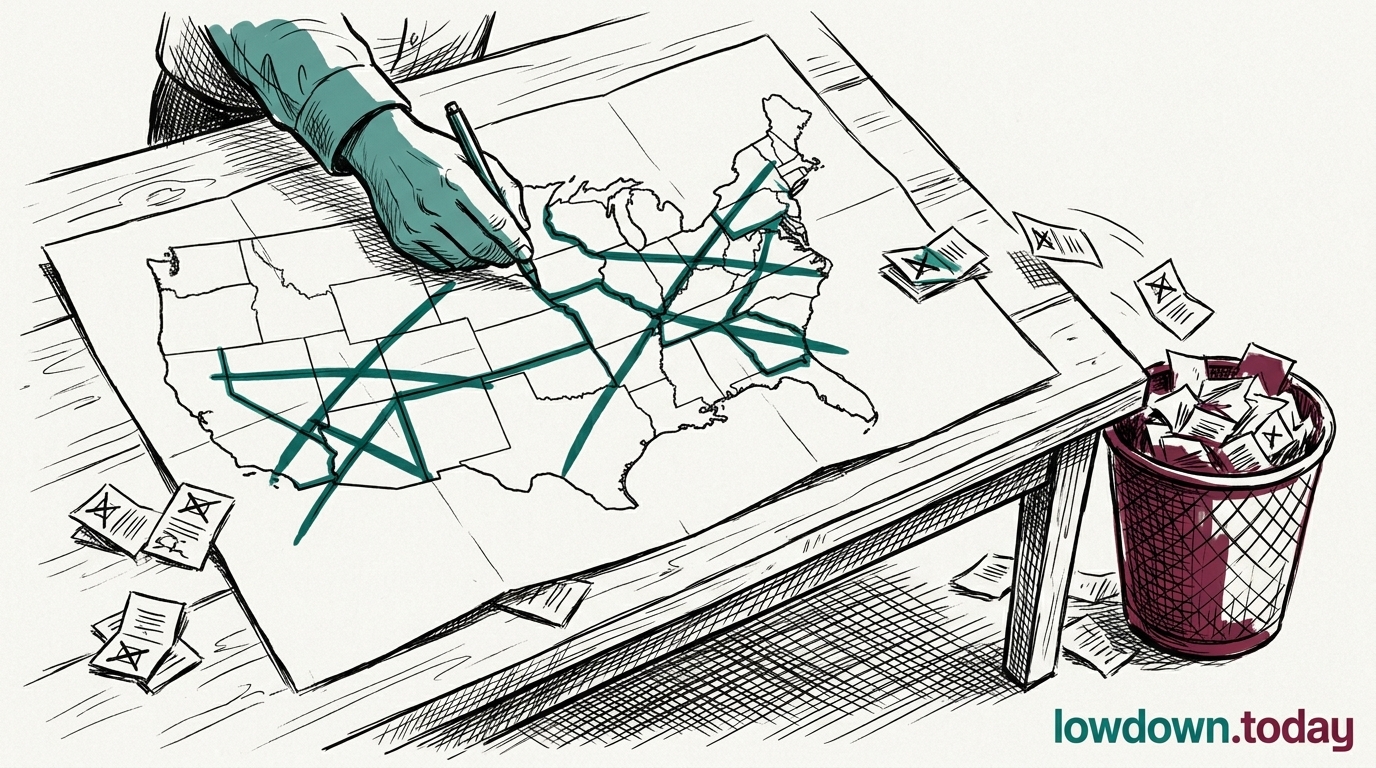
Governor Bill Lee signed Tennessee's new congressional map on Thursday 7 May, twelve days before the Alabama trigger. All nine districts are now Republican-leaning. The map carves Memphis and Shelby County across the 5th, 8th and 9th districts, eliminating the majority-Black 9th held by Representative Steve Cohen 1. The special session that produced the map convened on Tuesday 5 May.

The redraw delivers up to two additional House seats by January 2027 without any vote being cast in Tennessee. Louisiana v. Callais removed the Voting Rights Act Section 2 majority-minority mandate that had protected Cohen's district, the same legal lift that cleared Alabama's map seven days later. Tennessee was one of the four states that opened special sessions in the days after the 29 April ruling, and Lee's signing is the cleanest of those four resolutions to land on the calendar.

The template is Ron DeSantis's Florida 24R-4D map, signed three days earlier on 4 May and immediately challenged. Tennessee and Florida together have moved roughly nine seats from Democratic-held or competitive to Republican-leaning before any 2026 ballot is cast in either state. Brookings Institution analyst Vanessa Williamson called Memphis the cleanest example of a single Black-majority city dispersed across three districts to dilute Section 2 protection; the counter-view, advanced by State Senator Jack Johnson in the Tennessean, is that the city's geography makes a coherent 9th district impractical without crossing Shelby County boundaries the new map respects.

Unlike Florida, Tennessee draws no obvious state-law challenge. The Tennessee constitution carries no Fair Districts equivalent, and the federal Section 2 path closed with Callais. That leaves the 9th's elimination largely uncontested in court, in contrast to the Florida challenge under Judge Hawkes that may yet land before 8 June qualifying.

Deep Analysis

In plain English

Memphis is a majority-Black city in Tennessee. For decades, there was a congressional district drawn around Memphis that gave Black voters enough numbers to elect a representative of their choice. That representative was Steve Cohen, who has held the seat since 2007. In April 2026, the Supreme Court struck down the rule that required that kind of district to exist. Eight days later, Tennessee's governor called the legislature into special session. Within two days the legislature redrew the map. Instead of one Memphis district, the new map cuts the city into three pieces, each now part of a larger district dominated by rural Republican voters. Lee's signed map eliminated Cohen's 9th District by carving Memphis across three Republican-leaning districts. Up to two more Republican seats will appear in Congress from Tennessee by January 2027, without any election having been held under the new lines.

Deep Analysis
Root Causes

The Tennessee map's structural root is the Gingles framework's removal.

Thorнburg v. Gingles (1986) required states with sufficiently large and compact minority communities to preserve the possibility of a majority-minority district. Memphis, with a majority-Black city population, met the Gingles compactness and size tests.

That requirement forced Tennessee's pre-Callais mapmakers to draw the 9th district around Memphis rather than across it. Callais removed that floor on 29 April. The special session on 5 May and Lee's signature on 7 May moved on a calendar of eight days from judicial signal to signed law.

A secondary structural factor is Tennessee's absence of any state constitutional redistricting standard equivalent to Florida's Fair Districts Amendment or California's commission structure. The Tennessee constitution contains no independent partisan-intent prohibition.

With Section 2 gone and no state-law substitute, the legislature's only constraint was the federal Equal Protection Clause's racial-intent doctrine, which requires plaintiffs to prove discriminatory purpose rather than effect. Effect-based claims under Section 2 were precisely what Callais removed.

What could happen next?
  • Consequence

    Tennessee delivers up to two Republican House seats by January 2027 with no litigation path available, making it the cleanest Callais harvest among the four states that called post-ruling special sessions.

    Immediate · 0.87
  • Precedent

    The eight-day sequence from SCOTUS ruling to signed map sets the operational speed standard for post-Callais redistricting: contingent maps prepared in advance, special sessions called within 24 hours, gubernatorial signature within one week.

    Medium term · 0.82
  • Risk

    A racial-intent equal-protection challenge citing the speed and the explicit targeting of Cohen's seat could survive Callais as a distinct cause of action. No plaintiff has yet filed in Tennessee, unlike Florida where a challenge was filed within hours of DeSantis's signature.

    Short term · 0.48
First Reported In

Update #6 · 168 Days to Go: A primary nullified mid-vote

CNN· 19 May 2026
Read original
Different Perspectives
Black voters in Alabama
Four congressional primaries are being voided while 2.4 million Alabamans cast ballots today, with Shomari Figures's majority-Black seat scheduled for elimination under the 11 August re-do map. Figures was elected in 2024 as only the second Black congressman from Alabama in modern history.
Independent voters
Independent voters
Silver Bulletin's generic ballot has held at D+5.3-5.9 across the fortnight, flat against the D+5.8 reading on 28 April. The number sits below the D+6.8 that yielded a 40-seat Democratic pickup in 2018, meaning the structural map advantage Republicans built through redistricting has not yet been overridden by the swing environment.
Crypto industry
Crypto industry
Fellowship PAC, backed by Tether and Cantor Fitzgerald, scrubbed its $1.75 million Paxton buy under establishment pressure, the first visible retreat of crypto-PAC spending inside a Republican primary. The $89 million gap between Fellowship's claimed and disclosed cash remains unresolved in FEC filings.
Civil rights groups
Civil rights groups
NAACP Legal Defence Fund and the Brennan Center are pursuing the Florida Fair Districts challenge under the state constitution's partisan-gerrymandering ban, arguing the 24R-4D map uses partisan data in every district. They are also filing Watson v. RNC amicus briefs defending the 14 states' mail-ballot grace periods.
Federal courts
Federal courts
The judiciary is now the only institution with a live 2026 map-changing role: Judge Hawkes's Florida Fair Districts ruling arrives before the 8 June qualifying deadline, the 9th Circuit panel ruling on Oregon sets circuit precedent for 23 active DOJ cases, and SCOTUS carries Watson v. RNC to end of June on a separate ballot-counting track.
Republicans (Callais wing)
Fellowship PAC and the ideological state legislatures pushed the fastest post-Callais action: four special sessions within 72 hours of the ruling and an active-election nullification in Alabama. South Carolina and Mississippi's refusals show the wing's reach is real but not universal inside the Republican coalition.
