Skip to content
You can now search across every topic, entity and event.What's new
US Midterms 2026
7SEP

DOJ appeals its Michigan voter-file loss

2 min read
13:32UTC

The DOJ asked the full Sixth Circuit on 8 July to rehear its demand for Michigan's unredacted voter file, its first en banc escalation of six straight voter-data defeats.

PoliticsDeveloping
Key takeaway

The DOJ is escalating one Michigan voter-file loss to the full Sixth Circuit, not to the Supreme Court.

The Department of Justice (DOJ) filed a petition for rehearing en banc with the full Sixth Circuit on 8 July, asking every active judge on the Court to revive its demand for Michigan's complete, unredacted voter file. En banc rehearing sets aside a smaller panel's decision and puts the question to the whole appeals court. The DOJ wants Michigan's roll to feed the federal voter-eligibility checks at the centre of its campaign.

A three-judge panel had rejected the same demand 2-1 on 24 June, finding the department never specified which statute authorised it . The DOJ argues that panel misread Title III of the Civil Rights Act of 1960, which it says compels states to surrender voter records for federal inspection. The case names Michigan's Secretary of State, Jocelyn Benson, as defendant.

This is the first of the DOJ's six voter-data losses to reach en banc review rather than a refiling or a fresh panel, and no petition to the Supreme Court has followed. The Sixth Circuit grants full-court rehearings sparingly. The choice signals the department would rather exhaust the Sixth Circuit than test its losing reasoning before the justices yet.

Deep Analysis

In plain English

A federal appeals court panel already ruled against the Department of Justice's demand for Michigan's full voter list, 2 votes to 1. Now DOJ is asking every judge on that court, rather than the original three, to rehear the case. This is called an en banc petition, and courts grant it rarely. If DOJ wins, it could reopen the door to its voter-data demands nationwide; if it loses, this ruling becomes binding precedent making future demands harder everywhere in the circuit.

Deep Analysis
Root Causes

En banc rehearing requires a majority of the Sixth Circuit's active judges to vote for review, a bar that succeeds in roughly one in ten petitions nationally. DOJ's choice to seek it signals the department sees the panel's reasoning as an existential threat to its remaining seven appeals, beyond this single Michigan loss.

The structural problem is that DOJ's sole surviving legal theory, the 66-year-old Civil Rights Act of 1960, was drafted for targeted enforcement against documented discrimination, not a modern nationwide voter-roll matching programme. Retrofitting a narrow 1960 statute onto a 2026 data-collection goal keeps producing the same particularity objection across circuits.

What could happen next?
  • Precedent

    A Sixth Circuit en banc ruling against DOJ would bind Michigan, Ohio, Kentucky and Tennessee, hardening the particularity requirement across four states.

First Reported In

Update #12 · Voter-data drive stalls; jobs turn soft

Law.com (National Law Journal)· 9 Jul 2026
Read original
Causes and effects
This Event
DOJ appeals its Michigan voter-file loss
En banc review is the department's first attempt to overturn a voter-data loss at the whole circuit rather than refile or go straight to the Supreme Court.
Different Perspectives
New Hampshire student voters
Students who hold no accepted photo ID under HB 323 cannot vote in the 8 September primary after Judge Laplante declined to block the law on timing grounds. Whether the same rule applies on 3 November is still open.
Alaska Democratic Party
The Alaska Democratic Party moved $884,835 in coordinated spending to Mary Peltola between 17 and 30 July, more than the DCCC spent nationally in the same fortnight.
National Republican Senatorial Committee
The NRSC, which sued to remove coordinated-spending caps in NRSC v. FEC, put $2,230,472 behind candidates in the first complete month after winning that case, more than double the total for the prior six months combined.
Supreme Court of Missouri
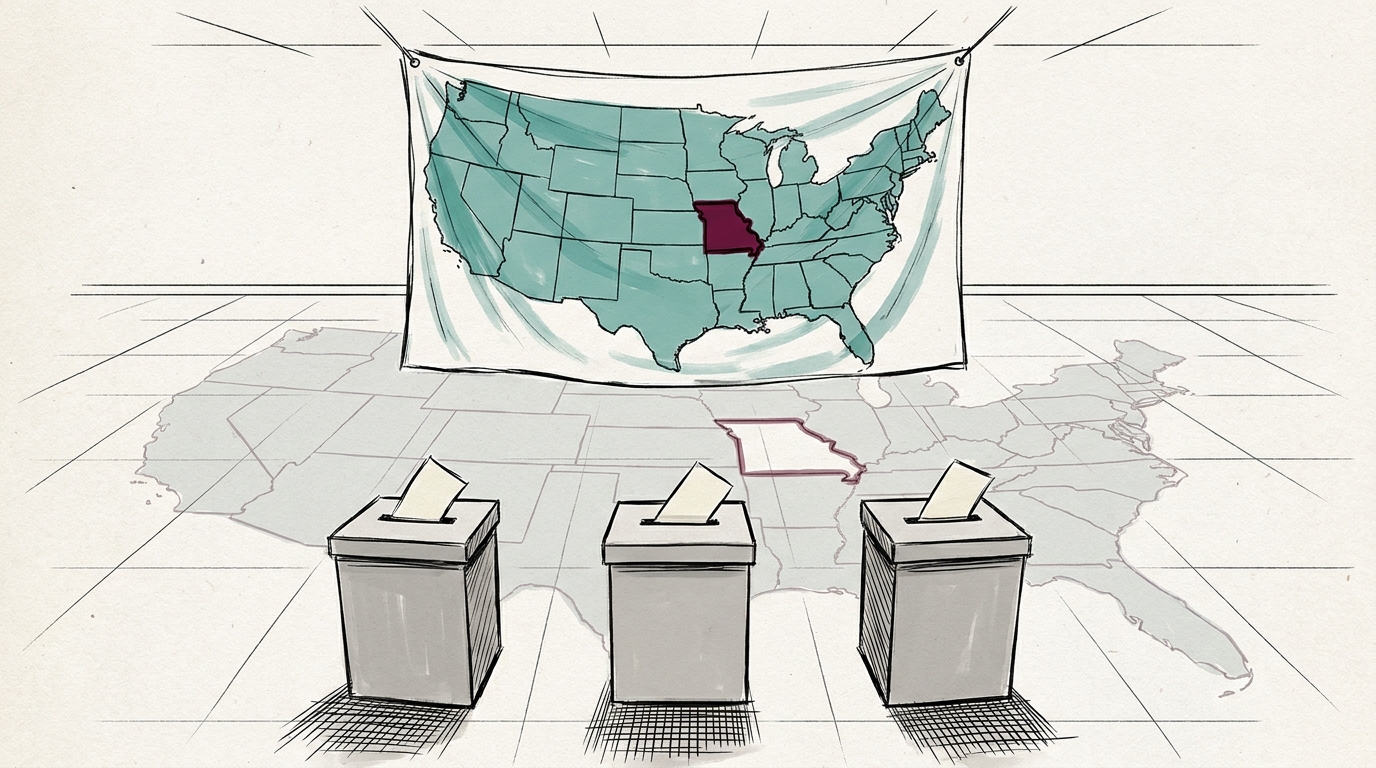
The unanimous court held that Article III, section 49 carries no redistricting exception, so a referendum petition against a congressional map is as valid as against any other law. It ordered the 2022 map to govern unless voters approve HB 1 on 3 November.
Denny Hoskins, Missouri Secretary of State
Hoskins told the Supreme Court that changing the congressional map after 1.2 million primary votes and ahead of the 19 September overseas-ballot deadline violates Purcell and the Elections Clause. He wants HB 1 reinstated before ballots print for November.
Senate Republican leadership
Floor time is finite at 51-47 with a bipartisan funding negotiation running, and a contested procedural fight over grant conditions is not the best use of it this month. Nothing has been abandoned; the resolution keeps its place on the calendar.
