Skip to content
You can now search across every topic, entity and event.What's new
US Midterms 2026
7SEP

Alabama voids its own primary mid-vote

3 min read
13:32UTC

Alabama tabulated four congressional primaries on Tuesday whose results Governor Kay Ivey announced will be discarded; SCOTUS vacated the majority-Black district order one week earlier on 12 May.

PoliticsDeveloping
Key takeaway

Alabama annulled a federal primary in progress to install a post-Callais map that eliminates its only Black-held congressional seat.

Alabama tabulated four congressional primaries on Tuesday 19 May 2026 whose results Governor Kay Ivey announced will be declared legally void. The 1st, 2nd, 6th and 7th district contests drew 2.4 million eligible voters under maps the state intends to discard. The US Supreme Court vacated the lower-court order requiring a second majority-Black congressional district on Tuesday 12 May, clearing Louisiana v. Callais to take operational effect inside Alabama. Ivey scheduled a re-do special primary for Tuesday 11 August under the redrawn map.

The redrawn map removes the seat held by Representative Shomari Figures, the Democrat elected in 2024 from Mobile as only the second Black congressman from Alabama in the state's modern history 1. No post-Voting Rights Act precedent exists for a state legislature voluntarily annulling an election already in progress under its own redrawn lines. Alabama was among the four states that called post-Callais redistricting sessions in late April ; today is what one of those resolutions looks like in practice.

The 12 May order was not a merits ruling on the new Alabama map. the Court vacated the existing remedial requirement on the strength of Callais and remanded, which is the procedurally smallest move that produces this outcome. Other states with pending Section 2 challenges, Louisiana and Georgia among them, will read the precedent. NAACP Legal Defense Fund counsel, cited by NPR, argued the opposite reading: the remand still permits the district court to reinstate the majority-Black requirement on the merits; nothing in the 12 May order forecloses that path before 11 August.

The broader pattern compresses the candidate fundraising window for the redrawn 7th district to roughly ten weeks. Figures-style coalitions must now hold a district without Section 2 protection, on a map drawn precisely to disperse the Black voters that Section 2 had clustered. That is the operational test the August primary will run.

Deep Analysis

In plain English

For years, US federal law required states with large Black populations to draw at least one congressional district where Black voters were the majority. That rule meant Alabama had to create a district where a Black candidate could win. In April 2026, the Supreme Court scrapped that requirement. Alabama had already drawn a new map without the Black-majority district. On 12 May the Supreme Court cleared the legal obstacle that had blocked that map. Alabama had just held four congressional primary elections on 19 May under the old maps. Governor Kay Ivey then declared those elections void, meaning the results from 2.4 million voters were thrown out. A new election will be held on 11 August under the new map, which cuts the seat held by Shomari Figures, the only Black congressman the state has had in modern times.

Deep Analysis
Root Causes

Three structural conditions made Alabama's 19 May action possible.

First, Louisiana v. Callais removed the federal statutory floor that had made Section 2 remedial orders enforceable. Without the Gingles framework requiring majority-minority districts, the lower court's original order rested on a doctrine SCOTUS had overturned on 29 April. Appellate housekeeping then followed: when a court's remedial order rests on overturned doctrine, the vacatur is the mechanical consequence.

Second, Alabama's legislative caucus had drawn the post-Callais map before the ruling issued, using the same special-session mechanism other Republican states activated within 24 hours of 29 April. The contingent maps and the governor's void authority were legal infrastructure prepared in anticipation, not improvised.

Third, the compressed primary calendar created a perverse incentive. Had Alabama waited, the district court on remand might have reinstated the majority-Black requirement, forcing yet another redraw closer to November. Ivey's void declaration converts a live legal question into a fait accompli: any court order arriving after 11 August runs against a completed election, not a scheduled one.

What could happen next?
  • Precedent

    The first documented case of a US state annulling a federal primary in progress sets a procedural template: any state with a pending Section 2 remedial order can now follow the Alabama sequence on the next SCOTUS vacatur.

    Medium term · 0.78
  • Consequence

    The 11 August re-do compresses candidate fundraising for the redrawn 7th district to roughly ten weeks, disadvantaging challengers who lack incumbent name recognition or donor networks.

    Immediate · 0.85
  • Risk

    If the district court on remand reinstates the majority-Black requirement before 11 August, Alabama faces a constitutional conflict between a state gubernatorial calendar and a federal court order, with no clear resolution mechanism.

    Short term · 0.55
  • Consequence

    Louisiana and Georgia, which also have pending Section 2 challenges, will read the 12 May vacatur as authority to implement their own post-Callais maps without waiting for district court guidance.

    Short term · 0.72
First Reported In

Update #6 · A primary nullified mid-vote

NPR· 19 May 2026
Read original
Different Perspectives
New Hampshire student voters
Students who hold no accepted photo ID under HB 323 cannot vote in the 8 September primary after Judge Laplante declined to block the law on timing grounds. Whether the same rule applies on 3 November is still open.
Alaska Democratic Party
The Alaska Democratic Party moved $884,835 in coordinated spending to Mary Peltola between 17 and 30 July, more than the DCCC spent nationally in the same fortnight.
National Republican Senatorial Committee
The NRSC, which sued to remove coordinated-spending caps in NRSC v. FEC, put $2,230,472 behind candidates in the first complete month after winning that case, more than double the total for the prior six months combined.
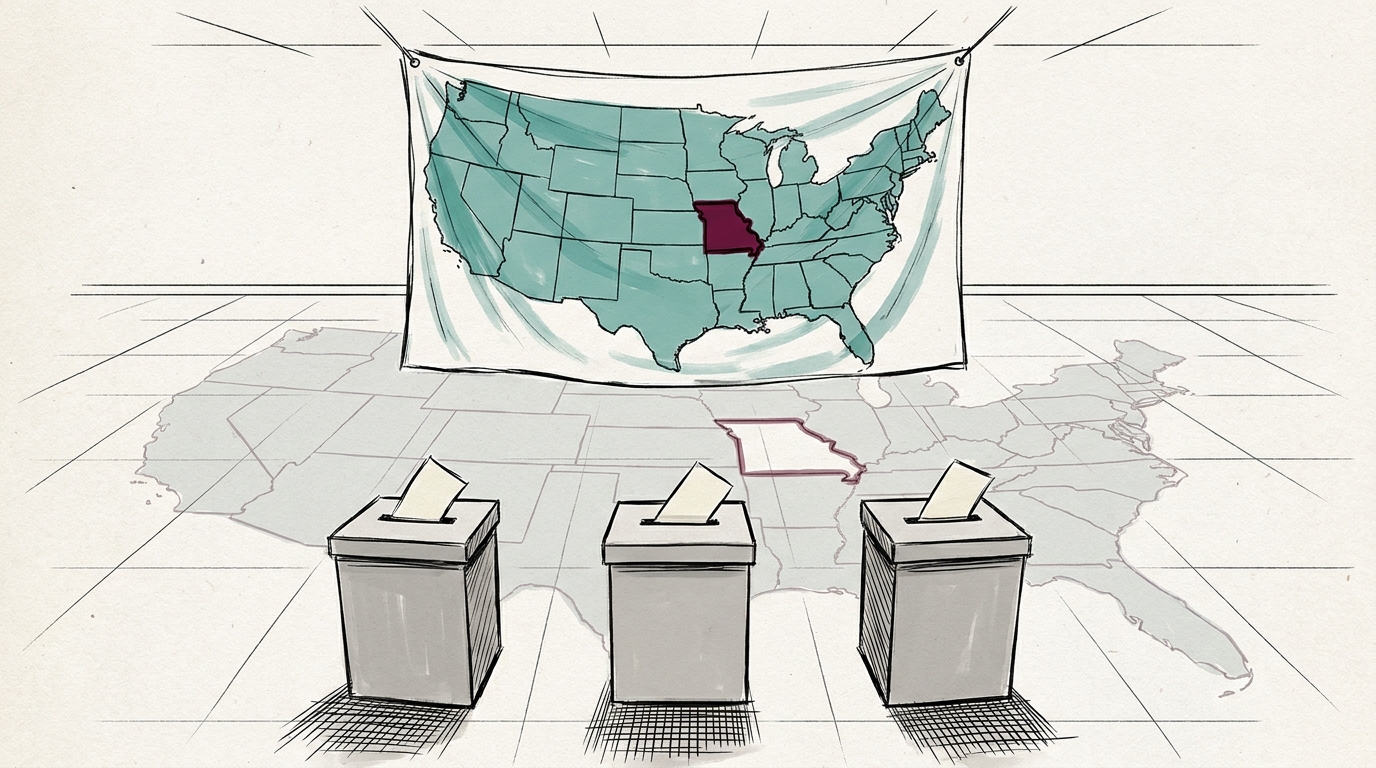
Supreme Court of Missouri
The unanimous court held that Article III, section 49 carries no redistricting exception, so a referendum petition against a congressional map is as valid as against any other law. It ordered the 2022 map to govern unless voters approve HB 1 on 3 November.
Denny Hoskins, Missouri Secretary of State
Hoskins told the Supreme Court that changing the congressional map after 1.2 million primary votes and ahead of the 19 September overseas-ballot deadline violates Purcell and the Elections Clause. He wants HB 1 reinstated before ballots print for November.
Senate Republican leadership
Floor time is finite at 51-47 with a bipartisan funding negotiation running, and a contested procedural fight over grant conditions is not the best use of it this month. Nothing has been abandoned; the resolution keeps its place on the calendar.
