Skip to content
You can now search across every topic, entity and event.What's new
US Midterms 2026
7SEP

Q1 GDP contracts under tariff drag

3 min read
13:32UTC

The Bureau of Economic Analysis recorded the first quarterly contraction of Trump's second term on 13 April, translating tariff pain that had only lived in polling into the national accounts.

PoliticsDeveloping
Key takeaway

Tariff pain has crossed from polling into the national accounts; a second negative quarter makes it a recession.

The Bureau of Economic Analysis, the Commerce Department agency that publishes US national accounts, recorded a Q1 (first quarter) 2026 GDP contraction of 0.3 percent on 13 April 2026 1. It is the first quarterly contraction of Trump's second term. The figure materialises the tariff economic pain that had previously been visible only in polling , where Trump's economic approval had collapsed to 31-35 percent in late March.

The Tax Foundation, a Washington DC tax-policy think tank, puts the 2026 effective tariff rate at 5.6 percent, the highest since 1972, with an average household burden of $600 this year 2. Those tariffs arrive at the register as higher grocery and fuel prices, which register in consumer spending, which registers in the national accounts. The Q1 print is the first quarter in which that sequence has completed. The National Bureau of Economic Research requires two consecutive negative quarters plus a broader slowdown across employment and industrial production to call one.

Q2 GDP publishes in late July, three months before the midterms. If that print is also negative, the midterms will be held during a formal recession with the incumbent party's fiscal policy as the named cause. The DCCC has already adopted tariff attacks as its core 2026 message , a choice that now has national-accounts data behind it rather than polling alone. Cook Political Report's Senate map moved the same day.

Deep Analysis

In plain English

Gross Domestic Product (GDP) measures the total value of everything an economy produces in a quarter. When GDP shrinks rather than grows, it is called a contraction. A second quarterly contraction in a row informally defines a recession. The US economy shrank by 0.3% in the first three months of 2026. The main cause is the current administration's tariffs, which are taxes on imported goods paid by American importers and typically passed on to consumers in higher prices. A nonpartisan research group called the Tax Foundation calculates the average American household is paying $600 more per year as a result. The political consequence is direct: economies that shrink during an election year tend to punish the party in power. This GDP number gives the opposition party hard data to reinforce its cost-of-living message.

Deep Analysis
Root Causes

The Q1 contraction has two separable causes. First, a front-running effect: importers accelerated purchases ahead of tariff implementation dates, inflating import volumes and mechanically reducing the net-exports component of GDP. Second, a consumption compression effect: the $600 per-household annual burden translates into roughly $50 per month less in discretionary spending from the moment tariffs hit retail prices.

The Bureau of Economic Analysis figure captures both simultaneously, which is why the contraction figure may partially reverse: the front-running effect is one-time, but the consumption compression is structural and compounds as tariff schedules remain in place.

What could happen next?
  • Risk

    A second negative quarter arriving in late July would constitute a formal recession entering the final stretch of the midterm campaign, a scenario with no precedent for the incumbent party escaping electoral punishment.

    Medium term · 0.68
  • Consequence

    The regressive income-share impact of the tariff burden concentrates economic pain in working-class households in Ohio, Georgia, and North Carolina, the three states Cook has now rated as competitive.

    Short term · 0.82
  • Risk

    Front-running inventory distortions may partially reverse in Q2, giving the administration a politically useful GDP rebound figure before the election even if the structural burden persists.

    Short term · 0.65
First Reported In

Update #3 · Tariff shock reads in GDP. Senate map moves.

Silver Bulletin· 16 Apr 2026
Read original
Different Perspectives
New Hampshire student voters
Students who hold no accepted photo ID under HB 323 cannot vote in the 8 September primary after Judge Laplante declined to block the law on timing grounds. Whether the same rule applies on 3 November is still open.
Alaska Democratic Party
The Alaska Democratic Party moved $884,835 in coordinated spending to Mary Peltola between 17 and 30 July, more than the DCCC spent nationally in the same fortnight.
National Republican Senatorial Committee
The NRSC, which sued to remove coordinated-spending caps in NRSC v. FEC, put $2,230,472 behind candidates in the first complete month after winning that case, more than double the total for the prior six months combined.
Supreme Court of Missouri
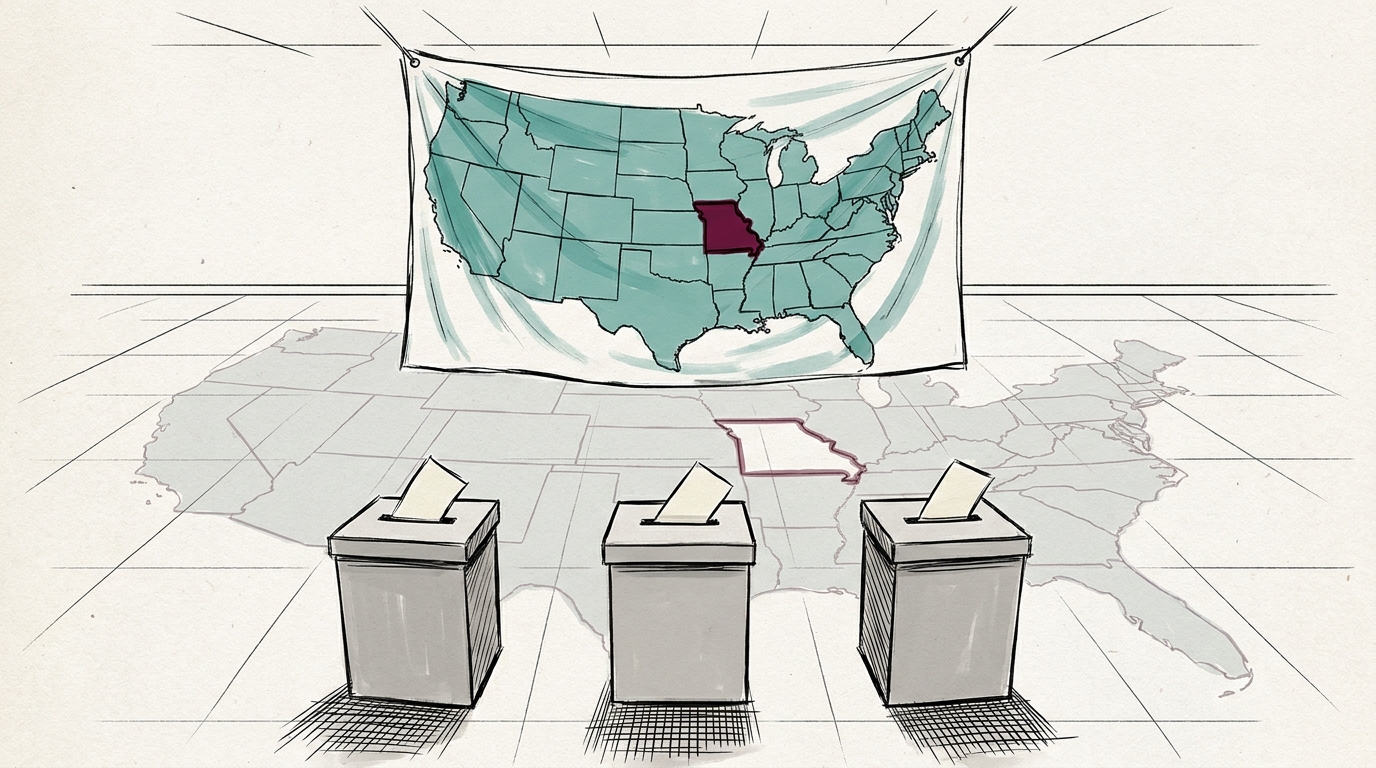
The unanimous court held that Article III, section 49 carries no redistricting exception, so a referendum petition against a congressional map is as valid as against any other law. It ordered the 2022 map to govern unless voters approve HB 1 on 3 November.
Denny Hoskins, Missouri Secretary of State
Hoskins told the Supreme Court that changing the congressional map after 1.2 million primary votes and ahead of the 19 September overseas-ballot deadline violates Purcell and the Elections Clause. He wants HB 1 reinstated before ballots print for November.
Senate Republican leadership
Floor time is finite at 51-47 with a bipartisan funding negotiation running, and a contested procedural fight over grant conditions is not the best use of it this month. Nothing has been abandoned; the resolution keeps its place on the calendar.
