Skip to content
You can now search across every topic, entity and event.What's new
US Midterms 2026
7SEP

Trump Economic Approval Drops to 31 Percent

2 min read
13:32UTC

Multiple polls show Trump's economic approval at 31-35%, with 56% of Republicans saying tariffs raise prices. Lower-income voters have shifted 7 points toward Democrats since January 2025.

PoliticsDeveloping
Key takeaway

A majority of Republicans now say tariffs raise prices, eroding the party's economic insulation.

A YouGov/Economist survey (20-23 March) found 35% approval for Trump's economic handling; CNN polling (26-30 March) found 31% 1. Quinnipiac polling shows 75% of Americans, including 56% of Republicans, believe tariffs are raising prices. Lower-income voters have shifted 7 points toward Democrats since January 2025.

The Republican-voter figure is the one that matters for midterm projections. When a majority of the president's own base agrees that his trade policy raises their costs, the political insulation that partisanship normally provides begins to erode. The 7-point shift among lower-income voters is the transmission mechanism: tariff costs concentrate in food, fuel, and imported consumer goods, the categories that consume the largest share of lower-income household budgets.

The Georgia 14th result provides a concrete test case. Shawn Harris campaigned on the price of feed, fertiliser, and petrol, not abstract policy, in a district where those costs dominate daily life. His historic overperformance occurred in precisely the demographic and geographic territory these polls describe. The generic ballot shift to D+5.5 may reflect a national average that masks larger swings in communities where tariff exposure is most direct.

Deep Analysis

In plain English

Cook Political Report and Sabato's Crystal Ball are the two most widely cited services that rate how competitive each congressional district is. They use a sliding scale from 'Safe Democrat' through 'Toss-up' to 'Safe Republican'. When districts move on these scales, it signals that expert forecasters think the seat has become more competitive. Pennsylvania's 8th District (around Scranton) moved from 'Lean Republican' , meaning Republicans were expected to win fairly comfortably , to 'Toss-up', meaning either party could win. Ohio's 1st District (Cincinnati area) moved even further, to 'Lean Democrat'. Both raters moved on the same day, after the Georgia and Wisconsin results. PA-08 is historically important because it has voted for the winning presidential candidate in every election since 2008. When it enters competitive territory, experienced forecasters treat it as an early warning signal for broader Republican vulnerability across the House.

Deep Analysis
Root Causes

Ratings services move when two independent conditions align: polling shifts and structural district vulnerability. PA-08's movement to Toss-up reflects both.

Structurally, PA-08 (northeastern Pennsylvania, Scranton area) is the working-class district with the highest density of union-household voters who have split between parties in consecutive cycles. It has a higher concentration of workers in tariff-sensitive industries , steel, manufacturing, logistics , than almost any other competitive district. The same input cost pressures that moved GA-14 are operating here, but through manufacturing supply chains rather than agricultural inputs.

The polling shift (Trump economic approval at 31-35%) translates directly to PA-08 because district-level retrospective economic voting is tightly correlated with presidential approval. A 30% presidential economic approval in a district where the president won by 3 points in 2024 effectively inverts the partisan lean.

What could happen next?
  • Consequence

    If PA-08 turns competitive and the D+5.5 model underestimates actual movement, districts currently rated Safe Republican begin entering the forecast model's competitive tier , expanding the total number of at-risk Republican seats beyond the current 12-20 projection.

  • Risk

    Coordinated dual-rater movement on the same day may signal polling methodology consensus rather than independent evidence, making the convergence vulnerable to the same systematic Republican-voter undercount that affected 2024 forecasts.

First Reported In

Update #2 · First votes exceed every forecast

YouGov/Economist· 12 Apr 2026
Read original
Causes and effects
This Event
Trump Economic Approval Drops to 31 Percent
A bipartisan consensus that tariffs raise prices, combined with a 7-point lower-income voter shift, provides the economic mechanism beneath the electoral overperformance visible in Georgia and Wisconsin.
Different Perspectives
New Hampshire student voters
Students who hold no accepted photo ID under HB 323 cannot vote in the 8 September primary after Judge Laplante declined to block the law on timing grounds. Whether the same rule applies on 3 November is still open.
Alaska Democratic Party
The Alaska Democratic Party moved $884,835 in coordinated spending to Mary Peltola between 17 and 30 July, more than the DCCC spent nationally in the same fortnight.
National Republican Senatorial Committee
The NRSC, which sued to remove coordinated-spending caps in NRSC v. FEC, put $2,230,472 behind candidates in the first complete month after winning that case, more than double the total for the prior six months combined.
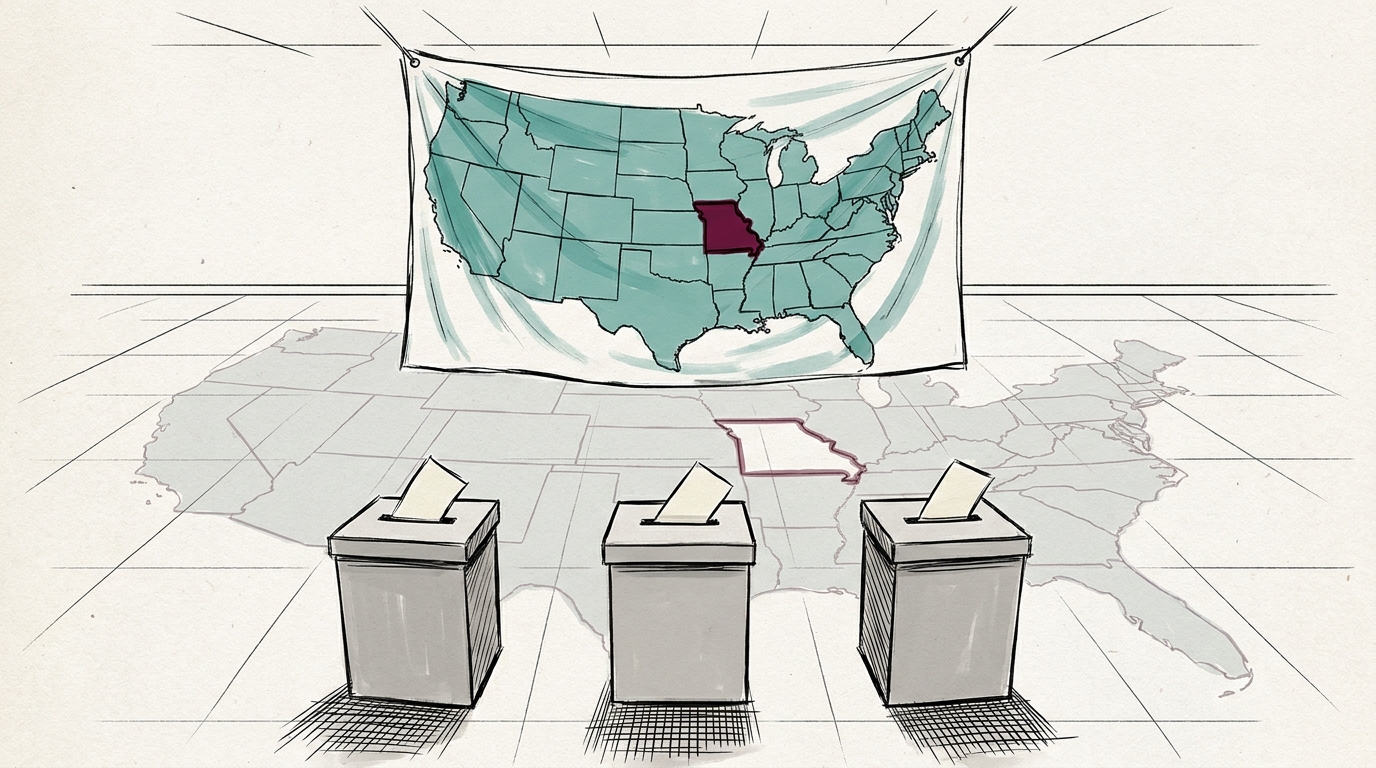
Supreme Court of Missouri
The unanimous court held that Article III, section 49 carries no redistricting exception, so a referendum petition against a congressional map is as valid as against any other law. It ordered the 2022 map to govern unless voters approve HB 1 on 3 November.
Denny Hoskins, Missouri Secretary of State
Hoskins told the Supreme Court that changing the congressional map after 1.2 million primary votes and ahead of the 19 September overseas-ballot deadline violates Purcell and the Elections Clause. He wants HB 1 reinstated before ballots print for November.
Senate Republican leadership
Floor time is finite at 51-47 with a bipartisan funding negotiation running, and a contested procedural fight over grant conditions is not the best use of it this month. Nothing has been abandoned; the resolution keeps its place on the calendar.
