Skip to content
You can now search across every topic, entity and event.What's new
US Midterms 2026
7SEP

Generic ballot hits D+6.9, above 2018 wave mark

3 min read
13:32UTC

Silver Bulletin recorded a D+6.9 congressional generic ballot average on Thursday, the highest Democratic reading of the cycle and the first to exceed the D+6.5 margin that delivered Democrats a 40-seat House gain in 2018.

PoliticsDeveloping
Key takeaway

D+6.9 clears the 2018 wave benchmark, but Democrats still face a structural Republican map advantage built to absorb that margin.

Silver Bulletin, the forecasting publication founded by Nate Silver, recorded a D+6.9 congressional generic ballot average on Thursday, up from D+5.9 in the prior reading and the furthest Democratic advantage of the cycle 1. The generic ballot measures which party voters prefer for Congress rather than testing any individual candidate; the aggregate tracks national political mood across dozens of polls, weighted by historical accuracy. Republican support fell to 41.6% in May, the lowest of the cycle, marking the third consecutive monthly decline. The prior D+5.8 reading from late April has moved a full point in four weeks.

The D+6.5 threshold is the comparable reading from the 2018 wave cycle that preceded a 40-seat Democratic House gain 2. The current D+6.9 reading sits above it. The counter-argument holds structural weight: the 2018 wave hit maps drawn before the redistricting harvest that has now banked a double-digit Republican structural floor without any Democratic offset. A uniform D+6.9 national swing hitting a map engineered to absorb that environment may produce gains in the low twenties rather than the 40-plus of 2018. The efficiency gap, how many Democratic votes pile up in already-blue districts versus reach the marginal seats the maps now insulate, is the decisive variable the topline does not capture.

Three consecutive months of Republican decline is not a single-week spike reversible through a single news event. The Q1 GDP contraction of 0.3% anchored the tariff-driven approval collapse that Cook first registered in April; the generic ballot's direction tracks that macro sequence rather than any single political event. Whether D+6.9 holds, widens, or softens over the next 158 days is the question neither party controls.

Deep Analysis

In plain English

The 'congressional generic ballot' is a standard polling question asking voters which party they would support in a generic House election, without naming any specific candidates. Political forecasters use it as a summary measure of the national political environment. A reading of D+6.9 means roughly 6.9 percentage points more voters say they would support a Democrat than a Republican in a generic congressional race. In 2018, a D+6.5 reading preceded a 40-seat Democratic gain and a House majority. However, the 2018 comparison has a catch. Republicans redrew congressional maps across multiple states in 2026 after a Supreme Court ruling removed a requirement to draw minority-majority districts. That redistricting added a structural advantage worth 12-15 seats in Republicans' favour. So Democrats would need to win more votes than they did in 2018 to gain the same number of seats.

Deep Analysis
Root Causes

Three structural drivers produced the third consecutive monthly Republican decline to 41.6% support.

The Q1 2026 GDP contraction of 0.3% anchored a tariff-driven approval collapse that began in January 2025 when the generic ballot stood at R+3.3 and has produced a 10.2-point cumulative swing. Consumer sentiment surveys from the University of Michigan show the largest four-month confidence drop since the 2008 financial crisis.

Special election results in Georgia's 14th District (25-point Democratic swing) and New Jersey's 11th District (20-point Democratic swing) have demonstrated that the generic ballot is not a lagging indicator in 2026: both results ran ahead of contemporaneous ballot readings, suggesting the aggregate understates Democratic intensity.

The third driver is compounding: each monthly Republican decline makes the 2026 environment resemble 2008 and 2010 more closely, pulling late-deciding campaign donors toward the party showing upward momentum.

First Reported In

Update #7 · Paxton wins; maps lock

Silver Bulletin· 29 May 2026
Read original
Different Perspectives
New Hampshire student voters
Students who hold no accepted photo ID under HB 323 cannot vote in the 8 September primary after Judge Laplante declined to block the law on timing grounds. Whether the same rule applies on 3 November is still open.
Alaska Democratic Party
The Alaska Democratic Party moved $884,835 in coordinated spending to Mary Peltola between 17 and 30 July, more than the DCCC spent nationally in the same fortnight.
National Republican Senatorial Committee
The NRSC, which sued to remove coordinated-spending caps in NRSC v. FEC, put $2,230,472 behind candidates in the first complete month after winning that case, more than double the total for the prior six months combined.
Supreme Court of Missouri
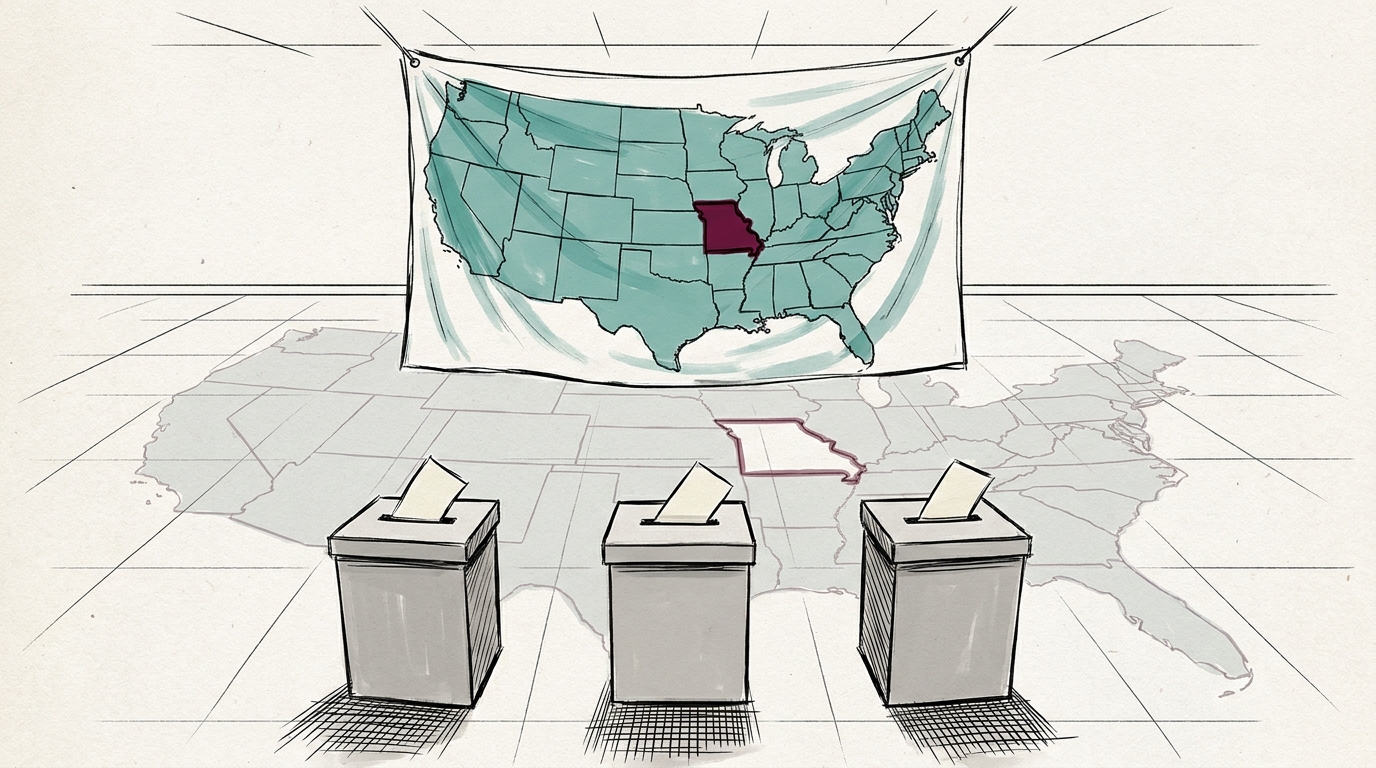
The unanimous court held that Article III, section 49 carries no redistricting exception, so a referendum petition against a congressional map is as valid as against any other law. It ordered the 2022 map to govern unless voters approve HB 1 on 3 November.
Denny Hoskins, Missouri Secretary of State
Hoskins told the Supreme Court that changing the congressional map after 1.2 million primary votes and ahead of the 19 September overseas-ballot deadline violates Purcell and the Elections Clause. He wants HB 1 reinstated before ballots print for November.
Senate Republican leadership
Floor time is finite at 51-47 with a bipartisan funding negotiation running, and a contested procedural fight over grant conditions is not the best use of it this month. Nothing has been abandoned; the resolution keeps its place on the calendar.
