Skip to content
Briefings are running a touch slower this week while we rebuild the foundations.See roadmap
Russia-Ukraine War 2026
27MAR

Ukraine $1,000 drone vs $6m Patriot

4 min read
20:48UTC

Ukraine has built drone interceptors that cost less than a used car. A wartime export ban is the only thing standing between Kyiv and a new role as arms supplier to Washington and the Gulf.

ConflictDeveloping
Key takeaway

Ukraine's $1,000 interceptor drone could flip air-defence economics globally if the wartime export ban is lifted.

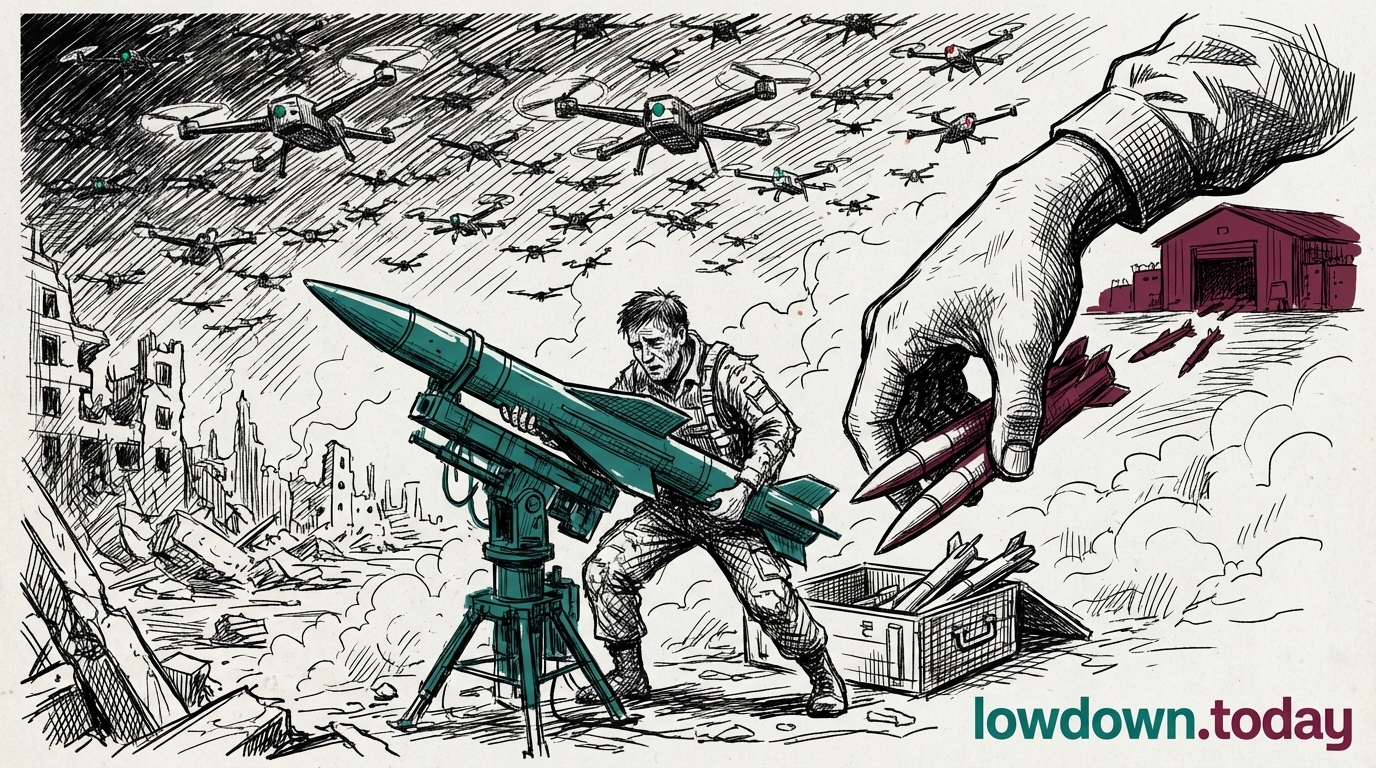
Ukraine has developed interceptor drones costing $1,000–$2,000 per unit — against $4–6 million for a single Patriot round and $12 million for a THAAD interceptor 1. The technology was refined through three years of countering Iranian-supplied Shahed drones over Ukrainian territory, and the Iran war has turned what was a domestic survival tool into an export commodity. US and Gulf state interest is building pressure against the wartime export ban that currently blocks all sales 2.

The arithmetic behind that pressure is simple. A Shahed-136 costs Iran an estimated $30,000–$50,000 to produce. A Patriot interceptor to destroy it costs roughly a hundred times more. At scale, this exchange rate bankrupts the defender. Ukraine discovered this in 2023 and built its way out of it — small, cheap, expendable drones that match the attacker's cost structure rather than dwarfing it. At $1,000–$2,000 per interceptor, the defender spends less than the attacker, a condition that conventional air defence has not achieved against mass drone warfare.

Ukraine signalled this trajectory on 2 March when it announced plans to package its counter-drone operational knowledge — radar signatures, interception angles, electronic warfare countermeasures — for export to non-NATO states facing Iranian-pattern threats . The low-cost interceptor drone moves beyond consultancy to hardware. Zelenskyy's 7 March call to Saudi Crown Prince Mohammed bin Salman made the sales pitch directly, and Bloomberg reported the transaction as drone assistance offered explicitly in exchange for ceasefire progress 3. Ukraine entered 2026 asking for weapons and money; the Iran war has repositioned it as a provider of military capability that its own patrons cannot manufacture fast enough.

The bottleneck is political, not industrial. Lifting the export ban would give Ukraine a revenue stream independent of Western aid packages, a diplomatic asset with Gulf States whose neutrality on the war has frustrated Kyiv, and a structural role in Middle Eastern air defence architecture that would be difficult to unwind. For Washington, the decision exposes a contradiction: the Pentagon needs cheap interceptors now, but approving Ukrainian arms exports builds exactly the kind of durable strategic relationship that complicates any peace deal requiring Kyiv to make territorial concessions. Lockheed Martin's agreement to quadruple THAAD production from 96 to 400 per year will take years to deliver. Ukraine's production lines exist today.

Deep Analysis

In plain English

For three years Ukraine has been caught in an economic trap: shooting down cheap $20,000 Iranian-made drones with missiles costing $4–6 million each. Ukraine's engineers — working under fire, bypassing slow procurement bureaucracy — built a solution: a small drone that intercepts incoming Shaheds for $1,000–$2,000 per unit. Now the US and Gulf states face the same Iranian drones and urgently want this technology. A wartime export ban is the only obstacle. Whether Washington lifts it will determine whether Ukraine's new leverage is real or theoretical.

Deep Analysis
Synthesis

Ukraine has created the conditions for a new strategic-economic model: a wartime client state generating exportable technology that its great-power patrons urgently need. Export revenue from even modest Gulf and US penetration could reduce Ukraine's dependence on Western aid packages — aligning Ukrainian and donor interests in ways military grants alone do not.

The technology also carries a recurring revenue dimension. Software updates, training programmes, and maintenance contracts would extend the economic relationship beyond a one-time hardware transaction. Ukraine's drone sector could emerge post-war as a competitive defence-technology exporter — a structural transformation of Kyiv's economic relationship with the West that no amount of grant aid could produce.

Root Causes

The body credits Ukraine's wartime experience but not the structural origins of the capability. Ukraine ranks among Europe's largest software-developer pools per capita; the Brave1 defence-tech cluster, launched in 2023, channelled civilian tech talent into military drone development outside standard procurement bureaucracy.

Rapid iteration under fire compressed what would normally be a five-to-ten year development cycle into months. The $1,000–$2,000 price point reflects commercial off-the-shelf hardware adapted for military use — a cost structure that established defence contractors, locked into certified supply chains and regulatory overhead, structurally cannot replicate.

What could happen next?
1 opportunity2 risk1 meaning1 precedent
  • Opportunity

    Lifting the export ban would simultaneously generate hard currency for Ukraine and provide Gulf and US partners with the most cost-effective counter-drone solution currently available.

    Short term · Assessed
  • Risk

    Continued export restrictions allow Iran-war-driven Gulf demand to shift permanently to US or Israeli alternatives, foreclosing Ukraine's market window once the acute crisis passes.

    Short term · Suggested
  • Meaning

    Ukraine's transition from aid recipient to technology exporter reframes the political economy of Western support — Kyiv becomes a strategic partner, not a client.

    Medium term · Suggested
  • Risk

    Russian acquisition of captured or reverse-engineered Ukrainian interceptors could nullify Shahed value to Moscow while simultaneously compromising Ukrainian countermeasure doctrine.

    Medium term · Suggested
  • Precedent

    First instance of a wartime developing state exporting indigenous air-defence technology to NATO-aligned great powers and Gulf states simultaneously.

    Long term · Assessed
First Reported In

Update #3 · Iran war halts talks, drains air defences

Bloomberg· 9 Mar 2026
Read original
Causes and effects
This Event
Ukraine $1,000 drone vs $6m Patriot
Ukraine's low-cost interceptor drones solve a cost-exchange problem that Western air defence systems cannot: a $1,000–$2,000 drone defeating a $50,000 attack drone, instead of a $4–6 million Patriot round doing the same job. The wartime export ban is the sole barrier between Ukraine and a structural role as a defence supplier to the US and Gulf states — a role that would fundamentally alter its negotiating position.
Different Perspectives
North Korea / DPRK
North Korea / DPRK
ISW confirmed the first mounting of DPRK Type-75 MLRS on Russian autonomous UGVs near Kharkiv on 7 June, the latest step in a supply axis that escalated from shells in 2023 to troops in 2024. Pyongyang gains live battlefield data on its ordnance and on Russia's uncrewed-systems programme.
IAEA / Rafael Grossi
Grossi confirmed Chornobyl structural damage with nuclear material metres away and could not attribute the ZNPP 15-hour blackout during the agreed repair window. Six ceasefires brokered and broken at ZNPP, compounded by Rosatom's May attack on IAEA neutrality, have eroded his ability to enforce the windows he negotiates.
Emmanuel Macron / France
Macron co-signed the E3 framework whose line-of-contact baseline marks Europe's first formal acceptance that 1991 borders are not the opening position. France's role carries weight because Macron had previously proposed a European force for Ukraine, and the framework's multinational force point is the vehicle for that.
Keir Starmer / E3
Keir Starmer / E3
Starmer, Macron and Merz met Zelenskyy on 7 June and backed a five-point framework taking the line of contact as the talks baseline, conceding roughly one fifth of Ukraine in exchange for a multinational force and frozen assets. With US mediation ended, the NATO Ankara summit on 7-8 July is the next test.
Vladimir Putin / Kremlin
Putin used SPIEF to reject Zelenskyy's summit letter, citing 'elements of rudeness', and repeated the pre-agreed treaty precondition that has frozen every diplomatic round since May. The SPIEF platform's message of investor confidence was punctured by naval fires visible from St Petersburg, which Moscow declined to dispute in scale.
Ukraine / Unmanned Systems Forces
Commander Brovdi confirmed USF units tracked and set fire to Boikyi at Kronstadt, while Code 9.2 struck the Chonhar Bridge the following day. Ukraine is sequencing strikes for rear-area interdiction and political timing rather than ground gains, trading the Baltic Fleet's home base for the logistics squeeze Russia cannot absorb without rationing its own occupied territory.
