Skip to content
You can now search across every topic, entity and event.What's new
Russia-Ukraine War 2026
15MAR

948 drones — war record in one day

2 min read
06:46UTC

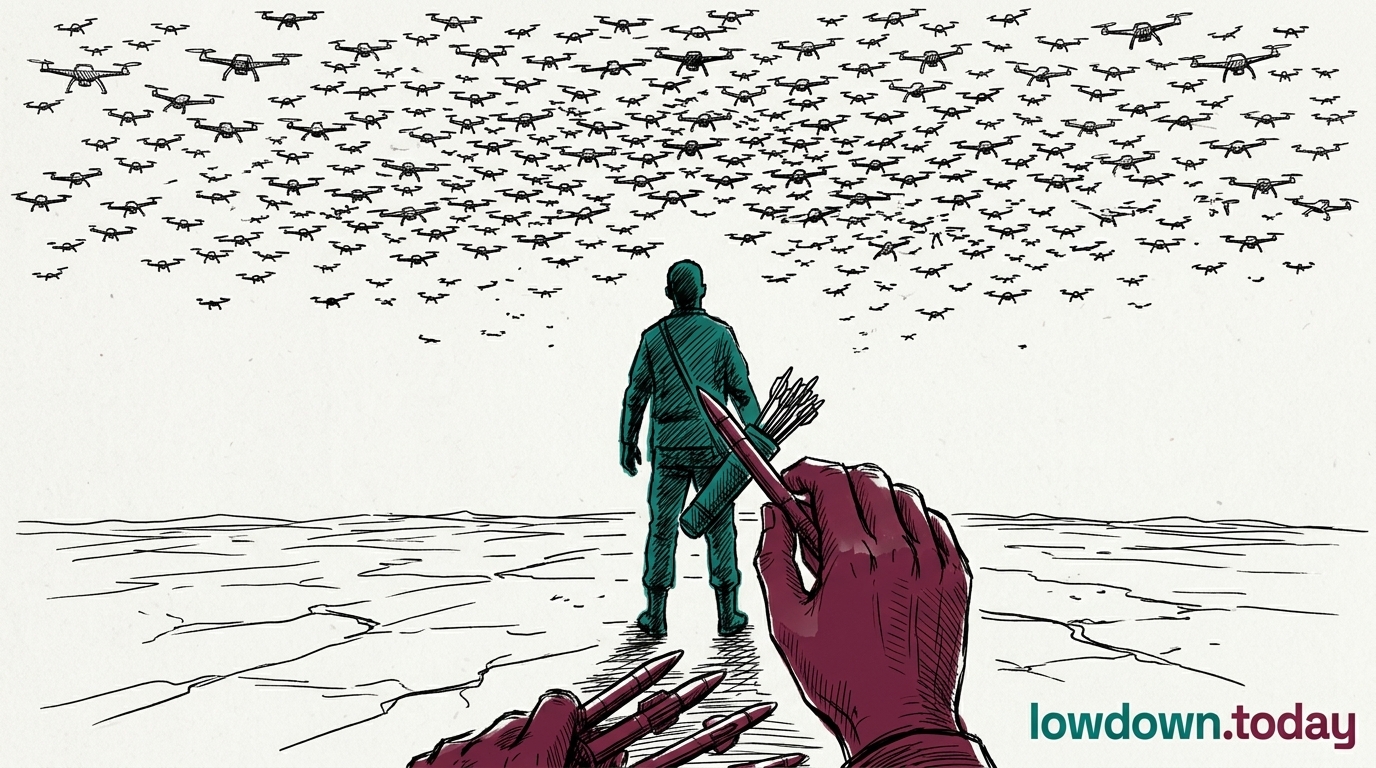
The largest single drone attack of the war hit 11 Ukrainian regions in rare daytime waves, killing at least eight people as the spring offensive gathered force.

ConflictDeveloping
Key takeaway

Russia launched its largest ever drone barrage precisely when US interceptor stocks were split between two wars.

Russia launched 948 drones at Ukraine on 24 March, the largest single drone attack since the full-scale invasion began in February 2022 1. Strikes hit 11 oblasts in rare daytime waves, killing two people in Ivano-Frankivsk, two in Poltava, and one each in Vinnytsia, Zaporizhzhia, Kherson, and Kharkiv.

The barrage dwarfed the previous record of 430 drones and 68 missiles on 13-14 March and continued a trajectory that saw 9,616 kamikaze drones launched on 17 March alone . Daytime attacks are operationally different from night strikes: thermal detection works best against dark skies, while cluttered urban environments in daylight demand radar-guided interception instead. Russia appears to be testing whether saturating both halves of the 24-hour cycle can overwhelm Ukrainian air defence scheduling.

Zelenskyy told the BBC two days later that 800 US-made interceptors were consumed in three days of the Iran war , against 700 Ukraine received over its entire winter. With American production at 60 to 65 Patriot rounds per month, replacing those 800 takes a full year. Russia's spring offensive launched in the window of maximum interceptor scarcity.

In Lviv, a UNESCO World Heritage city 750 kilometres from the front line, the 16th-century Bernardine monastery lost its tower and the Church of St Mary Magdalene had its windows shattered 2. UNESCO dispatched experts to assess the cultural damage. The reach of the barrage, far beyond the eastern front, signals a deliberate effort to stretch Ukrainian air defences across the country's entire depth.

Deep Analysis

In plain English

Russia launched nearly 1,000 drones at Ukraine in a single day — more than double its previous record. Think of it as flooding every intersection in a city with cars at once: no matter how many traffic police you have, some will get through. Ukraine uses expensive missiles (think £1 million each) to shoot down cheap drones (think £10,000 each). Russia is betting it can exhaust Ukraine's missiles before Ukraine gets more. The timing matters because the US — Ukraine's main missile supplier — is currently using its own stockpile in a separate war against Iran.

Deep Analysis
Root Causes

Russia's drone escalation stems from three structural factors not visible in the daily headlines.

First, Iran's supply of Shahed-136 production licences in 2023 enabled Russia to manufacture at scale domestically, breaking its dependence on imported units and absorbing Western supply interdiction.

Second, Ukrainian air defence is fundamentally reactive: it must cover the entire country's depth, while Russia chooses when and where to strike. The 948-drone barrage across 11 oblasts simultaneously exploits that asymmetry.

Third, the Iran war created a window of US interceptor scarcity that Russia's military planners almost certainly anticipated from the moment American involvement in the Middle East became probable.

First Reported In

Update #8 · Pentagon diverts funds; 948 drones fired

Al Jazeera· 27 Mar 2026
Read original
Different Perspectives
Turkey
Turkey
Turkey, a major buyer of Russian diesel cargoes, loses that access under Moscow's first producer-binding export ban, in force from 8 July to 31 July. Ankara hosted the same week's NATO summit pledging EUR 70bn to Ukraine, sitting on both sides of the fuel-and-alliance ledger.
NATO
NATO
NATO leaders meeting in Ankara on 7 and 8 July pledged EUR 70bn in equipment, assistance and training for Ukraine across 2026, with a 2027 sustainment commitment and a $40bn Drone Edge counter-drone initiative. European allies now fund the vast majority of that package, filling the gap left by Washington's idled crude waiver.
India
India
India's state refiners continued buying discounted Urals crude as June's price fell to $63.18 a barrel, insulating New Delhi from the OFAC waiver gap still constraining Western buyers. Indian refiners could pick up diesel-export share as Russia's producer-binding ban shuts out its former customers.
China
China
China's independent refiners kept importing discounted Urals crude through June as the price fell to $63.18 a barrel, down 26% month-on-month per CREA. Beijing has said nothing on Moscow's new diesel ban, leaving Chinese refiners a likely beneficiary if Turkish and Brazilian buyers seek replacement cargoes.
United States
United States
No successor licence has been issued since General License 134C lapsed on 17 June, leaving a 26-day gap, the longest of the war, in the Russian crude waiver. Washington's silence is tightening the channel without any stated decision, as Treasury weighs whether to let it die.
Ukraine
Ukraine
Ukraine's long-range strike campaign shifted from refineries to seaborne fuel tankers crossing the Sea of Azov, cutting tracked vessel traffic 55% between 30 June and 11 July, per Starboard Maritime Intelligence. The shift targets Russia's export revenue directly rather than just domestic supply, adding pressure alongside the collapsing Urals price.
