Skip to content
You can now search across every topic, entity and event.What's new
Russia-Ukraine War 2026
23JUL

Two financial EOs, zero Iran instruments

3 min read
20:33UTC

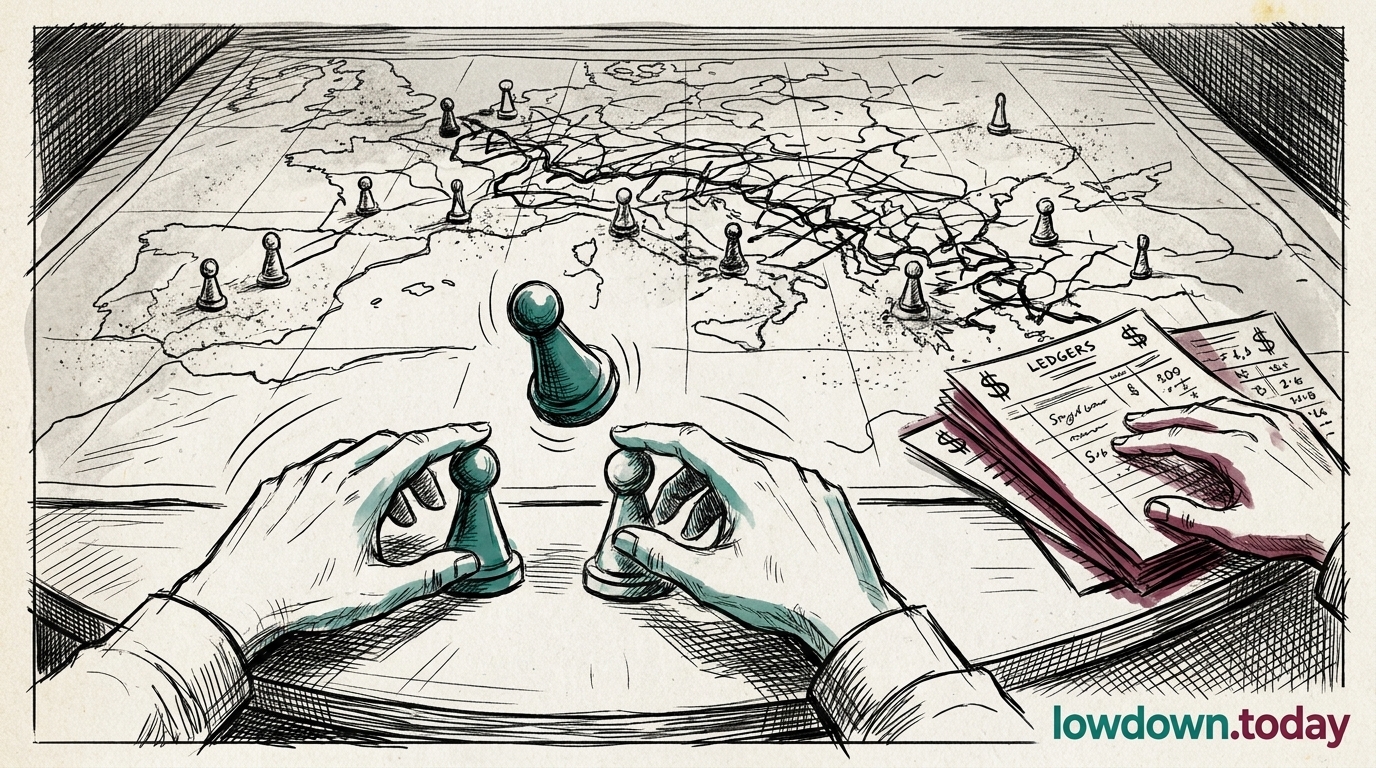
The White House signed two financial-sector executive orders on 19 May, on fintech and financial-system integrity. None touched Iran, the IRGC or Hormuz. The streak of zero Iran-specific presidential instruments extends through Day 84.

ConflictDeveloping
Key takeaway

Eighty-four days, no signed Iran instrument from Trump. The verbal and documentary tracks have separated.

Donald Trump signed two financial-sector executive orders on Tuesday 19 May, per the White House Presidential Actions index 1. One covered fintech regulation, the other financial-system integrity. Neither order touched Iran, the Islamic Revolutionary Guard Corps (IRGC) or the strait of Hormuz. With Tuesday through Thursday adding no further presidential instruments on Iran, the streak of zero Iran-specific signed acts extends across the entire 19-22 May window.

The documentary absence sits alongside an active verbal posture. Trump has called the ceasefire "on massive life support", rejected Tehran's 10-point counter-proposal, and his cabinet has named Hormuz tolls as a deal-killer this week. None of those positions have been encoded in a sanctions designation, an executive order, a national-security memorandum or any other instrument the federal government keeps a paper trail for. Trump has spoken about Iran for 84 days while signing nothing.

The practical effect runs through delegated authority. The agencies that need a presidential instrument to act, primarily Treasury for sanctions and Defence for force-posture changes, retain only the standing authorities they had before the war. The 11 May OFAC round operated under existing terrorism designations rather than a fresh executive order. Hegseth's 12 May Article 2 doctrine sits on constitutional argument, not on a signed directive the chamber could test. Trump's verbal track is rich; his documentary track on Iran is empty.

Trump's says-versus-does scoreboard reads simply. Says: ceasefire on life support, Hormuz toll a deal-killer, ten-point counter-proposal a piece of garbage. Does: two financial EOs unrelated to Iran. Eleven weeks of that pattern has hardened into The White House position itself. A White House that wanted Iran-specific authority would have signed it; the absence is the policy.


Deep Analysis

In plain English

Every few days, the US President can sign executive orders; formal legal documents that give instructions to government departments. Since the Iran war began, the White House has signed two executive orders a week on average, covering topics like trade, finance, immigration and technology. None of them have been about Iran. Not one has named the Iranian government, the Iranian military, or the Strait of Hormuz as a target. This is surprising given what Trump has said. He has called the ceasefire 'on life support', rejected Iran's counter-proposals, and had Defence Secretary Hegseth testify to Congress on 12 May that the strikes were legally justified. None of those statements appear in any signed order, memorandum, or executive instrument in the White House's public record. Why does it matter? Because US government departments; especially the Treasury, which handles financial sanctions; generally need a fresh presidential order to take new action. Without one, they keep using older legal authorities from before the war. The gap between Trump's public statements and his signed documents on Iran is now 84 days and counting.

What could happen next?
  • Consequence

    The agencies that need presidential instruments to act; primarily Treasury for sanctions and Defence for force-posture changes; retain only standing pre-war authorities. The 11 May and 19 May OFAC rounds both operated under pre-existing terrorism designations. Fresh designations targeting new categories (Chinese state refiners, European shipping intermediaries) would require a signed order that does not exist.

  • Precedent

    If the Iran campaign ends without a single signed presidential instrument, it will establish; as a practical precedent; that the United States can conduct a military campaign, maintain economic sanctions, and manage a diplomatic negotiation for over three months on pre-existing statutory authorities and verbal executive direction alone. That precedent expands future executive branches' room for uninstrumented engagement.

First Reported In

Update #105 · Khamenei keeps the uranium; House pulls the vote

White House Briefing Room· 22 May 2026
Read original
Causes and effects
This Event
Two financial EOs, zero Iran instruments
Trump's verbal track on Iran continues; the documentary track does not. The gap between what the President says about Tehran and what the President signs about Tehran is now a measurable absence.
Different Perspectives
IAEA (Rafael Grossi)
IAEA inspectors logged Zaporizhzhia's 22nd loss of off-site power, ten of them in the last three months, after a thunderstorm knocked out the plant's sole surviving backup line. Grossi reads the accelerating frequency, not any single outage, as the safety signal now that the plant's redundancy is exhausted.
United States (Treasury/OFAC)
Washington has let general licence 134C, its Russian crude waiver, lapse for 36 days with no successor, the longest gap of the war. Treasury has not said whether the non-renewal reflects deliberate policy or administrative delay, leaving buyers to price in compliance risk rather than wait for clarity.
Slovakia
Slovakia
Slovakia dropped its hold-out on the EU's 21st sanctions package only after winning a 2028 guarantee phasing out Russian gas, the exact pipeline dependency, roughly 80% of its crude supply, that gave it leverage. Bratislava's climbdown clears the package but leaves the same single-veto mechanism intact for the next round.
Russia (Kremlin and general staff)
General staff chief Gerasimov claimed Donetsk captures on 18 July that ISW says it cannot corroborate, extending a pattern ISW clocked at a 5:1 exaggeration ratio earlier this year. Moscow is conditioning its public for a possible autumn mobilisation after September's Duma elections rather than acknowledging the front has stalled.
Ukraine (Zelenskyy government)
Zelenskyy dismissed his commander-in-chief, defence minister and chief of general staff within eight days, replacing Syrskyi with Drapatyi and Hnatov with Skybiuk as protesters demanded Syrskyi go and Fedorov return. Kyiv frames the sweep as a bet on manoeuvre capacity ahead of a feared Russian autumn surge, not the disarray critics read into three changes in a week.
The United Kingdom
The United Kingdom
Starmer pledged £300 million in Kyiv on 16 July toward Ukraine's Gripen E squadron, adding to the PURL expansion Trump and Rutte had announced two days earlier. London is paying into a scheme built around a shortfall NATO's own published $4bn-plus pledge does not close against Zelenskyy's roughly $15bn stated need.



