Skip to content
You can now search across every topic, entity and event.What's new
Russia-Ukraine War 2026
19JUL

Iran succession stalls; seat stays empty

3 min read
13:35UTC

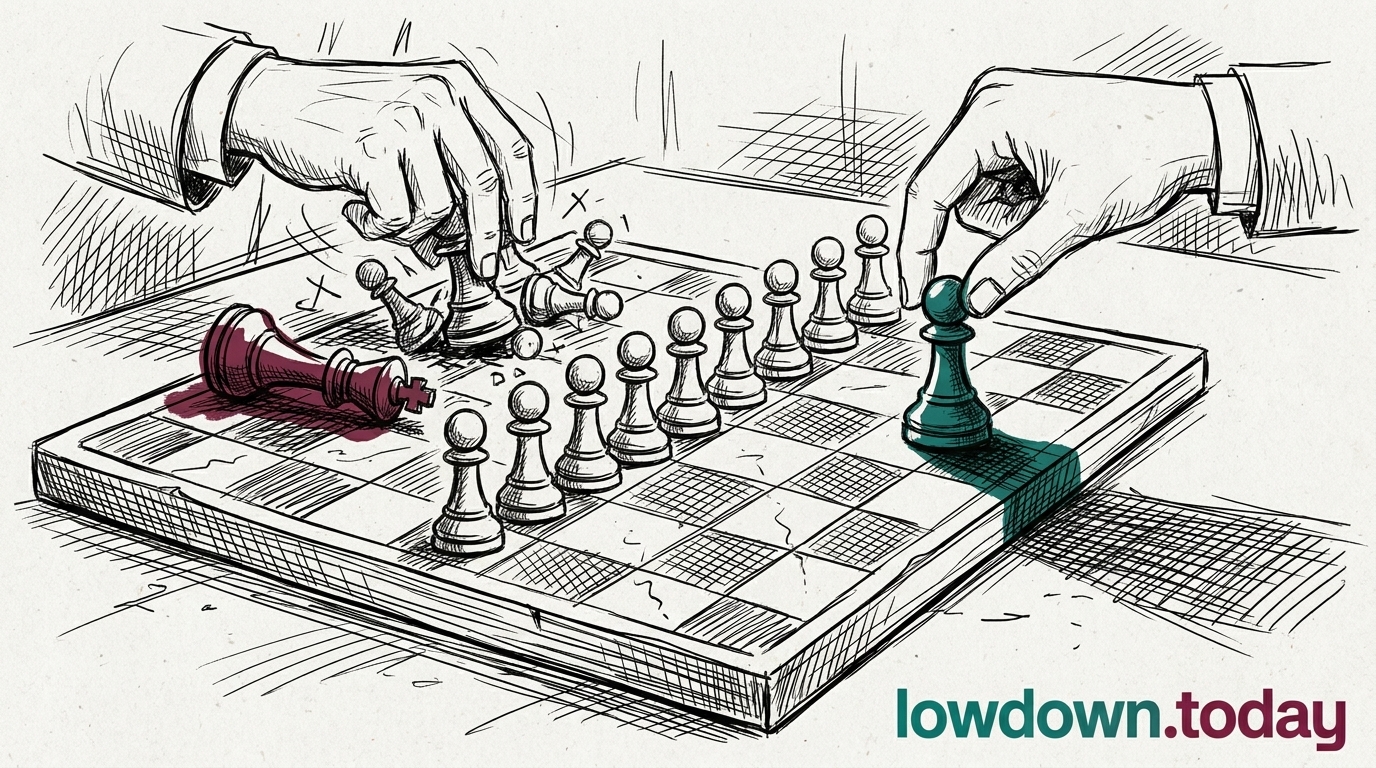
The Assembly of Experts was supposed to name a new Supreme Leader within days. Its headquarters was bombed, 90 million Iranians have no communications, and the leading candidate has an 18% probability on prediction markets.

ConflictDeveloping
Key takeaway

Iran's constitutional succession mechanism is effectively paralysed by the very military campaign it was designed to outlast, creating an unprecedented interregnum with no constitutional exit pathway.

Iran's foreign minister Abbas Araghchi told Al Jazeera that a new Supreme Leader could be named in "a day or two." As of Monday, it has not happened. Sanam Vakil of Chatham House assessed that the Assembly of Experts "may not convene until US and Israel wind down their operations" — a judgement grounded in physical fact: the Assembly's headquarters in Tehran was struck in the campaign's opening hours.

When Ayatollah Ruhollah Khomeini died on 3 June 1989, the Assembly of Experts convened and elevated Ali Khamenei to Supreme Leader within 24 hours. That succession was managed by Akbar Hashemi Rafsanjani, who controlled both the Assembly and the political machinery needed to enforce the outcome. No comparable figure exists today. The Interim Leadership Council formed under Article 111Ayatollah Alireza Arafi, President Masoud Pezeshkian, and Chief Justice Mohseni-Ejei — is a constitutional stopgap, not a succession mechanism.

The Assembly has 88 members, most of them elderly clerics scattered across Iran's provinces. Convening them requires secure transport, functioning communications, and a venue — all three compromised by active bombardment, a communications blackout that has cut 90 million Iranians from phone, internet, and SMS for more than 48 hours, and the destruction of the Assembly's own building.

Polymarket prices Mohseni-Ejei as the likeliest successor at roughly 18% — a number that reflects deep uncertainty, not a frontrunner. A meaningful share of bets is on the position being abolished entirely, which would mean dismantling velayat-e faqih — the guardianship of the Islamic jurist, the foundational doctrine on which Khomeini built the Islamic Republic in 1979. Araghchi's own admission that military units are "acting independently" of central government direction raises the harder question: whether a new Supreme Leader, once named, could command the forces fighting in his name. The Islamic Republic's succession architecture was designed for an orderly transfer of power between eras — not a selection under bombardment with the entire country cut off from communication.

Deep Analysis

In plain English

Iran's Supreme Leader is the most powerful figure in the country — above the president, controlling the military and judiciary. When a Supreme Leader dies or becomes incapacitated, a body of 88 senior clerics called the Assembly of Experts is supposed to meet immediately and choose a replacement. But their headquarters was bombed in the war's opening hours, communications across Iran have been cut for 90 million people, and the clerics themselves are scattered across a country under sustained attack. The result is a leadership vacuum at the top of a nuclear-threshold state at the exact moment when authoritative strategic decisions — escalate, negotiate, absorb — are most urgent.

Deep Analysis
Synthesis

Iran simultaneously faces a military crisis and a constitutional one, with each compounding the other: the communications blackout makes Assembly convening practically impossible, and the absence of an authoritative central decision-maker makes ceasefire negotiation structurally harder, since no interlocutor can credibly commit. A prolonged interregnum risks fracturing the IRGC along factional lines — Quds Force, Aerospace Force, Ground Forces — producing competing power centres rather than a unified successor, which would be qualitatively more dangerous than any single successor however hardline.

Root Causes

Khamenei systematically suppressed potential successors for three decades — most prominently Rafsanjani (died 2017) and Ali Larijani — to prevent a rival power centre from forming. This left the succession landscape populated by second-tier figures with limited theological or political legitimacy, which is why Polymarket's frontrunner holds only 18% — the market cannot identify a clear heir because none was permitted to emerge.

Escalation

The interregnum creates a decision-making vacuum precisely when strategic choices about escalation or ceasefire are most consequential; Revolutionary Guards hardline factions may fill that space autonomously, raising the risk of escalatory action disconnected from any central political authority — a dynamic that cannot be walked back by a successor once taken.

What could happen next?
  • Risk

    A prolonged succession vacuum enables IRGC hardline factions to take unilateral escalatory action — including strikes on Gulf oil infrastructure or Strait of Hormuz interference — without central political authorisation or the ability to stand it down.

    Immediate · Assessed
  • Risk

    A weak or contested successor may overcompensate with aggressive external posturing to consolidate domestic legitimacy, extending the conflict well beyond the timeline US planners have modelled.

    Medium term · Suggested
  • Precedent

    The first forced constitutional breach in the Islamic Republic's 47-year history establishes that extra-constitutional power transfers are survivable, potentially normalising them for future crises.

    Long term · Assessed
First Reported In

Update #10 · Friendly fire kills three US jets in Kuwait

Al Jazeera· 2 Mar 2026
Read original
Causes and effects
This Event
Iran succession stalls; seat stays empty
Iran's constitutional succession process has been physically and logistically disrupted by the ongoing military campaign. The inability to name a Supreme Leader prolongs the command vacuum in which military units are operating independently of central government direction, and raises the question of whether velayat-e faqih — the Islamic Republic's foundational governing doctrine — survives the war.
Different Perspectives
The United Kingdom
The United Kingdom
Starmer pledged £300 million in Kyiv on 16 July toward Ukraine's Gripen E squadron, adding to the PURL expansion Trump and Rutte had announced two days earlier. London is paying into a scheme built around a shortfall NATO's own published $4bn-plus pledge does not close against Zelenskyy's roughly $15bn stated need.
Brussels
Brussels
The EU's 21st sanctions package missed its Coreper vote on 15 July over Greek LNG re-export rights and an Austrian bank compensation demand, the same week Hungary stalled accession clusters on procedure rather than veto. Both processes run on unanimity, so a single national interest, not Russia policy, sets the pace either can move at.
Hungary's Tisza government
Budapest refused to open EU accession Clusters 2 and 3 for Ukraine at COELA on 17 July, offering Moldova a standalone opening instead, and the question returns on 22 July. Having ended Orbán's blanket loan veto in May, it now blocks the narrower rule-of-law chapters where its own electorate is least comfortable.
Washington
Washington
Trump and Rutte expanded PURL on 14 July, letting allies fund the American interceptors and jets Washington will license but no longer gift outright. The same week, Lockheed Martin told allies it cannot guarantee PAC-3 MSE delivery timelines even after tripling output, so Washington now shapes Ukraine's air defence through a supply queue rather than a donation decision.
Moscow
Moscow
Novak ordered a study into cutting the diesel exchange quota to 10% within a week of his export ban, while June delivered Russia's first budget surplus of 2026 and National Wealth Fund liquidity above its own May forecast. Its own investors disagree: the Moscow Exchange has fallen for its longest losing streak since 1997.
Ukraine's government and its street protesters
Zelenskyy sacked Fedorov on 15 July, installed an acting SBU officer in his place, and did not move against three days of protest that followed across eight cities. He is betting that visible tolerance for dissent, timed to EU accession hearings on rule of law, outweighs whatever command dispute forced the reshuffle.
