Skip to content
You can now search across every topic, entity and event.What's new
Russia-Ukraine War 2026
16JUN

Brent falls straight through the strikes

2 min read
10:25UTC

Brent crude settled at $71.99 on 26 June, down from $76.14 on 24 June, falling steadily through both the IRGC drone strike and the US bombing of Iranian soil.

ConflictDeveloping
Key takeaway

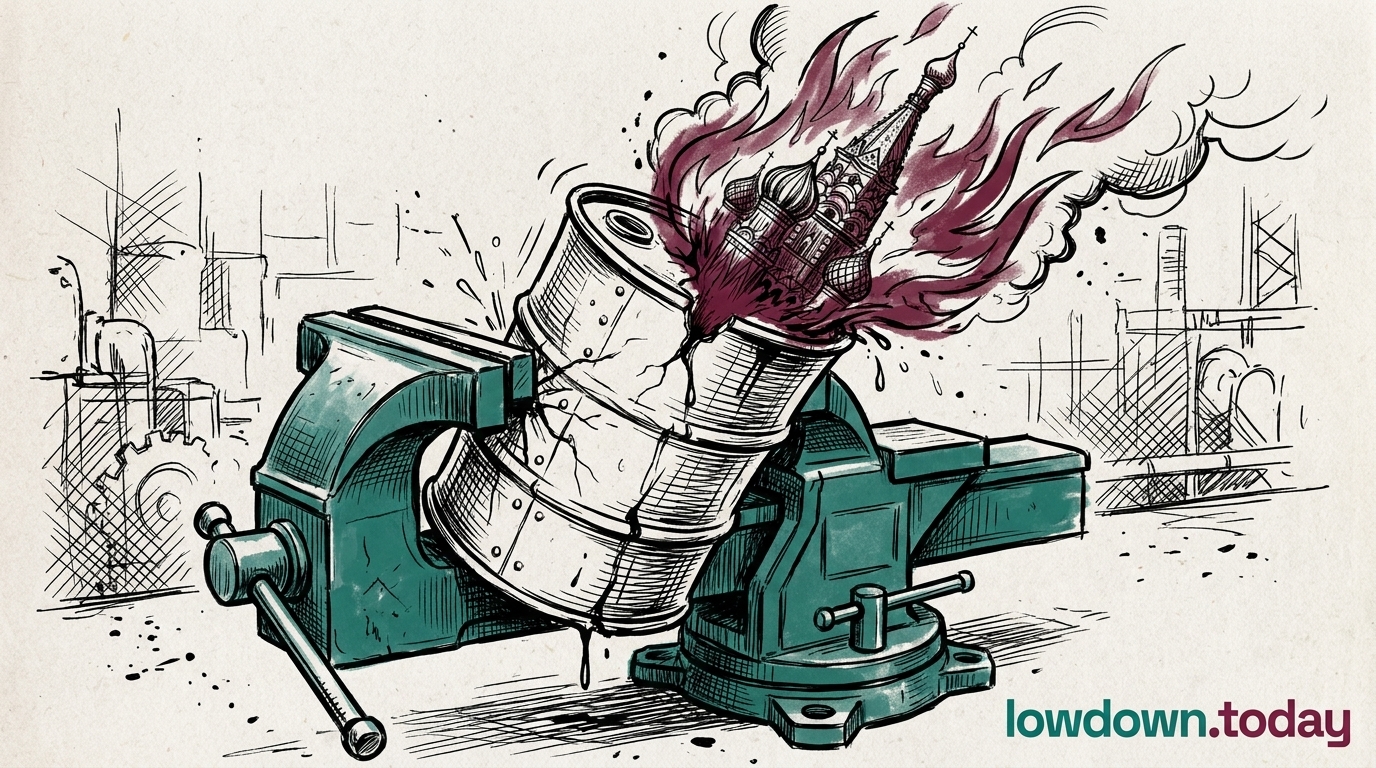
Oil markets have stopped pricing Hormuz violence and now price only Hormuz volume.

Brent Crude settled at $71.99 on 26 June, down from $76.14 on 24 June . The global oil benchmark declined steadily through both the IRGC drone strike on the Ever Lovely and the US bombing of Iranian soil. 1

A US attack on a major oil producer and two damaged ships pushed Brent down more than 5.4 per cent across two sessions, not up, despite a direct US-Iran kinetic exchange. The war premium that carried the benchmark above $100 at the crisis peak never returned.

As long as Hormuz keeps clearing oil at its pre-crisis volume, an isolated drone strike that kills no one and stops no cargo registers as noise. Traders are pricing the corridor, not the conflict. The link between Hormuz violence and the oil price has, for now, gone quiet. 2


Deep Analysis

In plain English

Brent crude oil, the main global oil price benchmark, fell from $76.14 on 24 June to $71.99 by 26 June, even though Iran attacked a container ship and the US bombed sites in Iran during those same two days. A 5.4 per cent price fall during an active military exchange between two nations is unusual, because crises usually push oil prices up. The reason markets were not alarmed is that record amounts of oil were moving through the Strait of Hormuz at the time: 20 million barrels on 25 June alone. Investors were watching how much oil was actually flowing, not how many weapons were being fired. The last time oil prices were this low was before the conflict began in February, meaning the market has concluded the fighting has not actually reduced supply.

What could happen next?
  • Risk

    Brent pricing below the pre-conflict level embeds unverifiable assumptions about MOU compliance and IAEA inspection timelines; a failure of either by the 21 August deadline would trigger a rapid reversal of the war-premium erasure, with the magnitude of the reversal amplified by how far markets have run ahead of verified supply restoration.

  • Meaning

    The IRGC's inability to generate a sustained oil-price response through the Ever Lovely attack and the corridor disruption removes the economic lever from its strategic toolkit: if attacks on individual vessels no longer move Brent, the financial cost of shipping attacks falls entirely on insurers and operators rather than on the global economy.

First Reported In

Update #140 · US bombs Iran, and the oil market shrugs

Trading Economics· 28 Jun 2026
Read original
Different Perspectives
Belgium
Belgium
Belgium blocked outright confiscation of the roughly EUR 210bn in frozen Russian assets held at Euroclear in December 2025, because Euroclear would carry the legal liability. Ukraine has since proposed moving custody to the EU instead.
European Commission
European Commission
The Commission said on 2 September that Ukraine has drawn EUR 3.2bn against an EUR 8.35bn annual target, and that a revenue-mobilisation law stuck in the Rada is one of twelve conditions for the next EUR 3.7bn payment.
Steve Witkoff and Jared Kushner
The US envoys met Putin in Moscow on 5 September and Zelenskyy in Kyiv on 6 September without an announced result from more than three hours of talks. Their mediation continues with no public outcome to show for this round.
Robert Brovdi
Robert Brovdi
Brovdi said on 12 September that his Unmanned Systems Forces struck 285 Russian tankers in ten weeks. His own monthly breakdown sums to 79, and he has given no account of the remaining 206.
Sergei Lavrov
Sergei Lavrov
Lavrov said on 12 September that Russia is ready to negotiate but will not suspend military operations while it does. He treats talking and fighting as compatible policies, ruling out a ceasefire as a precondition for further talks.
Belarus
Belarus
Minsk announced completion of its own 37th Separate Airborne Assault Brigade near Gomel, under plans dating to August 2025 rather than a response to any single frontline event this window, keeping its hedge of hosting the war without formally joining Russia's mobilisation drive.


