Skip to content
Briefings are running a touch slower this week while we rebuild the foundations.See roadmap
Russia-Ukraine War 2026
5MAR

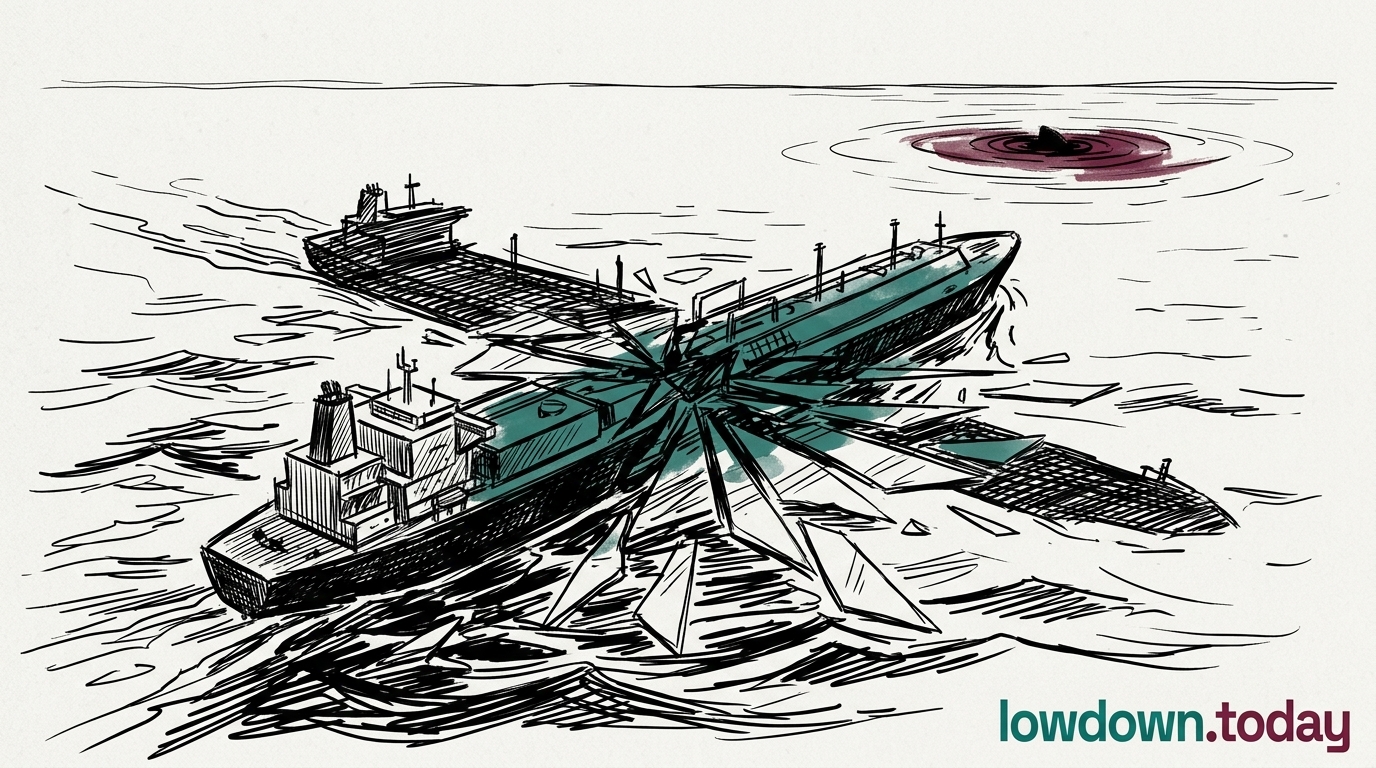
Hormuz open to friends, shut to enemies

3 min read
04:57UTC

Iran's foreign minister told Japanese media the strait is blocked only for hostile nations — the first official articulation of a selective blockade doctrine designed to fracture the coalition arrayed against Tehran.

ConflictDeveloping
Key takeaway

Selective passage weaponises transit rights as diplomatic currency while denying opponents a unified casus belli.

Iranian Foreign Minister Abbas Araghchi told Japan's Kyodo News: "the strait is closed only to ships belonging to our enemies, countries that attack us. For other countries, ships can pass through the strait." The audience was deliberate. Japan depends on Hormuz for more than 90% of its Middle Eastern crude imports and was granted passage the same week. Araghchi's statement codifies what the IRGC toll system had already established in practice — a selective blockade distinguishing between hostile and non-hostile nations.

Under international maritime law, all vessels hold transit passage rights through straits used for international navigation. A blanket Hormuz closure would unite maritime powers against Tehran and provide clear legal grounds for military enforcement. A selective closure divides them. Nations that joined the 22-country demand for reopening but pledged no warships NOW have a route to continued energy access — provided they keep their commitments rhetorical. Iran's doctrine rewards the gap between words and action that has characterised the international response. The seven-nation statement from 19 March produced no vessels; the expanded 22-nation version tripled the signatories and still produced none .

Araghchi's framing is consistent with Iran's broader negotiating posture. Days earlier, he told The National that Iran does not "believe in a ceasefire" and set conditions including removal of all US bases from the region and reparations . The selective blockade is not a de-escalation offer. Tehran maintains the military closure against US-aligned shipping while building bilateral dependencies with non-aligned states — dependencies that give each country an individual reason to resist joining any enforcement Coalition. For Washington, the structural problem is plain: every nation that secures bilateral passage from Iran has less incentive to challenge Iran's control of the strait.

Deep Analysis

In plain English

International law normally guarantees all ships the right to pass through major straits like Hormuz. Iran is claiming that, because it is at war, it can decide who gets through based on whether their country is an enemy. It has told Japan it may pass; US-allied countries cannot. This is legally contested — UNCLOS does not permit this discrimination — and it is deliberately designed to split potential opponents by giving some of them a reason not to enforce the rules.

Deep Analysis
Synthesis

By communicating the policy to a Japanese outlet rather than through formal diplomatic channels, Iran simultaneously sends three distinct messages: to Tokyo (passage is available), to non-aligned states (apply for your own exemption), and to the US (the closure has third-party legitimacy). The choice of venue is itself a diplomatic instrument.

Root Causes

Iran's selective blockade doctrine exploits a structural gap in UNCLOS enforcement: no automatic mechanism exists for enforcing transit passage rights, and enforcement depends entirely on state initiative and collective political will. A selective closure — which gives major powers a financial reason not to enforce — is specifically calibrated to paralyse that will.

Escalation

The public articulation of the doctrine locks Iran in. Araghchi's statement to Kyodo News — a deliberate choice of non-Western media venue — makes selective closure official Iranian policy. Iran cannot quietly reopen the strait to all shipping without a visible public concession, raising the political cost of de-escalation for Tehran regardless of military outcome.

What could happen next?
  • Precedent

    If Iran's selective blockade doctrine is tolerated, it establishes that belligerent states may discriminate among shipping by flag-state political alignment, rewriting the legal architecture of international straits passage.

    Long term · Assessed
  • Consequence

    Non-aligned states granted passage acquire a covert dependency on Tehran: passage can be revoked if their political alignment shifts, creating permanent ongoing Iranian leverage over their energy security.

    Medium term · Suggested
  • Risk

    The explicit public statement forecloses quiet diplomatic resolution — Iran cannot reopen the strait to all shipping without a public concession that signals domestic weakness.

    Short term · Assessed
First Reported In

Update #45 · Ultimatum expires; Iran tolls Hormuz at $2m

Al Jazeera· 23 Mar 2026
Read original
Causes and effects
This Event
Hormuz open to friends, shut to enemies
By drawing an explicit distinction between hostile and non-hostile nations, Iran converts a military closure into a diplomatic instrument that penalises coalition membership and rewards strategic ambiguity.
Different Perspectives
North Korea / DPRK
North Korea / DPRK
ISW confirmed the first mounting of DPRK Type-75 MLRS on Russian autonomous UGVs near Kharkiv on 7 June, the latest step in a supply axis that escalated from shells in 2023 to troops in 2024. Pyongyang gains live battlefield data on its ordnance and on Russia's uncrewed-systems programme.
IAEA / Rafael Grossi
Grossi confirmed Chornobyl structural damage with nuclear material metres away and could not attribute the ZNPP 15-hour blackout during the agreed repair window. Six ceasefires brokered and broken at ZNPP, compounded by Rosatom's May attack on IAEA neutrality, have eroded his ability to enforce the windows he negotiates.
Emmanuel Macron / France
Macron co-signed the E3 framework whose line-of-contact baseline marks Europe's first formal acceptance that 1991 borders are not the opening position. France's role carries weight because Macron had previously proposed a European force for Ukraine, and the framework's multinational force point is the vehicle for that.
Keir Starmer / E3
Keir Starmer / E3
Starmer, Macron and Merz met Zelenskyy on 7 June and backed a five-point framework taking the line of contact as the talks baseline, conceding roughly one fifth of Ukraine in exchange for a multinational force and frozen assets. With US mediation ended, the NATO Ankara summit on 7-8 July is the next test.
Vladimir Putin / Kremlin
Putin used SPIEF to reject Zelenskyy's summit letter, citing 'elements of rudeness', and repeated the pre-agreed treaty precondition that has frozen every diplomatic round since May. The SPIEF platform's message of investor confidence was punctured by naval fires visible from St Petersburg, which Moscow declined to dispute in scale.
Ukraine / Unmanned Systems Forces
Commander Brovdi confirmed USF units tracked and set fire to Boikyi at Kronstadt, while Code 9.2 struck the Chonhar Bridge the following day. Ukraine is sequencing strikes for rear-area interdiction and political timing rather than ground gains, trading the Baltic Fleet's home base for the logistics squeeze Russia cannot absorb without rationing its own occupied territory.