Skip to content
You can now search across every topic, entity and event.What's new
Russia-Ukraine War 2026
24APR

EU freezes Russia oil cap for a week

2 min read
11:21UTC

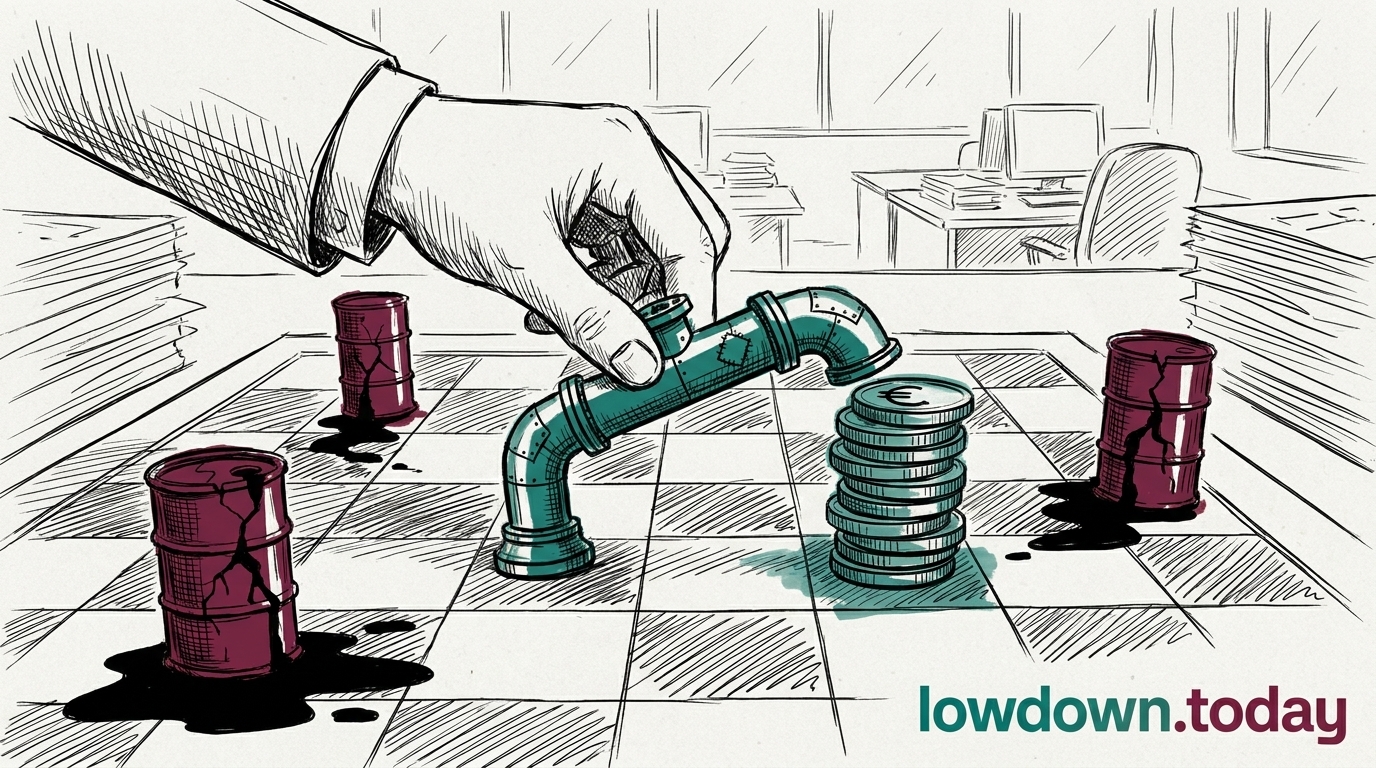
EU ambassadors froze the $44.10 Russia oil cap to 23 July, dodging a formula revision the desk now reads near $58, not $75.

ConflictAssessed
Key takeaway

The avoided cap lift was near $58, not $75, a smaller Russian windfall than the desk had assumed.

EU ambassadors froze the $44.10 Russia oil price cap until 23 July on 15 July, a one-week stopgap that sidestepped the automatic six-monthly formula revision 1. Foreign ministers had failed two days earlier to agree either the 21st sanctions package or a durable freeze duration , with the Commission's freeze-to-January-2027 line and a Greece-Cyprus-Malta three-month compromise both collapsing 2. The cap is the G7 mechanism that bars Western shippers and insurers from carrying Russian crude sold above the ceiling.

The formula lift the freeze avoided pointed to roughly $58/bbl, not the ~$75 the desk had carried since mid-June, because the 22-week calculation window that closed in mid-June had already banked the war's price surge 3. Read $58 as a cap-formula ceiling, distinct from Brent's own ~$87 war-premium spot; conflating the two overstates the windfall the EU was staring down. At $58 rather than $75, the auto-lift the freeze headed off would have handed Russia far less than the desk had priced.

With the cap frozen rather than lifted, Urals P&L still runs off the Brent-Urals basis, not the ceiling. Kaja Kallas's hoped-for round of 250 individual designations stayed unconfirmed, and the wider package stays blocked on the LNG phase-out and Raiffeisen-access disputes, with Greece resisting the freeze duration on shipowner-registry grounds 4. The same argument returns on 23 July, so the fight is deferred, not settled.

Deep Analysis

In plain English

The EU capped how much anyone can pay for Russian oil transported by Western-linked ships and insurers, currently $44.10 a barrel. That cap is not fixed forever: a formula built into the rule recalculates it every six months based on recent market prices, and if left alone that formula was about to push the cap up to roughly $58. EU ambassadors voted to pause that recalculation for one week rather than let the cap rise. It is a stalling tactic while EU governments argue over a bigger sanctions package, not a change to Russia's actual oil income, since Russian oil has mostly been selling for less than $44.10 anyway.

Deep Analysis
Root Causes

The formula's mechanical trigger is the actual constraint: it calculates the cap from a trailing six-month Urals average, and because Urals has traded persistently below the current $44.10 ceiling on its own war-risk discount, an unfrozen recalculation would lift the cap toward $58 even though no member state wants a higher number published.

Changing the formula itself, rather than freezing it, needs unanimous agreement under Article 29 TEU's requirement for Common Foreign and Security Policy sanctions decisions. Greece, backed by Cyprus and Malta on shipping-registry grounds, will not accept the Commission's preferred freeze to January 2027, leaving the one-week stopgap as the only unanimous outcome available before 23 July.

What could happen next?
  • Consequence

    The unresolved formula fight likely recurs at the 23 July deadline unless the 21st sanctions package unblocks first

  • Risk

    Greece, Cyprus and Malta could block any longer freeze extension on shipping-registry grounds, forcing repeated weekly stopgaps

First Reported In

Update #17 · EU freezes the cap a week; Brent-WTI gaps to $5.13

Bloomberg· 16 Jul 2026
Read original
Different Perspectives
Turkey
Turkey
Turkey, a major buyer of Russian diesel cargoes, loses that access under Moscow's first producer-binding export ban, in force from 8 July to 31 July. Ankara hosted the same week's NATO summit pledging EUR 70bn to Ukraine, sitting on both sides of the fuel-and-alliance ledger.
NATO
NATO
NATO leaders meeting in Ankara on 7 and 8 July pledged EUR 70bn in equipment, assistance and training for Ukraine across 2026, with a 2027 sustainment commitment and a $40bn Drone Edge counter-drone initiative. European allies now fund the vast majority of that package, filling the gap left by Washington's idled crude waiver.
India
India
India's state refiners continued buying discounted Urals crude as June's price fell to $63.18 a barrel, insulating New Delhi from the OFAC waiver gap still constraining Western buyers. Indian refiners could pick up diesel-export share as Russia's producer-binding ban shuts out its former customers.
China
China
China's independent refiners kept importing discounted Urals crude through June as the price fell to $63.18 a barrel, down 26% month-on-month per CREA. Beijing has said nothing on Moscow's new diesel ban, leaving Chinese refiners a likely beneficiary if Turkish and Brazilian buyers seek replacement cargoes.
United States
United States
No successor licence has been issued since General License 134C lapsed on 17 June, leaving a 26-day gap, the longest of the war, in the Russian crude waiver. Washington's silence is tightening the channel without any stated decision, as Treasury weighs whether to let it die.
Ukraine
Ukraine
Ukraine's long-range strike campaign shifted from refineries to seaborne fuel tankers crossing the Sea of Azov, cutting tracked vessel traffic 55% between 30 June and 11 July, per Starboard Maritime Intelligence. The shift targets Russia's export revenue directly rather than just domestic supply, adding pressure alongside the collapsing Urals price.
